
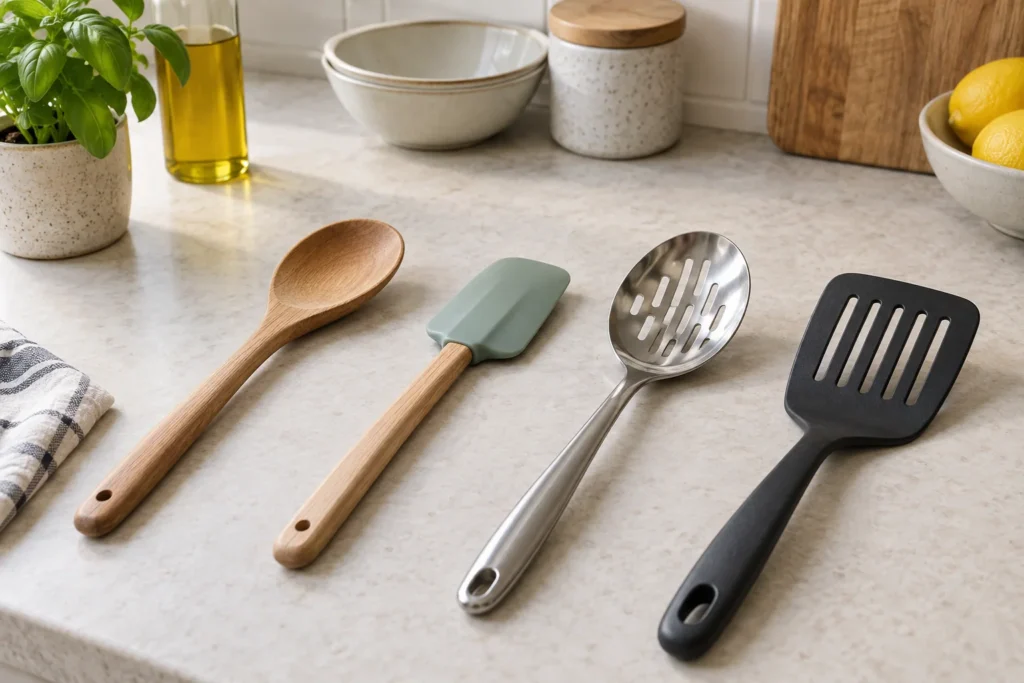
A personalised kitchen utensil should work as a utensil before the message is added. Choose the shape and intended use first, then confirm where the engraving goes and how the finished item should be cared for. A decorative keepsake and an everyday cooking spoon can look similar in a product photograph while needing different decisions.
Image: AI-generated editorial illustration of generic equipment; not a photograph of a reviewed product.
Table of Contents
Decide whether the gift will be used or displayed
Think about the recipient's cooking habits. A long stirring spoon may suit someone who uses deep pots, while a compact scraper may be more useful to a frequent baker. If the item is intended purely for display, choose it as decoration and make that purpose clear when giving it.
For a working utensil, look for an explicit description of the intended food use and the materials supplied. Do not infer suitability from a photograph beside ingredients. If the description concentrates entirely on the message and gift occasion, ask the maker about the actual utensil and its finish.
Confirm the engraving position
Ask whether the message appears on the handle, the head or both, and whether you can approve its orientation. A message designed to be read while the spoon hangs may appear upside down when held. Neither arrangement is inherently wrong; the useful choice depends on how the recipient will use or display it.
For areas that contact food, ask the maker to confirm that the finished engraved product is intended for that use and explain its care. This guide does not recommend adding craft paint, an unknown coating or a home engraving treatment to an existing cooking tool. Choose a finished product with accountable instructions.
| Detail to approve | Why it matters |
|---|---|
| Exact wording | Names, dates and punctuation are easy to overlook |
| Placement | Handle and working head serve different purposes |
| Orientation | Hanging display and cooking grip may favour different layouts |
| Finished size | A readable message can still be too large for the utensil |
| Care information | The recipient needs to know how to wash and maintain it |
Read a real product specification
T&G personalised wooden spoon identifies a beech spoon, laser personalisation and hand-wash care. Those are the kinds of details worth finding before ordering. They do not establish that every engraved wooden utensil has the same construction, finish or care requirements.
Compare the ordinary utensil dimensions with something the recipient already uses, if you know their preference. A personalised message cannot make a handle more comfortable or a head fit inside a small saucepan. If you are unsure, a familiar practical shape is a more considered choice than an unusually large novelty item.
Prepare the text carefully
Type the final message in a separate note, then check it character by character. Confirm accents, apostrophes, capitalisation and any date format. If the maker offers a proof, review both spelling and placement rather than replying that the overall design looks good.
A short message often leaves more room for readable lettering. That is a layout consideration, not a universal character limit; follow the actual product's restrictions. Avoid relying on a website preview as evidence of the exact appearance of natural wood grain or the finished engraving tone.
Check timing and order terms
Read the current production and delivery information when you are ready to order. Personalisation can add a preparation stage, and an event date is different from a dispatch date. Leave time to inspect the finished item before giving it, especially when the message contains several names or a specific anniversary date.
Check the seller's terms for changes, cancellations and problems with the finished product. Keep the approved wording and proof with the order confirmation. This is ordinary purchase documentation; it helps explain an error clearly if the delivered message differs from what you submitted.
Give the care instructions with the gift
Include the maker's care card or a link to the exact instructions. A recipient should not have to guess whether the item belongs in the dishwasher or whether a finish needs maintenance. Avoid adding your own oiling advice unless it matches the manufacturer's guidance.
On arrival, inspect the working surface, handle and engraving before wrapping. A useful personalised gift combines a suitable tool, an accurately approved message and clear care information. The personal detail is most successful when it accompanies something the recipient will enjoy using for its ordinary purpose.