
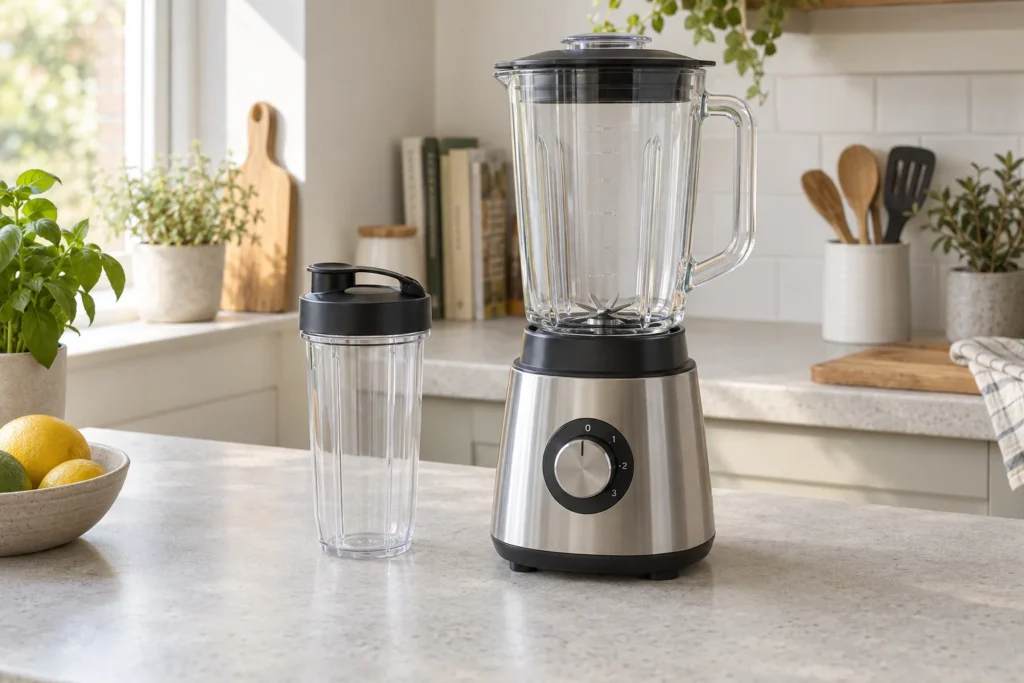
A blender’s advertised jug capacity is only the starting point. The useful batch depends on its working fill mark, the type of food and whether there is enough mixture to circulate. Choose a size that covers your regular recipe without making every small portion an awkward job.
Image: AI-generated editorial illustration of generic equipment; not a photograph of a reviewed product.
Table of Contents
Measure the serving you actually use
Fill your normal drinking glass or soup bowl with water to the level you would serve, then measure that water in a kitchen jug. This gives a better personal starting point than a claim that an appliance serves a fixed number of people. A small snack smoothie and a large breakfast drink are different portions.
For example, three 300ml drinks require 900ml of finished smoothie. That arithmetic does not mean you can place 900ml of every raw ingredient combination in a 900ml vessel. Whole fruit occupies space differently before blending, and the machine may need additional headroom. Use the calculation to shortlist sizes, then check the recipe and fill line.
Distinguish the container from its working allowance
nutribullet’s official Tall Cup page describes a 680ml cup. That product description does not replace the maximum blending line moulded into the actual cup. Likewise, Sage’s Super Q page lists a 2L jug and a separate personal cup: the vessels should be assessed individually.
Make a small comparison sheet with separate entries for nominal volume, permitted cold batch, permitted hot batch if applicable, and any minimum recipe quantity. Leave unknown fields blank while you seek the manual. Turning an unknown into a guessed percentage creates an apparently precise figure with no reliable basis.
Allow for the kind of mixture
Thin drinks, foamy mixtures and dense dips may have different instructions. Check whether the manufacturer gives lower allowances for particular ingredients or recipes. A jug that blends a family-sized drink may not handle a small spoonful of dressing effectively if the mixture sits below or outside its intended circulation pattern.
Do not fill empty space automatically. If the manual provides a minimum and maximum for a task, stay within that range. If it gives a recipe instead, use that recipe’s quantity as the starting example. Smaller batches can help handling, but reducing a thick recipe too far can stop it moving as intended.
| Your routine | What to compare |
|---|---|
| One small drink | Whether an approved cup or narrow container suits the quantity. |
| Several drinks together | Working cold limit and comfortable pouring weight. |
| A saucepan of cooked soup | Hot-input permission and any separate hot limit before volume. |
| Occasional nut butter | The supported recipe mass and container, rather than litres alone. |
| Two different drinks | Cleaning between batches and whether separate approved cups are useful. |
Check physical size as well as litres
Measure the cupboard opening, shelf depth and the counter space under any wall cabinet. Include the lid and the clearance needed to remove the jug. Two containers with the same stated volume can have different heights and footprints. Store any tamper and spare cup where they will not be confused with another machine’s accessories.
Think about the sink too. A tall jug may be easy to blend in but awkward to rinse under a low tap. The correct washing method still comes from the manual, but the physical fit affects how convenient that method will be every day.
Decide whether repeated batches are acceptable
If the larger machine only helps with an occasional gathering, compare that benefit with the daily space it occupies. Making two permitted batches can be a reasonable choice when the manual’s operating and rest limits allow it. For a busy household making several drinks every morning, repeated washing and cooling intervals may be frustrating.
Write down a realistic routine: number of drinks, actual measured serving, ingredient type and time available. Then compare suitable models through the smoothie blender guide. Buy against your common batch, while ensuring occasional larger recipes can be divided safely. Extra nominal volume is useful only when the working instructions and handling also suit you.