
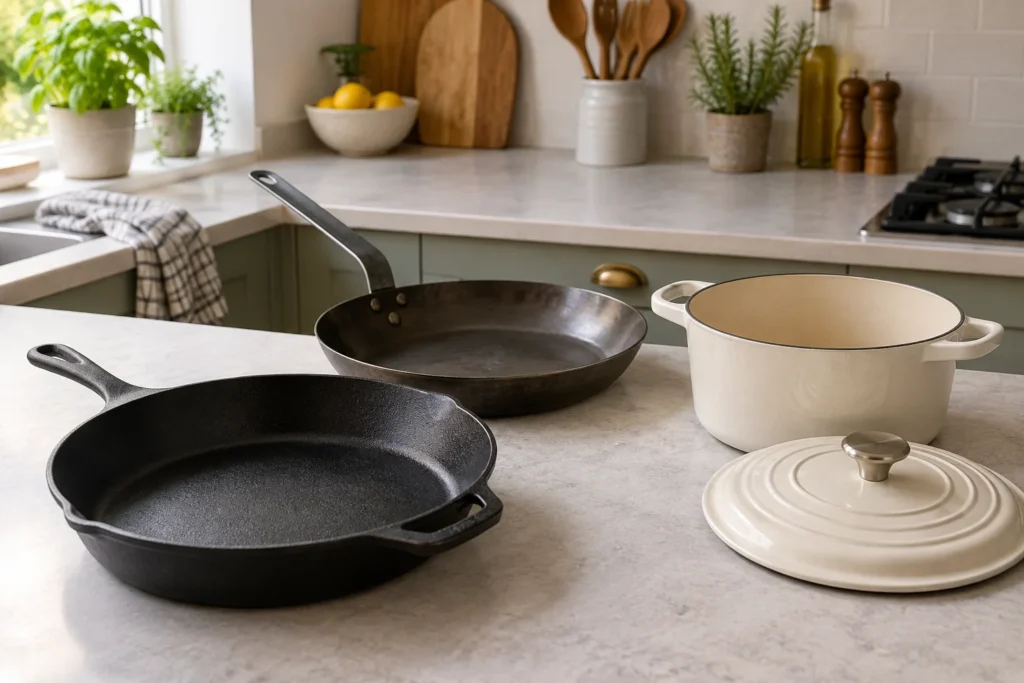
Choose your first carbon steel pan only after reading its first-use and everyday care instructions. Then compare the actual cooking area, base diameter, weight and handle. Carbon steel can be a useful addition to a kitchen, but buying the right size and understanding its routine matter more than choosing the most heavily promoted model.
Image: AI-generated editorial illustration of generic equipment; not a photograph of a reviewed product.
Table of Contents
Check the supplied surface condition
Some pans arrive with a protective finish that must be treated according to the maker's first-use instructions; others are sold pre-seasoned. Identify the condition of the exact product rather than assuming all dark pans are ready to use or all pale pans need the same preparation.
de Buyer MINERAL B 28 cm specifications describes a beeswax-protected MINERAL B pan and links its seasoning guidance. That is a product-specific starting point. Do not copy a method intended for another coating, handle or pan range, particularly when it involves oven use.
Measure the cooking area you need
A sloping-sided frying pan can have a noticeably smaller base than its rim diameter. The de Buyer example publishes both dimensions, illustrating why a headline size is not the whole story. Compare the usable interior area with the food you normally cook, while following the recipe's guidance about quantity and arrangement.
| Dimension | Useful reason to record it |
|---|---|
| Rim diameter | Overall opening and lid considerations |
| Base diameter | Contact with the hob and flat interior area |
| Side height | Containment and access with a turner |
| Total length | Handle clearance in oven and cupboard |
| Empty weight | Handling before food is added |
Use like-for-like sizes when comparing candidates. A larger pan is not necessarily a better first purchase if it is difficult to heat appropriately on your hob or awkward to lift and wash.
Check the handle's separate restrictions
A steel body does not establish unrestricted oven use. Handle material, coating and fixing can change the permitted method. The cited MINERAL B model has a specific limited oven instruction, so it should not inherit the unrestricted oven treatment of a differently handled pan.
Read the complete assembly's limit and any time restriction. If you want to use the pan for a recipe with a long oven stage, choose a model explicitly suitable for that task. Do not plan to remove or modify a fixed handle to make an unsuitable pan fit the method.
Match the base to the hob
Confirm compatibility with your exact heat source and check any guidance about cooking-zone size, preheating and gradual heat changes. A magnetic material alone does not remove the need to follow the hob and cookware instructions together.
Plan a stable resting surface and enough room to move the pan without dragging it across a surface where the manufacturer advises lifting. Consider neighbouring pans and the handle's position. The useful setup includes the whole cooking area, not just the centre of one burner.
Decide whether the care routine is realistic
Read how the maker expects the pan to be washed, dried, stored and maintained. Do not assume it can follow the same dishwasher routine as another steel pan. Carbon steel and stainless steel are different categories, and an everyday instruction for one should not be transferred to the other.
Think about who else will use it. Keep its care information accessible and give it a clear storage place. If the household is unlikely to follow the required routine, a different construction may be a more suitable everyday choice even if you like the idea of carbon steel.
Begin with one familiar task
Choose an appropriate recipe and learn the pan's instructions before changing several variables at once. This guide does not promise a particular food-release result or a fixed number of uses needed to develop a surface. Keep notes about the recipe, pan and permitted method so future adjustments are informed.
Buy one purposeful pan before expanding into a complete range. A good first choice is the size you can handle, the base your hob accepts and the construction whose care you understand. Once you know how it fits your routine, you can decide whether another shape would add a genuinely different use.