
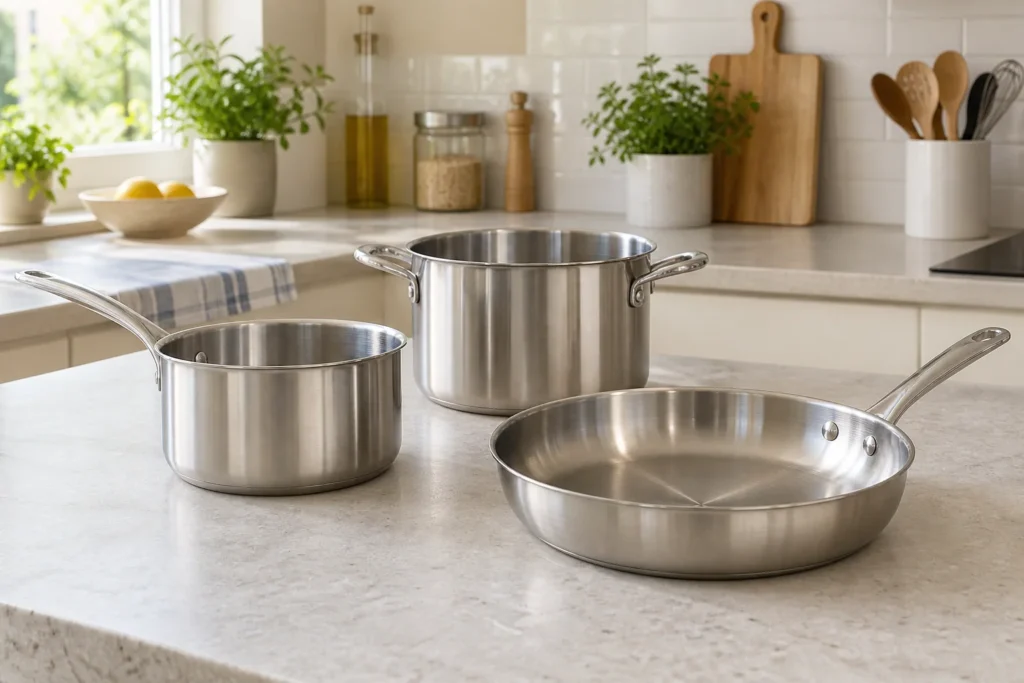
Choose a stockpot by the batch you plan to make and the way you will fill, move and empty it. A larger litre figure is useful only when the pot fits the hob and remains manageable. Check working headroom, base diameter, lid height and the route between cooking position and sink before buying.
Image: AI-generated editorial illustration of generic equipment; not a photograph of a reviewed product.
Table of Contents
Start with the actual batch
Read a recipe you expect to repeat and note its specified vessel and yield. Ingredients occupy space as well as the liquid around them, and the method may require room for movement or expansion. Do not treat the pot's brimful capacity as the amount you should cook in it.
The name “stockpot” does not imply one fixed large size. ProCook Professional 18 cm stockpot specifications lists an 18 cm model with a 3.2 litre capacity. That example shows why the category name should be followed by the actual dimensions and volume, rather than interpreted as a guarantee of family-sized batch capacity.
Distinguish total volume from working room
Ask how the advertised capacity is measured and follow any maximum-fill instruction. A recipe may need less than that maximum to remain workable. Keep the manufacturer's fill limit and the recipe's equipment requirement as separate checks rather than inventing a universal percentage for every stockpot.
| Planning detail | Question to resolve |
|---|---|
| Recipe quantity | What pot size does the method specify? |
| Published capacity | Brimful or recommended working volume? |
| Internal depth | Can you stir and retrieve ingredients comfortably? |
| Opening width | Does the utensil or strainer fit? |
| Lid height | Is there clearance under the extractor or in storage? |
If your current pot is nearly suitable, identify exactly what is missing. A little more depth, a wider opening or more comfortable handles are different reasons to replace it.
Match the base to the hob
Record the actual base diameter and check it against your hob's pan guidance. A tall stockpot can have a smaller base than its upper body suggests. On induction, confirm the exact model's compatibility and the appliance's detection-size requirements.
Consider the surrounding cooking positions too. A wide stockpot may crowd another pan or obstruct access to controls. Use measured footprints on a worktop to plan the arrangement, keeping paper and measuring equipment away from a live hob.
Calculate the load you will handle
Add the empty pot, lid and planned contents when considering weight. For illustration, a 2 kg pot, 0.5 kg lid and 4 kg of contents make a 6.5 kg combined load. Those are arithmetic examples, not specifications or a recommended lifting limit.
Think about where that load moves. Filling the pot, transferring it after cooking and emptying it into a strainer can be more demanding than simply lifting the empty vessel in a shop. Choose an arrangement you can manage without relying on an improvised grip or an unsupported lid.
Check the handles and sink
Look at loop size, spacing and the room available for the required heat protection. A short loop close to the body can be awkward even when the pot's total weight seems acceptable. Assess a cool display item where possible and do not use a heavy load to test your limits.
Measure the sink opening and the clearance under the tap. Check whether the pot can be washed and dried in the normal kitchen setup. A stockpot used occasionally still needs a practical cleaning route; storing an oversized vessel does not solve that problem.
Plan what happens after cooking
Follow appropriate recipe and food-safety guidance for serving, cooling and storing the food. A large pot's capacity should not be used to justify an unplanned batch that you cannot handle or store appropriately. Have suitable receiving containers and tools ready before beginning the recipe.
Choose the smallest stockpot that reliably meets the intended batch and working-space requirements. A second larger pot can be added later if repeated use justifies it. Useful capacity, suitable hob contact and manageable handling are better reasons to buy than a category name or an unusually large number of litres.