
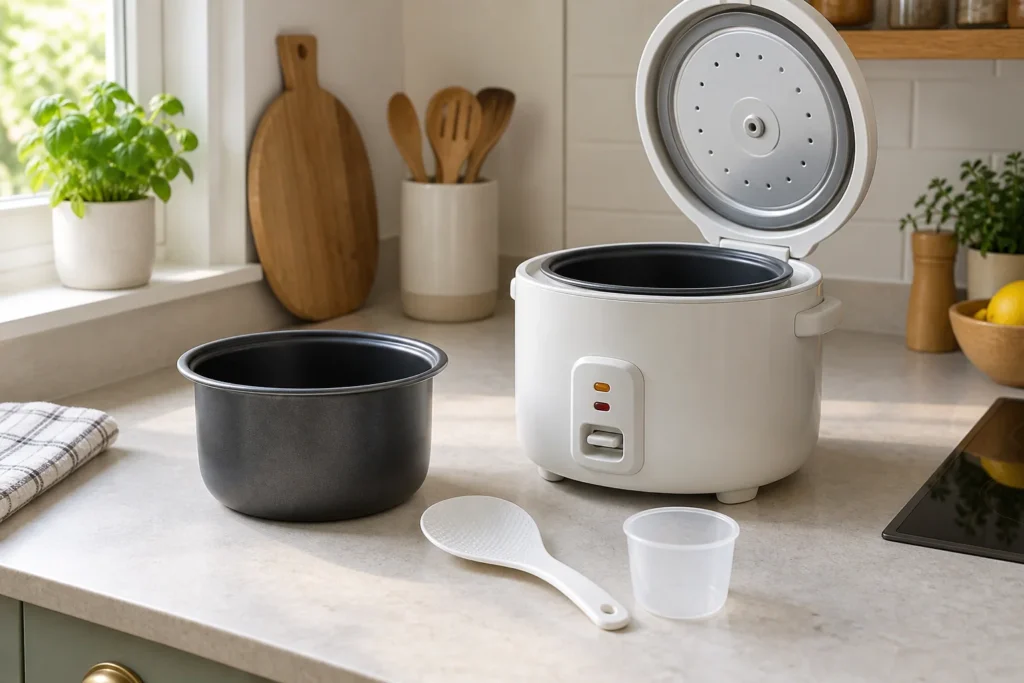
Use the rice cooker’s supplied measure and matching bowl instructions unless the manufacturer specifies another method. A rice-cooker cup is often smaller than a kitchen baking cup, and the numbers inside the pot can represent a water level for measured rice rather than an empty-pot volume.
Image: AI-generated editorial illustration of generic equipment; not a photograph of a reviewed product.
Table of Contents
Check what the supplied cup actually holds
Yum Asia’s Kumo accessory guide explains that its cup holds 180ml when filled to the brim, although the highest printed graduation is 160ml. That is a helpful example of why the last visible mark and the cup’s full intended measure are not always the same thing.
Read the manual’s wording about levelling or filling the cup. Do not assume that a mug, a 250ml baking measure or a scoop from a different appliance matches it. If the original cup is missing, find its stated capacity and an approved replacement rather than estimating from a photograph.
Distinguish dry rice from cooked servings
A cooker advertised by cups may mean cups of dry rice, cooked rice or a seller’s serving estimate. Find the definition before comparing machines. The amount a person eats also depends on whether rice is a small side or the main part of a meal, so a serving claim is not a household measurement.
As a simple arithmetic example, two level 180ml cups contain 360ml of dry rice by volume. That is not 360g, and it does not tell you the volume of the cooked result. Keep weight, dry volume and finished serving size in separate columns if you are comparing recipes.
Read the pot’s scale with rice already accounted for
Follow the specific loading order. Where the instructions say to add rice and then water to a matching line, the line describes the combined setup at that stage. It is not necessarily an instruction to measure that many cups of water in a separate jug.
Identify the scale for the rice type you are cooking. A pot can carry different markings for white rice, brown rice or porridge. Check the minimum and maximum for the selected programme as well. Using the right cup with the wrong scale still produces the wrong setup.
| Term | Meaning to verify |
|---|---|
| Rice-cooker cup | The supplied measure’s stated volume and filling method. |
| Cup capacity | Whether the figure refers to uncooked or cooked rice. |
| Water line | The correct scale and the stage at which it is read. |
| Serving count | The maker’s assumed portion, if stated. |
| Minimum batch | The smallest amount the model supports for that programme. |
For the complete sequence around those measurements, follow our step-by-step guide to using a rice cooker, then use your model’s instructions for its quantities and programme.
Measure on a level surface
Place the inner pot on a stable level surface when reading its water line. A tilted pot makes one side look full before the other. Check at the level indicated by the manual, and return the pot to the cooker with its outside clean and dry as directed.
Keep preparation consistent between batches. If the instructions call for rinsing and draining, do that before making the final water adjustment, using a separate suitable bowl where required to protect the coating. Do not combine one recipe’s fixed water ratio with another manual’s fill-line method unless they explicitly agree.
For quinoa, our rice-cooker quinoa guide separates the documented ingredient measurements from ordinary rice bowl markings. Use the method for the named model rather than treating its measures as universal.
Choose capacity from your regular batch
Write down the number of supplied cups needed for a meal you commonly make. Compare that with each model’s supported range for your rice type, then check how much space the appliance occupies. The largest advertised capacity is less valuable if the cooker cannot handle your usual small portion well. For the control options, see our basic versus fuzzy-logic rice-cooker comparison.
If you sometimes cook for guests, decide whether a second batch or a different cooking method is acceptable. Remember that the appliance’s operating instructions and rice-storage guidance still apply. Do not make a much larger batch simply to use the machine’s maximum capacity.
Keep the measure with the cooker
Store the cup with the rice paddle and manual, clearly separated from baking measures. Mark its storage container with the appliance model if several people cook. A short note of rice type, number of cups and programme makes a successful batch easy to repeat. Use our rice cooker guide for broader model selection once these capacity terms are clear.