
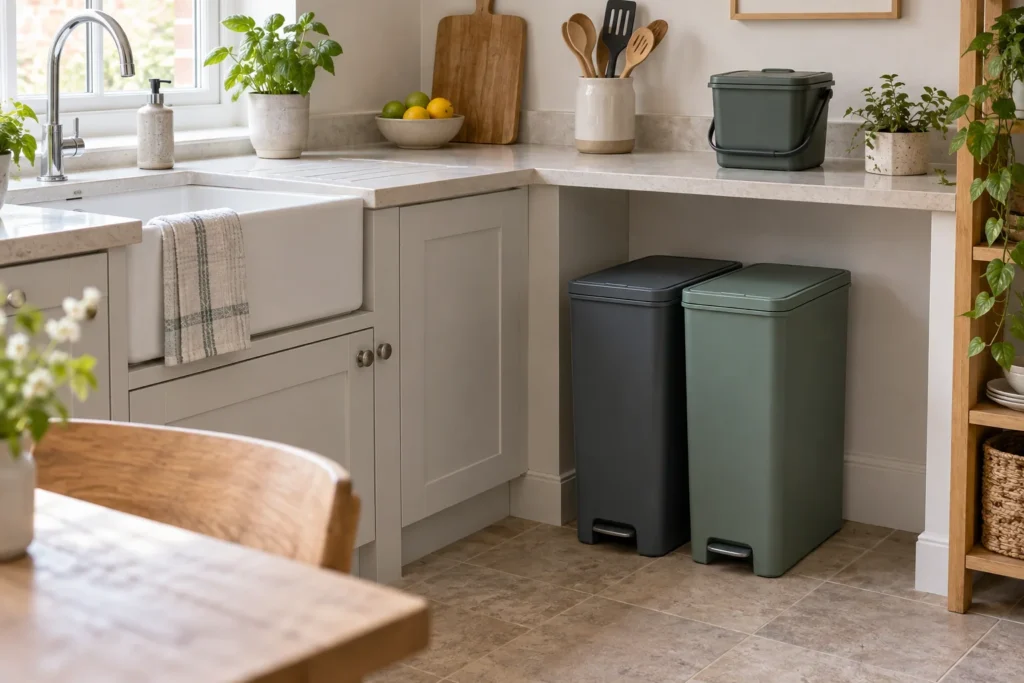
A kitchen food-waste caddy is a short stage in a larger disposal routine. It needs to accept the waste your local service allows, sit conveniently during preparation and be manageable when you empty it. Start with that route before comparing capacity, filters or a particular finish.
Image: AI-generated editorial illustration of generic equipment; not a photograph of a reviewed product.
Table of Contents
Check the collection rules before the liner
Use the GOV.UK council finder to locate your current food-waste instructions. Check accepted contents and liner requirements for your address. A bag labelled compostable is not automatically the right liner for every collection service.
If your council supplies a kitchen caddy or specifies a particular outside container, include that in the plan. An indoor product can still be chosen for convenience, but it must work with the actual local system rather than a generic description of composting.
Choose capacity around emptying
Think about the waste produced during ordinary preparation and when it is transferred to the collection container. A larger caddy offers more room but also takes more worktop space and may be less convenient to carry. Do not choose litres independently of the emptying routine.
Measure the useful opening as well as the body. A broad opening may make scraping a plate more straightforward; a narrow tall body may fit a different location. Check the complete dimensions with the lid and handle in their operating positions.
Compare where the caddy will sit
Joseph Joseph’s food-waste caddy guide describes countertop and in-cupboard formats within its range. The important comparison is whether the design’s access and movement suit your kitchen, not whether one placement is universally preferable.
A countertop caddy should leave the preparation area usable. A cupboard-mounted design needs the correct installation and enough space for the door, lid and inner container to move. Follow the exact manufacturer’s fitting instructions rather than hanging a container from an unsuitable hook or door edge.
Make lid and handle operation part of the choice
Check whether the lid stays where intended while you add waste and whether you can grip the handle for the normal carrying task. Consider the route to the outside collection container, including doors and steps. The most convenient empty caddy in a shop may feel different when used through that whole journey.
If the product has a filter, vent or removable insert, obtain the instructions for it. A filter is another part to maintain or replace under the maker’s guidance, not permission to ignore cleaning or emptying. Do not interpret an odour-reduction claim as a guarantee that every food-waste combination will be smell-free.
Check the liner and cleaning access together
| Feature | Question |
|---|---|
| Liner support | Will a locally accepted liner fit as intended? |
| Opening | Can ordinary plate scraps be added without awkward manoeuvres? |
| Inner bucket | Can it be removed and cleaned under the instructions? |
| Lid and filter | What care and replacement steps are required? |
For a practical trial, trace the route with the empty caddy: preparation position, temporary storage and outside emptying point. Notice where you need a free hand or extra clearance. This can reveal a handle or lid inconvenience before capacity becomes the main consideration.
Compare a small and a larger caddy in position
Put a footprint for each candidate where it would stand and open the imagined lid through its full travel. A larger caddy may reduce how quickly it fills, but its height can prevent opening beneath a shelf. A smaller caddy may fit neatly yet require the handle to be moved every time you scrape a plate. Consider the journey from that position to the collection container as well. The practical choice balances access, the household’s emptying routine and the local service’s instructions; it is not settled by choosing the largest advertised capacity.
Buy the caddy that supports the routine
Our kitchen bin guide provides wider waste-storage context. Choose a food-waste caddy whose local liner compatibility, opening, carrying and cleaning requirements you can manage consistently. The useful result is a clear disposal route that fits your kitchen and collection service.