
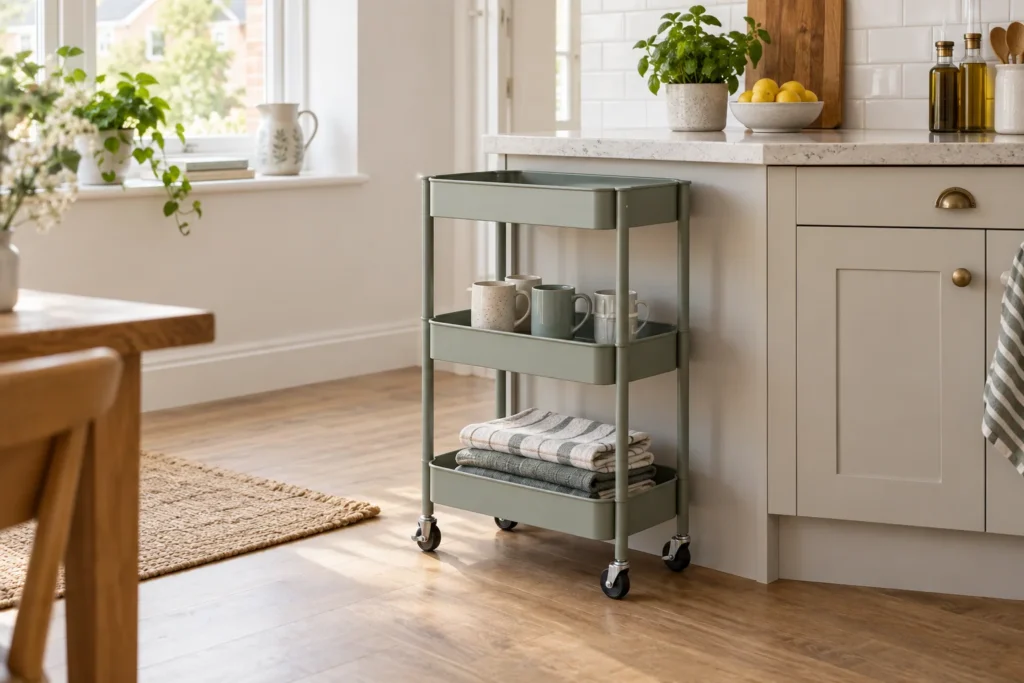
A kitchen storage trolley can provide a useful movable home for equipment, but its parked footprint is only part of the decision. It must also turn, pass doors and remain manageable with the intended load. Start by mapping where it will live and where you expect to move it during an ordinary day.
Image: AI-generated editorial illustration of generic equipment; not a photograph of a reviewed product.
Table of Contents
Define the trolley’s actual job
Choose whether it will store pantry supplies, hold occasional equipment or support another specific routine. A trolley filled with unrelated overflow can become difficult to move and harder to keep organised. Give each shelf a clear purpose before comparing the number of tiers.
Distinguish storage from food preparation. A tray or shelf on a trolley is not automatically approved as a direct food-contact or cutting surface. If a work surface is part of the intended use, obtain the exact manufacturer’s permission and instructions for that product.
Read load limits per shelf and overall
IKEA’s RÅSKOG trolley lists 6 kg per shelf and 18 kg overall, and says it is for indoor use and not approved for food contact. These are useful examples of separate limits that should be checked on any trolley you consider.
Do not treat a total load figure as permission to place the entire amount on one shelf. Include the actual contents in your plan and follow the maker’s loading, assembly and movement instructions. A metal frame or broad wheel does not replace those specifications.
Measure the route, not only the gap
Record the trolley’s complete width and depth, including handles, wheels and projecting accessories. Then measure the narrowest part of its intended route. Check doorways, cupboard handles and the turning space between counters.
Use a paper footprint on the floor to visualise the parked position, keeping the area safe to walk through. Consider how the trolley will be turned and which side you will grip. A unit that fits a narrow recess may still be awkward to pull out if its handle is hidden against the wall.
Check wheels and parking features
Find out which wheels, if any, lock and how the maker instructs you to operate them. Check suitability for the actual floor and any thresholds on the route. Do not assume that a trolley rolls equally well on every surface because it moves smoothly in a product video.
Keep the intended parking place clear of access routes and appliance openings. If a trolley has to move every time the oven, dishwasher or cupboard opens, decide whether that repeated step is acceptable before buying.
Compare usable shelf space
| Measurement | Question |
|---|---|
| Overall footprint | Will it park and pass through the route? |
| Usable shelf area | Do the actual containers fit inside rims and supports? |
| Vertical clearance | Can tall items be removed without tilting awkwardly? |
| Load limits | Are both per-shelf and total instructions met? |
For an illustrative comparison, a trolley storing lightweight packaged supplies may need different shelf spacing from one holding bulky appliances. Put the largest intended item into the paper plan first, then check the remaining space. Do not buy around a photograph of small accessories if your real load is much larger.
Draw the trolley at its narrowest turn
Measure a route through the kitchen rather than drawing only the trolley’s parking rectangle. Include a turn around a table leg, the doorway opening and any projection from a handle. The loaded shelf contents must also remain within the arrangement permitted by the maker; an overhanging board can change the clearance. Check the route when ordinary doors and drawers are in the positions they usually occupy during use. If the trolley only moves freely after several other items are relocated, decide whether it is really mobile storage or effectively a permanent extra shelf in that kitchen.
Keep the trolley useful when stationary
Check cleaning access beneath and between shelves, and retain the assembly instructions for later checks. Our kitchen island guide provides wider context for adding storage to a room. Choose a trolley when its supported load, movement and parked access fit your actual kitchen rather than merely filling an unused gap.