
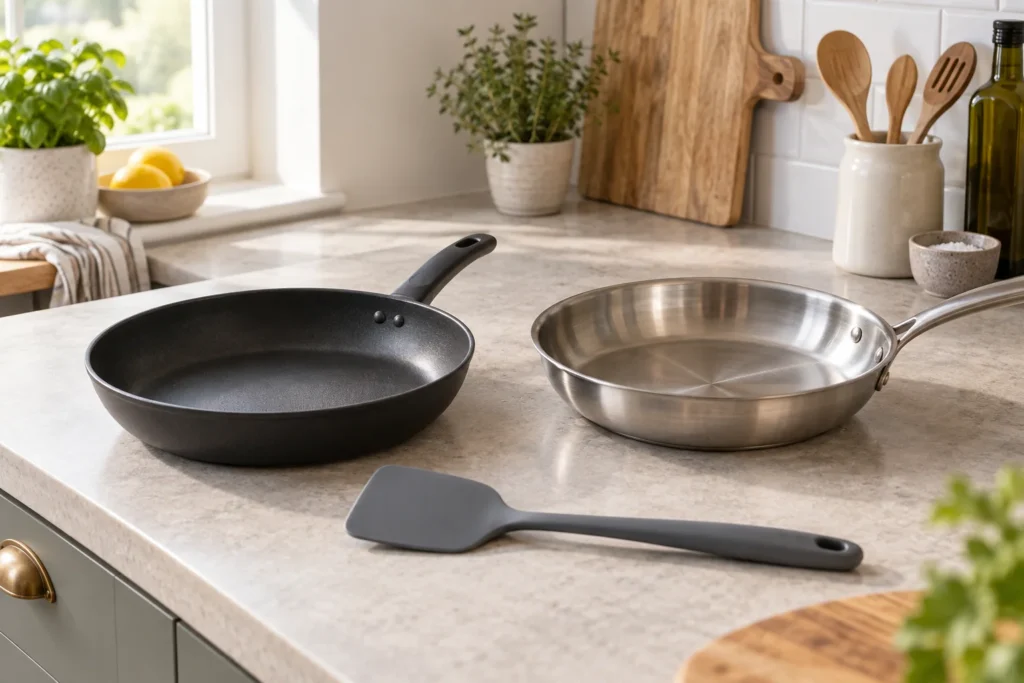
Replace a non-stick pan when its coating is damaged in a way the manufacturer says requires replacement, or when another fault makes it unsuitable for use. Do not rely on a universal age limit. A calendar cannot tell you whether a particular pan has been lightly used, overheated, scratched or stored badly.
Image: AI-generated editorial illustration of generic equipment; not a photograph of a reviewed product.
Table of Contents
Start with a clean, cold inspection
Clean the pan using its approved routine and let it dry before assessing it. Food residue can conceal the surface, while grease and reflections can exaggerate marks. Look across the cooking area, sides and rim without picking at anything that appears to be lifting.
Tefal’s lifecycle guidance advises replacing cookware if its coating is damaged. It also distinguishes care that protects the coating from actions that can reduce its non-stick properties. That is a condition-based instruction, not a fixed number of years for every owner. Tefal pan maintenance and lifecycle
If you see peeling, flaking or an uncertain exposed layer, stop using the pan while you obtain the maker’s assessment or arrange replacement. Do not perform a scratch test to determine how firmly the remaining coating is attached.
Separate sticking from visible damage
Sticking can prompt an inspection, but it does not identify the cause by itself. A build-up on the surface may need the maker’s approved cleaning method, while genuine coating deterioration will not be repaired by adding more oil.
Record whether the problem developed gradually or followed a particular incident. Include overheating, metal-utensil contact or a cleaning product if relevant. Being precise helps support assess the issue and helps you avoid repeating the same problem with a new pan.
| Observation | Appropriate next step |
|---|---|
| Residue on an otherwise intact surface | Follow the approved cleaning method and reassess |
| Peeling or flaking coating | Stop use and seek replacement or maker advice |
| A mark whose depth is unclear | Send clear photographs rather than scratching it |
| Loose or damaged handle | Use the maker’s repair or assessment process |
| Rocking or distorted base | Check the pan’s condition before further cooking |
Inspect more than the coating
A non-stick pan is also a body, handle, fixing and base. A pristine interior does not cancel out a broken handle or a distorted underside. Check the cold pan for obvious movement at the fixing without loading it or stressing the handle.
If a repairable part is loose, follow the exact repair instructions. Do not replace a screw with an arbitrary one or assume that every handle is designed to be tightened at home. Retain the model number and purchase information if you contact support.
Avoid restoration claims that promise a new coating
Household oiling is not the same as replacing a factory-applied coating. Do not sand away damage, apply an unknown spray or copy a bare-cast-iron seasoning method onto a coated pan. Those actions change the surface without establishing that it remains suitable for food or heat.
An approved cleaning procedure may restore release by removing residue. Describe that accurately as cleaning, not as creating a new non-stick layer. If the surface itself has failed, replacement is the practical decision unless the manufacturer offers a documented repair service.
Choose a replacement around the failure
Write down what the old pan actually did each week. If it was used mainly for eggs and delicate fish, a modestly sized suitable replacement may be enough. There is no need to replace an entire cookware set because one frequently used coated pan has worn out.
Review the utensils, heat settings, storage and cleaning arrangement alongside the purchase. A new pan exposed to the same unsuitable routine may encounter the same problem. Choose instructions you can realistically follow in your household.
For disposal, check your local council’s current instructions for cookware and the material involved. Do not assume a pan belongs in the kerbside recycling bin because its body is metal. Once the decision is made, keep a short record of the replacement model and care requirements so the next assessment is based on evidence rather than an arbitrary anniversary.