
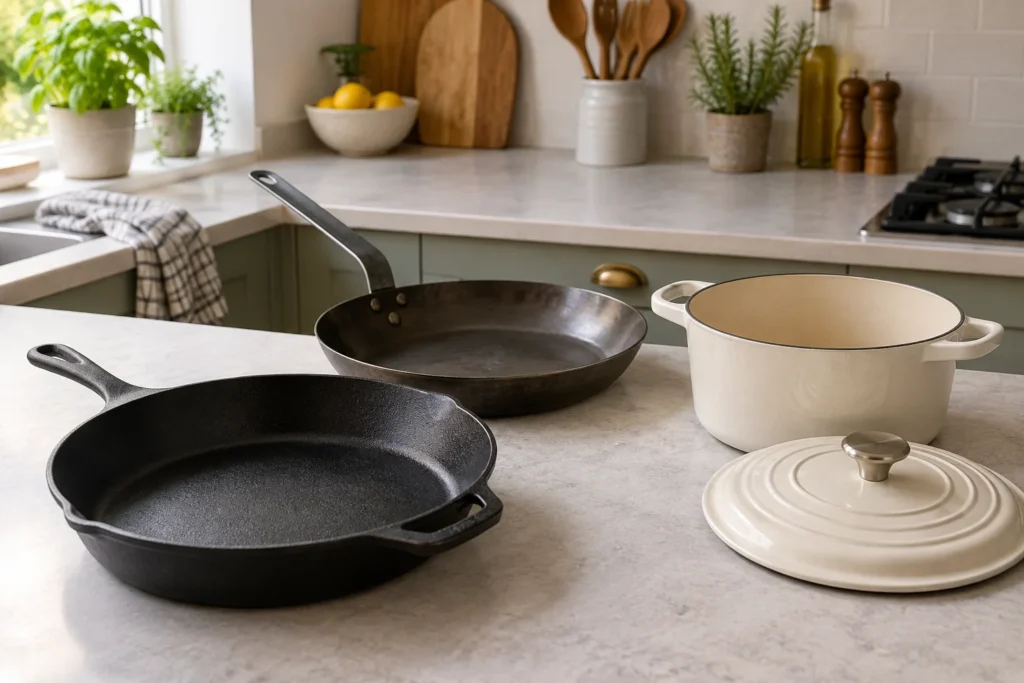
Choose enamelled or bare cast iron with the care routine in mind, not just the colour or weight. Enamelled cookware has a manufactured surface over the iron; seasoned bare iron relies on a maintained seasoning layer. Both need care, but the same cleaning or restoration method does not belong on both surfaces.
Image: AI-generated editorial illustration of generic equipment; not a photograph of a reviewed product. This guide draws on published manufacturer guidance, not hands-on product testing.
Table of Contents
Identify the surface, including dark interiors
A black interior is not proof that a pan is bare iron. Lodge specifically says its enamelled pieces need no seasoning, including those with a black interior. Identify the product from its instructions before following a bare-iron preparation routine. Lodge enamelled cast iron care
This matters when buying second-hand or receiving a pan without its box. Ask for the model number and clear photographs of the interior, exterior and base. If the finish is uncertain, resolve that before cleaning it aggressively or heating oil onto the surface.
Compare the weekly routine
Think about what happens immediately after a meal. Are you comfortable completing a specific drying and maintenance routine before putting the pan away? Or would you prefer a surface whose instructions do not include maintaining a seasoning layer?
Neither answer makes someone a better cook. Equipment works best when its care fits the household. A pan that is left in the sink because its routine feels inconvenient may be the wrong purchase even if you enjoy using it occasionally.
| Decision | Enamelled cast iron | Seasoned bare cast iron |
|---|---|---|
| First-use preparation | Follow enamel-specific instructions | Check whether supplied pre-seasoned and what preparation is required |
| Routine cleaning | Protect the manufactured finish | Preserve or maintain the instructed seasoning |
| Surface changes | Distinguish stains from enamel damage | Distinguish seasoning changes from residue or rust |
| Restoration | Do not apply bare-iron stripping methods | Use maker-approved restoration where appropriate |
| Storage | Follow the item’s drying and protection guidance | Follow its drying and maintenance guidance carefully |
Match the pan to your recipes
Look at five meals you regularly cook, rather than a list of everything cast iron might do. Check the maker’s guidance for the ingredients, cooking method and duration involved. A pan selected for long saucy dishes may face different use conditions from one mainly used for short frying tasks.
Do not infer open-fire, grill or oven permission from the material alone. Coatings, handles and knobs can change the answer. If outdoor use is important, obtain explicit permission for the exact product and intended heat source.
For a recipe that moves from hob to oven, compare the complete assembled item, including its lid. A suitable surface does not resolve a handle limit or a pan that is too large to retrieve comfortably.
Consider handling independently of finish
Enamelled and bare are surface descriptions, not weight categories. Compare the published empty weight of specific candidates, then allow for the food and lid. Check whether the handle shape gives you a comfortable grip with the protection the instructions require.
Imagine the full route from cupboard to hob, oven, table and sink. A heavy pan may be manageable at waist height but awkward on a low shelf or in a deep sink. Choose storage that supports the handling routine rather than treating cupboard space as an afterthought.
Decide how you will respond to wear
If you like maintaining equipment and are comfortable following a documented bare-iron care process, seasoned cast iron may suit you. If avoiding seasoning is a priority, enamelled cast iron removes that particular task, while still requiring attention to the finish and handling instructions.
Do not describe chipped enamel as a seasoning problem or ordinary seasoning changes as missing enamel. Keep the correct care record with the item so the next person washing it can identify the surface too.
For a bare-iron pan with rust, see our guide to assessing and restoring a suitable cast-iron pan. That process does not apply to chipped enamel.
Make the final comparison between actual pans of useful size. The better choice is the one whose surface, permitted cooking uses, loaded handling and care routine fit your kitchen together. There is no need to buy both simply because each has different strengths.