
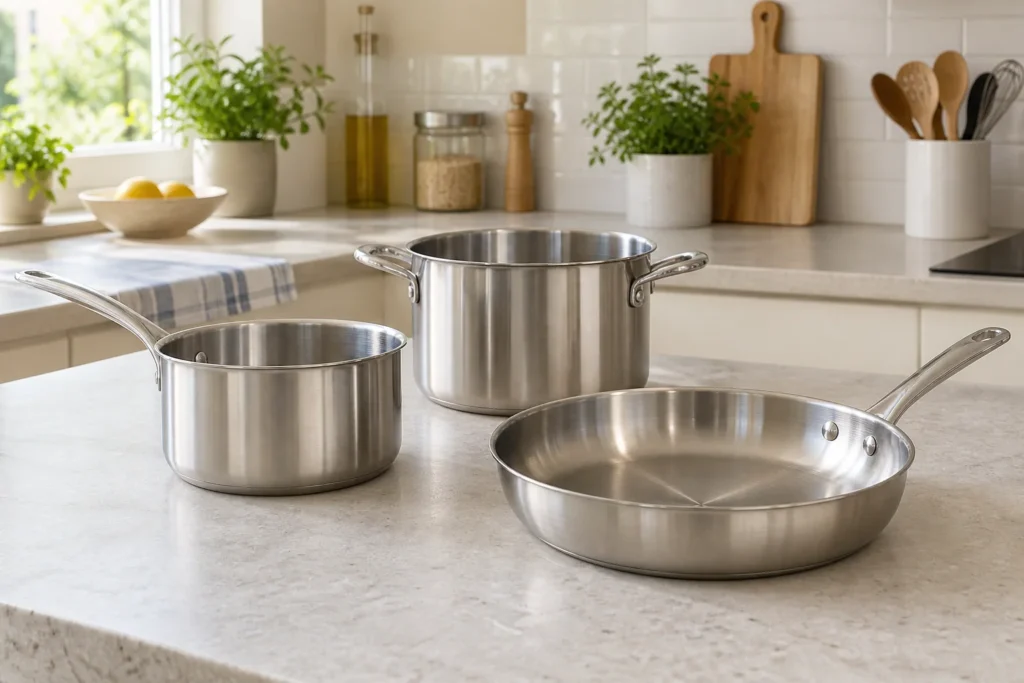
Compare aluminium and stainless steel cookware as complete pans, rather than as two single-material categories. A stainless-steel pan may contain aluminium in its base or layers, and an aluminium body may carry a coating and a separate induction-compatible base. Identify those parts before deciding which construction suits your cooking.
Image: AI-generated editorial illustration of generic equipment; not a photograph of a reviewed product.
Table of Contents
Separate the body from the cooking surface
A listing should tell you what the pan body is made from and what food contacts inside it. Stainless steel can be an exposed cooking surface or sit underneath a non-stick coating. Aluminium may be described as cast, pressed or hard-anodised, with additional surface information elsewhere in the specification.
GreenPan UK construction comparison gives a concrete example: its comparison distinguishes hard-anodised aluminium bodies from stainless-steel layers around an aluminium core. That shows why “steel versus aluminium” is not always an either-or choice. The construction can combine them for different roles.
Compare like-sized pans
Choose two candidates intended for the same task and compare their dimensions. A deeper pan or thicker base can change weight and capacity, so comparing a small aluminium frying pan with a large steel casserole tells you little about your actual choice.
| Detail | Record for each candidate |
|---|---|
| Rim and base dimensions | Opening size and actual contact area |
| Usable cooking area | Flat area inside, where specified |
| Capacity and depth | Relevant to the food and liquid you use |
| Empty weight | Whether the figure includes the lid |
| Surface and layers | Coated or uncoated, base-only or full-body construction |
If a specification omits weight or base diameter, ask for it rather than estimating from a photograph. Keep the units consistent so the comparison is easy to read.
Evaluate handling before material preference
Consider the movement you perform most often. A saucepan used for pouring has different handling demands from a pan that normally stays on the hob until serving. A long handle, two side handles and a helper handle create different options, regardless of the material label.
Hold an authorised display item if possible. Check the grip, balance and route into your oven or cupboard. Think about the added contents and lid without testing a load you cannot comfortably control. An apparently modest difference in empty weight may matter to you, but it should be assessed alongside handle design and how far you move the pan.
Read hob and oven compatibility independently
Do not decide induction suitability solely from “aluminium” or “stainless steel” in the title. Look for the maker's explicit compatibility statement, then check the hob's base-size requirements. The complete base construction is what the product specification needs to address.
For oven use, check the body, handle and lid as a complete assembly. A metal body does not establish the rating of a grip covering or glass lid. Include any grill restriction and detachable-handle instructions if those are relevant to your recipe.
Choose the surface for the cooking method
An uncoated steel cooking surface and a coated aluminium pan can require different approaches to heat, food release and cleaning. Follow the exact maker's instructions rather than treating a general material comparison as a cooking method. The same caution applies to a coated steel pan: its steel exterior does not make the interior uncoated.
Review two or three meals you cook frequently. Note whether the recipe calls for a particular surface or pan shape and whether your current difficulty concerns food release, capacity, weight or washing. That identifies the problem a new pan should solve.
Compare ownership details
Read the ordinary cleaning routine, utensil permissions and warranty exclusions. Check whether replacement lids or handles are available if those features matter to you. Avoid treating a broad lifetime guarantee as evidence that every component has identical coverage or that no care restrictions apply.
Choose on the full specification and your own priorities. A useful comparison might conclude that you prefer a lighter candidate with a documented coating routine, or a particular layered steel pan with comfortable handles. It does not need to declare one material universally superior. The worthwhile purchase is the pan that fits the task, hob and handling routine together.