
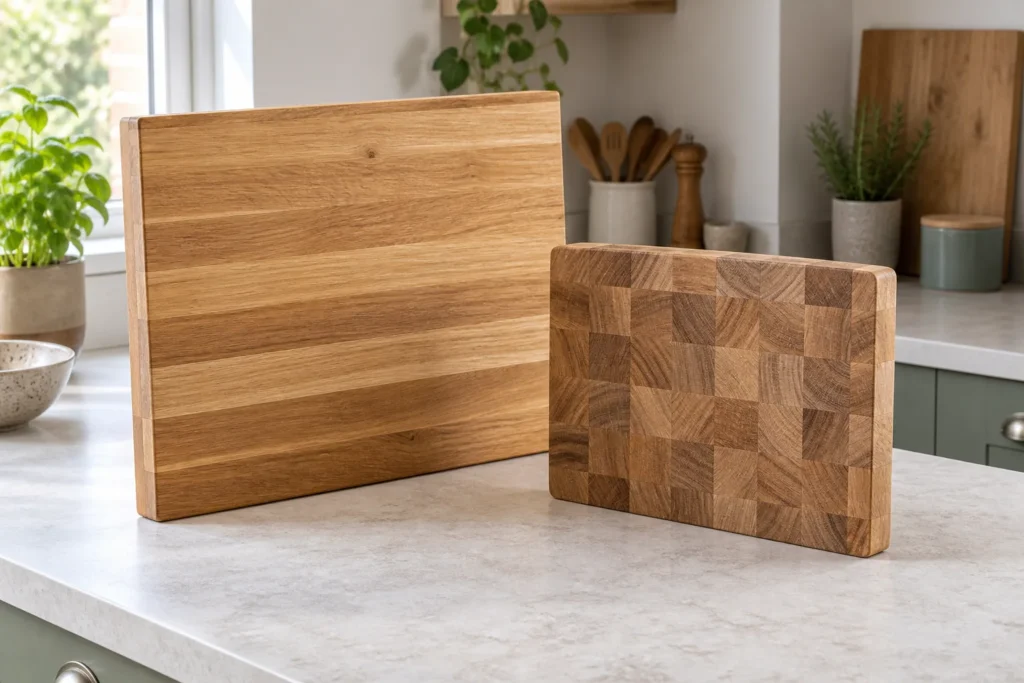
A large chopping board is useful only if it leaves room to work around it and can be washed and stored comfortably. “Large” and “small” are shopping labels, not measurements. A better starting point is the clear patch of worktop you actually use, followed by the food and tools that need to occupy that space together.
Image: AI-generated editorial illustration of generic equipment; not a photograph of a reviewed product.
Table of Contents
Measure the clear working rectangle
Measure width and depth where you normally prepare food. Exclude the space occupied by a kettle, utensil pot, drainer or anything that will remain there while you work. Also account for objects above the counter: an overhanging appliance or cupboard can affect lifting and moving equipment even when the surface below appears clear.
Write down the available rectangle before browsing. A board fitting inside that outline is only the first test. You still need somewhere for ingredients awaiting preparation, a bowl for prepared food and the equipment required for the task. Avoid treating every remaining centimetre as board space.
Make paper templates before buying
Mark two or three candidate footprints on paper or clean card and place them on the empty counter. These are planning templates, not cutting surfaces. Use them to see how each size changes the rest of the layout, then remove them before preparing food.
For an illustrative comparison, a 40 × 30 cm rectangle occupies 1,200 square centimetres; a 30 × 20 cm rectangle occupies 600. The larger template has twice the area, although that does not mean it will make every task twice as convenient. Shape, hand position and the food itself still matter. These dimensions are examples for planning, not measurements from a product test.
Give cutting and collection separate space
List the foods you handle most often. A long loaf, several small vegetables and a single piece of fruit make different demands on a board. Think about the largest ordinary item, not an exceptional celebration meal that happens once a year.
Place an empty preparation bowl beside each template. Check whether you can move between the cutting area and bowl without routing everything around another appliance. Decide whether you prefer collecting prepared pieces on the board or transferring them promptly to a bowl. The latter arrangement may let a smaller board serve your normal routine more conveniently.
Compare product dimensions accurately
Manufacturer listings can make size differences concrete: ZWILLING’s board range presents boards with specified length and width rather than one universal definition of large. Apply that same discipline to any shortlist by recording exact dimensions.
Include handles, feet, raised rims and collection attachments where relevant. A juice groove or handle cut-out also affects the usable surface, so the outer rectangle is not the whole story. If a seller provides only one measurement, ask for the missing dimensions rather than estimating them from the photograph.
| Measure | Why it matters |
|---|---|
| Outer width and depth | Whether the board fits the preparation position |
| Usable flat area | Room left after grooves, holes or raised edges |
| Thickness and attachments | Fit in a rack or cupboard slot |
| Weight | How manageable washing and retrieval will be |
Check the journey to the sink
Measure the washing area and think through lifting, turning and drying the board using its permitted care method. A board can fit the worktop beautifully and still be awkward to control at the sink. Dishwasher suitability, where relevant, must come from the exact manufacturer’s instructions; dimensions alone cannot establish permission.
Consider where the board will dry and where it will live afterwards. A rack should accept the board’s thickness and support it securely. A cupboard slot should leave enough access to retrieve the board without dragging out several other objects.
Decide whether one size is enough
You may find that one everyday board and a second, task-specific size cover your household better than the largest possible board. Keep food-separation needs in that decision too. Our main chopping-board guide provides the wider material comparison. Use your measurements to narrow that choice to boards you can prepare on, wash, dry and retrieve without rearranging the whole kitchen.