
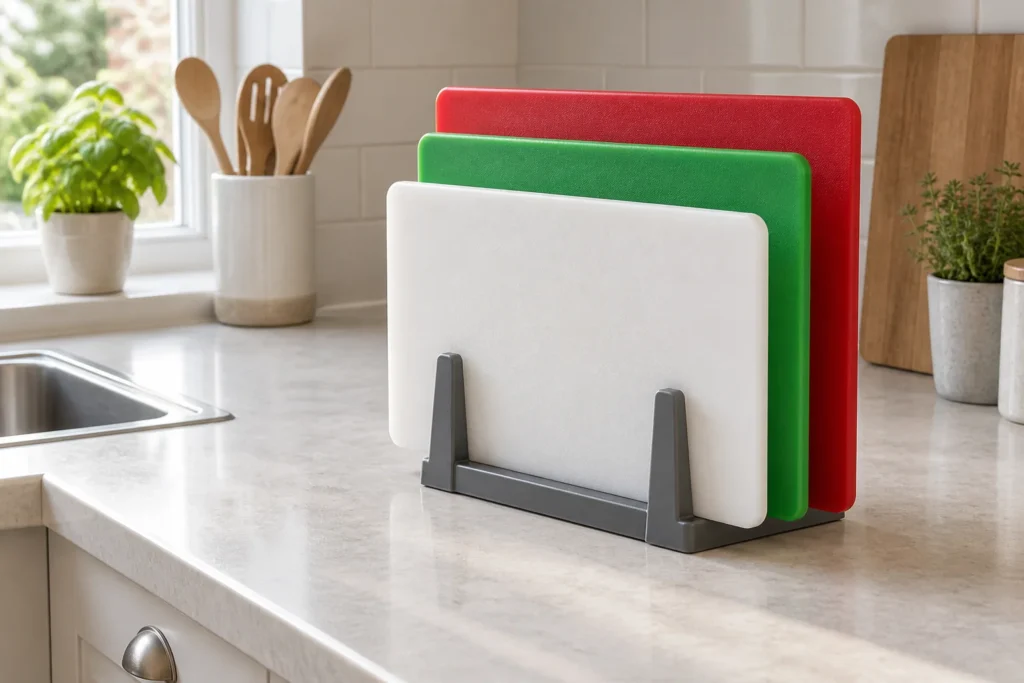
A chopping board with containers can keep prepared ingredients together, but it needs room to work as a complete system. The board’s advertised width tells you little about the space needed to pull out a tray, lift a box or wash the separate parts. Compare the preparation process, not just the number of containers supplied.
Image: AI-generated editorial illustration of generic equipment; not a photograph of a reviewed product.
Table of Contents
Decide what the containers will collect
Give each container a purpose before buying. You might want a tray for chopped vegetables waiting for the pan, a separate receptacle for peelings, or boxes that can move away from the board between stages. Those uses need different access and capacities. A deep box does not help if its opening is too narrow for the pieces you prepare.
Keep ingredient collection and waste collection clearly separate. Avoid planning a system in which the same unwashed tray switches between the two during a meal. Colour or position can help people remember the arrangement, but the cleaning routine still matters.
Measure the working footprint
Make a paper outline of the board and another of the space a container occupies when extended. Place them on your usual preparation surface. Check whether a cupboard door, sink edge or nearby appliance prevents the tray opening fully. Include the space your hand needs to grip and remove it.
For example, a hypothetical board occupying 40 by 30 cm may fit an empty section of worktop, while a tray projecting another 15 cm could block the space where you normally put the mixing bowl. That is a layout exercise, not a measurement of any particular product. Ask for open dimensions if the listing gives only the closed size.
Look closely at cutting space and board height
The overall top may include grooves, openings or raised edges. Establish the uninterrupted area available for cutting and whether the surface height suits your usual working position. A substantial box underneath can change the board’s height without enlarging its useful cutting area.
Check whether the board remains supported when a tray is removed. Look for the maker’s explanation of feet, rails and any locking arrangement. Do not assume a removable container forms part of the structural support, or that it does not; the design needs to make this clear.
Read the care instructions by component
ZWILLING’s BBQ+ board with tray is one concrete example: the maker describes a bamboo board and a sliding stainless-steel tray, and specifically permits dishwasher cleaning for the tray. That permission should not be extended to the complete assembly. This US listing illustrates construction, not confirmed UK availability.
Ask how food is removed from the underside, tray runners and corners. A system that separates for cleaning may be easier to inspect, provided the maker allows the relevant parts to detach. Check how those parts dry before being enclosed again.
| Detail to check | Why it matters |
|---|---|
| Open and closed dimensions | Room to collect and remove ingredients |
| Usable board area | Space for the actual cutting task |
| Container opening and depth | Whether ingredients fit without awkward transfer |
| Separate care instructions | Correct washing of board, tray and fittings |
| Replacement components | What happens if one box or runner fails |
Compare with a board and ordinary bowl
Before committing, try your existing board with a bowl positioned beside it. Notice which part of the process is inconvenient. If the problem is simply moving chopped ingredients, an integrated drawer may add more cleaning than benefit. If loose bowls repeatedly crowd the worktop, a well-fitting collection system could answer a real need.
Our general chopping-board guide covers the wider material and size choices. For a container model, make the final decision around access, separation and cleanability. The useful purchase is the complete arrangement that fits the way you prepare a meal.