
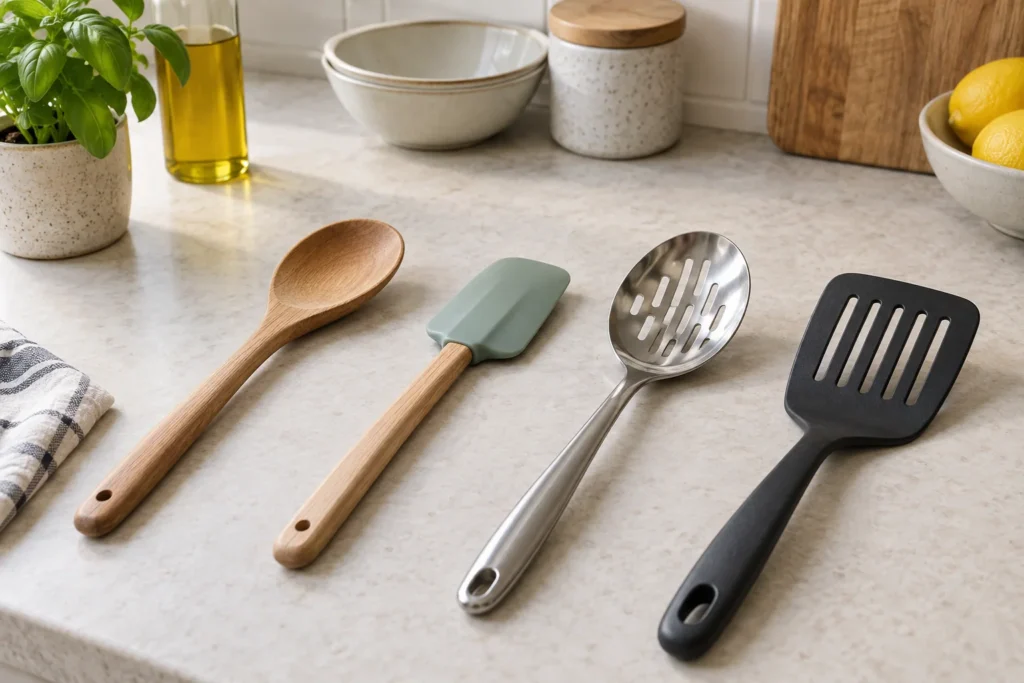
Choose a child's cooking utensil for one supervised task at a time. A tool needs to fit the child's hand, the bowl or food, and the movement they are learning. A bright colour or a “junior chef” label does not tell you whether a long spoon is controllable or whether a whisk fits comfortably in the mixing bowl.
Image: AI-generated editorial illustration of generic equipment; not a photograph of a reviewed product.
Table of Contents
Begin with the activity, not a boxed set
Think of a short, specific contribution: stirring a cool mixture, spreading a soft topping with a suitable blunt tool, or transferring pre-measured ingredients into a bowl. Arrange the activity with an adult present and keep hot equipment and sharp tools under adult control. Follow any age and use restrictions supplied with the product.
The NHS resource Just One Norfolk: family cooking offers a starting point for involving children in family food preparation. The equipment decision is narrower: what object makes this particular step manageable? You do not need to equip a miniature version of an adult kitchen before a child can take part.
Check the relationship between hand and handle
A small handle is not automatically easier. Ask the child to hold a clean display or household tool in the grip they would naturally use, with adult supervision. Notice whether they can keep the head pointing where intended without frequently repositioning their hand. A slippery, very narrow or top-heavy handle may make an otherwise simple task frustrating.
Compare two candidate tools in the same empty bowl. Can the child reach the mixture area without their knuckles hitting the rim? Is there enough handle to hold securely without a long end knocking nearby objects? This is a fit check, not a test with heat or sharp ingredients.
| Task | Detail to examine | Helpful setup question |
|---|---|---|
| Stirring a cool mixture | Spoon size and handle balance | Can the child move it around the bowl deliberately? |
| Scraping a bowl | Flexible head and manageable length | Does the head reach the lower curve? |
| Brushing a cool surface | Head size and comfortable grip | Is there a clear place to rest the brush? |
| Adding prepared ingredients | Scoop or small jug weight | Can it be lifted and put down without reaching across others? |
Make the bowl and workspace cooperate
A suitable utensil cannot compensate for a bowl that slides around. Choose a stable working arrangement on a clear surface at an appropriate height. Have the supervising adult manage the bowl if that is the simplest way to keep the activity controlled. Keep the route between ingredients and bowl short, with no need to reach over a hob or trailing cable.
Prepare small quantities for the step being practised instead of presenting a heavy full container. Put a resting plate and a cloth nearby. These ordinary layout choices reduce the number of things the child has to coordinate while learning a new movement.
Give the tool one clear job
Demonstrate the action slowly, then use a short instruction such as “stir around the bowl”. A child learning to mix does not also need to manage a crowded recipe page, measure every ingredient and decide where to put the spoon. Divide the recipe into manageable contributions and change the task when attention or comfort fades.
Avoid judging a tool solely by how much mixture stays in the bowl on the first attempt. Familiarity, the bowl's shape and the adult's demonstration can all affect the experience. If the child struggles, simplify the setup before assuming a more expensive utensil will solve it.
Choose care and storage the household can follow
Read the washing instructions for the complete tool, including detachable heads or wooden handles. An adult should check that parts are secure and surfaces are sound before reuse. Store children's cooking tools with a clear distinction from toys, particularly if both collections contain similar-looking spoons.
Buy one or two useful pieces for activities the child already enjoys, then add equipment as their tasks develop. Keep a note of what worked: comfortable handle, suitable bowl, short reach, simple clean-up. That record is more helpful than an age-based promise that one set will suit every child or prepare them for every cooking technique.