
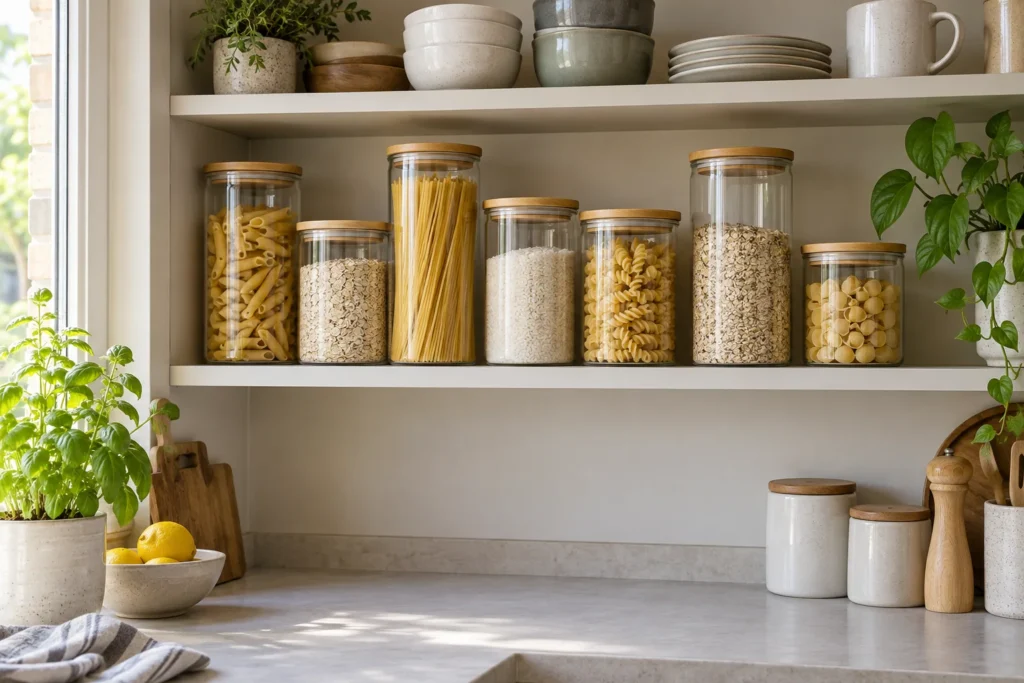
Choosing dry food storage containers is easiest when you start with the packets already in your cupboard. Flour, rice and pasta are sold in familiar pack sizes, but their weights do not tell you directly which litre capacity to buy. Shape, packing and the room needed to get food back out all affect the decision.
Image: AI-generated editorial illustration of generic equipment; not a photograph of a reviewed product.
Table of Contents
Separate the three measurements
Food mass, container volume and external dimensions answer different questions. Mass tells you how much product is in the packet. Volume describes the container’s stated capacity. External dimensions tell you whether it fits on the shelf. Write each in its own column so a promising capacity does not distract you from an unsuitable footprint.
Kilner’s capacity guide offers suggested jar formats for different ingredients, including taller shapes for long foods. Treat such guidance as a starting shortlist. The useful purchase is the format that accommodates your particular food and your way of serving it, rather than one that simply shares a label with it.
Decide what happens at refill time
Consider whether you buy a replacement only when the old packet is finished or keep one in reserve. A container sized for an unopened packet may not have space for that packet plus the remainder already inside. Plan what you will do with the remainder before buying a larger box to solve an occasional overlap.
One practical arrangement is to keep the current supply in the working container and unopened backup packets in a separate, labelled area. Another is to choose a capacity that accommodates the normal refill situation. Neither arrangement removes the need to retain date and storage information or to follow the food’s instructions.
Match the shape to the ingredient
For flour, consider the width needed for your usual scoop and whether you want to level it over a separate bowl. For rice, decide whether you normally pour or scoop. For pasta, look at the actual shape: spaghetti, nests and short tubes do not occupy a container in the same way.
Do not crush or break an ingredient just to satisfy a matching set unless that suits how you intend to cook it. A slightly different container for one awkward ingredient can make the whole cupboard more functional. The visual consistency of a set is an optional preference; access to the contents is the daily requirement.
Make an honest capacity record
Use a container you already know as a reference and record what fits comfortably, without presenting that observation as a universal conversion. Note the exact ingredient and pack you used. If another brand or pasta shape behaves differently later, the record explains why.
| Record | Example of the question it answers |
|---|---|
| Ingredient and usual pack | What am I actually trying to store? |
| Stated container capacity | Which candidate sizes should I compare? |
| Comfortable filling level | Can I still close the lid and use the scoop? |
| Outer dimensions | Will it fit the intended shelf? |
| Refill arrangement | Where does a remaining part-packet go? |
This record is especially helpful if you are replacing one failed container rather than redesigning the entire pantry. It prevents you from buying the same inconvenient shape in a more attractive material.
Keep packaging information with the food
Before discarding a packet, preserve the product name, relevant dates, storage instructions and information anyone in the household needs to identify the contents. A plain label reading “flour” may not distinguish between several types used for different recipes. Avoid a system that depends on one person remembering which unlabelled white powder is which.
Check that the container is intended for food storage and follow its cleaning instructions. Capacity planning does not establish whether a particular closure, material or lid is appropriate for another use such as heating or freezing.
Allocate space to actual turnover
Give frequently used ingredients the easiest positions and make backup stock visible enough to check before shopping. Our kitchen storage guide offers broader cupboard organisation ideas. For dry ingredients, buy the capacity that supports an ordinary refill cycle and a comfortable serving movement, not the largest box the shelf can hold.