
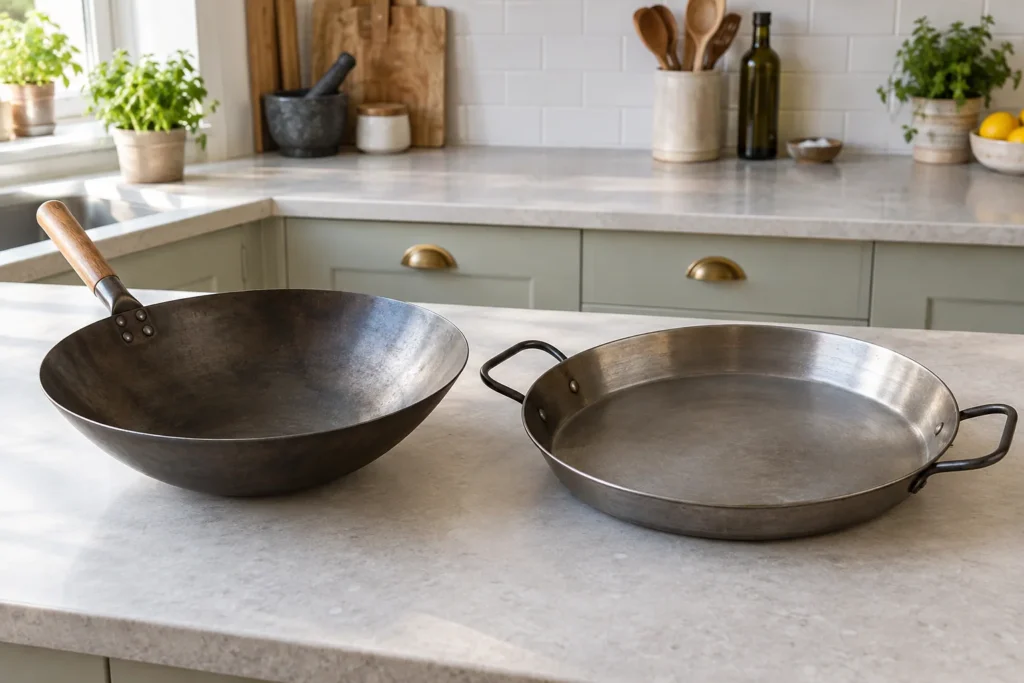
A flat-bottom wok is usually the practical starting point for a flat domestic hob. A round-bottom wok needs a cooking surface and support arrangement that its manufacturer and the hob maker expressly permit. Choose the arrangement that sits securely and heats as intended before choosing a wok for its appearance or reputation.
Image: AI-generated editorial illustration of generic equipment; not a photograph of a reviewed product.
Table of Contents
Separate the bowl from its base
The wide top of a wok describes the cooking bowl, while the underside determines how it meets the hob. These measurements can be very different. School of Wok lists a 14cm flat base for its 12-inch carbon steel wok and describes that model as induction compatible. This is a specific product example, not a promise that every similarly sized wok works on every zone. School of Wok 12-inch carbon steel wok
Ask for a side photograph and a base measurement when shopping online. A photograph from above cannot establish whether the underside is flat, curved or only partly magnetic. Nor does the word traditional tell you how the wok will stand on your cooker.
Match the support to the cooker
On a flat cooking surface, assess whether the intended base rests properly without leaning on the handle. For gas, check the cooker instructions for the permitted pan dimensions and any approved wok support. A ring offered with a wok is not automatically approved for your particular burner or pan stand.
Do not add an improvised support to turn an incompatible purchase into a usable one. The practical alternative is a compatible flat-base model or equipment expressly designed for a round bowl. This avoids making the hob itself part of an experiment.
| Kitchen situation | Information to obtain | Decision it resolves |
|---|---|---|
| Flat induction hob | Magnetic base diameter and zone requirements | Whether the hob can recognise the wok |
| Gas hob | Approved pan support and size guidance | Whether the bowl can sit securely |
| Dedicated wok appliance | Specified bowl shape and compatible cookware | Whether the wok matches its purpose-built surface |
| Small cooker | Overall width and handle projection | Whether neighbouring pans and controls remain accessible |
Think about how you actually stir
Imagine the task with the wok resting on the cooker. Is there enough room to move a spatula around the curved sides? Can the handle be held comfortably without reaching across another cooking zone? A large bowl that leaves little room for the hand may make an ordinary weekday stir-fry unnecessarily awkward.
Tossing is optional. If you normally stir with a utensil, compare stable resting position and access before prioritising a light wok that looks easy to lift. If you do lift the pan during cooking, the loaded weight matters more than its empty shipping weight. Assess handling with a cold, empty item when possible; do not stage a hot lifting test.
Allow for more than the hob
A wok also has to pass through the washing and storage routine. Measure the sink opening and the space needed to turn the bowl without knocking the tap. A long handle may fit across the hob but stop the cupboard door closing.
For a hanging arrangement, check the fixing and hook suitability for the item. If the wok lives on a shelf, check its resting position there too. A round bowl that is supported correctly on the cooker still needs a sensible home after washing.
Material and finish create a separate choice. An uncoated carbon steel wok and a coated wok can share the same shape but need different first-use and care routines. Decide whether those instructions suit you rather than treating shape as a substitute for maintenance information.
Make the purchase decision
Keep four numbers together: rim diameter, flat or magnetic base diameter, overall handle-to-handle length and empty weight. Add the exact hob model beside them. This compact comparison is more useful than comparing only two product photographs labelled flat and round.
Choose a flat-bottom model when it meets the domestic hob requirements and fits your normal cooking movements. Choose a round-bottom model only when you already have, or intentionally plan, an expressly compatible cooking setup. Neither shape alone guarantees a particular flavour or a professional cooking result.