
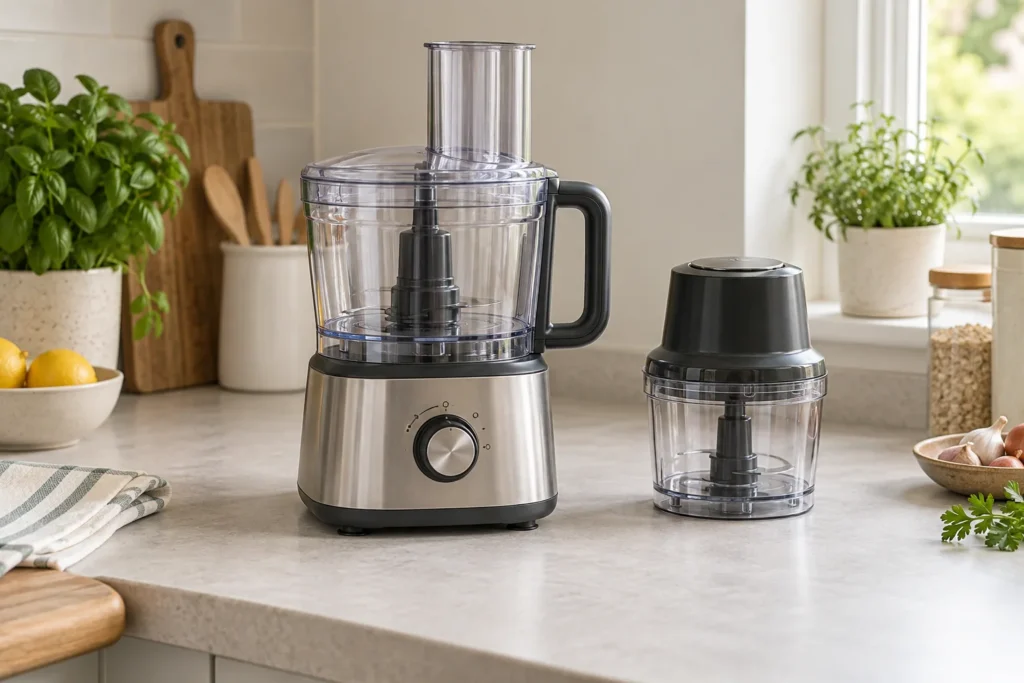
A dough blade is useful only as part of a supported machine-and-recipe combination. Some processors provide a separate tool; others permit particular doughs with a knife blade. Identify the exact instructions before deciding which component to fit or how much flour to add.
Image: AI-generated editorial illustration of generic equipment; not a photograph of a reviewed product.
Table of Contents
Identify the tool by the manual’s name
Plastic construction often makes a dough tool easy to distinguish visually, but appearance is not the deciding evidence. Match the part to the component diagram and the relevant recipe instructions. Do not use a blunt-looking accessory for dough simply because it is not the sharp chopping blade.
The Kenwood MultiPro Compact quick-start guide identifies a separate dough tool among its in-bowl attachments, alongside the chopping knife blade and emulsifying tool. The parts list helps identify the attachment; the complete manual and recipe must still establish the permitted flour or dough load.
Keep flour weight separate from finished dough weight
A recipe’s flour, water and other ingredients contribute to the final load. If a manual gives a flour limit, compare flour with flour. If it gives total dough mass, compare the complete recipe mass. Mixing these measures can make a recipe appear to fit when it does not.
For example, a recipe containing 300g flour and 180g water already weighs 480g before any salt, yeast or oil is added. This is simple addition to clarify the units, not a recommended recipe or a capacity approval. Use the machine’s actual limit and a complete supported method.
| Instruction field | What to write down | Why it matters |
|---|---|---|
| Tool | Exact part specified for the recipe. | Avoids substituting by appearance. |
| Capacity | Number, unit and whether it refers to flour or dough. | Makes the batch comparison meaningful. |
| Control | Permitted speed, programme or pulse method. | A dough preset on another model may work differently. |
| Operating period | Maximum running and required rest instructions. | Battery or motor power does not remove these limits. |
| Recipe endpoint | The stated texture or processing cue. | A timer alone does not describe the dough. |
Use a recipe intended for the processor
A stand-mixer method is not automatically transferable. The tool’s movement and the way the recipe is loaded can differ. Choose a manufacturer method for the relevant processor or another clearly appropriate recipe, and keep its first batch at the stated quantity.
Read the entire sequence before adding liquid. Some methods have a specific order, programme or manual finishing stage. Combining half of one method with a kneading time from another creates an unverified process, even when both recipes use similar ingredients.
Watch the process within the operating limits
Observe the recipe’s stated cues while respecting the machine’s maximum operation. Do not keep running until an imagined perfect ball appears if the permitted period has ended. Stop if the appliance behaves abnormally and use its troubleshooting guidance.
If a supported recipe calls for hand finishing or re-kneading, preserve that step instead of assuming another machine run is equivalent. Read the complete method before deciding that the dough needs more processing.
Think about recurring batch size
If your normal bread recipe exceeds the processor’s documented capacity, dividing it may or may not be convenient. Consider the additional preparation and rest periods, and use a recipe that supports the intended batch arrangement. Do not simply cram a larger dough into an apparently spacious bowl.
A dedicated mixer or a manual method may fit frequent larger bread-making better. Our stand-mixer comparison provides another arrangement to assess when dough is the main reason for buying equipment.
Store the tool with its identity intact
Keep the dough tool with the machine’s model information or original accessory storage. If replacing it, use the official part reference and confirm compatibility. Similar drive openings do not establish a safe fit.
Choose the tool, quantity and recipe together. This avoids both overloading and unnecessary guesswork, without claiming that one blade material produces better bread or that a universal kneading time applies across machines.