
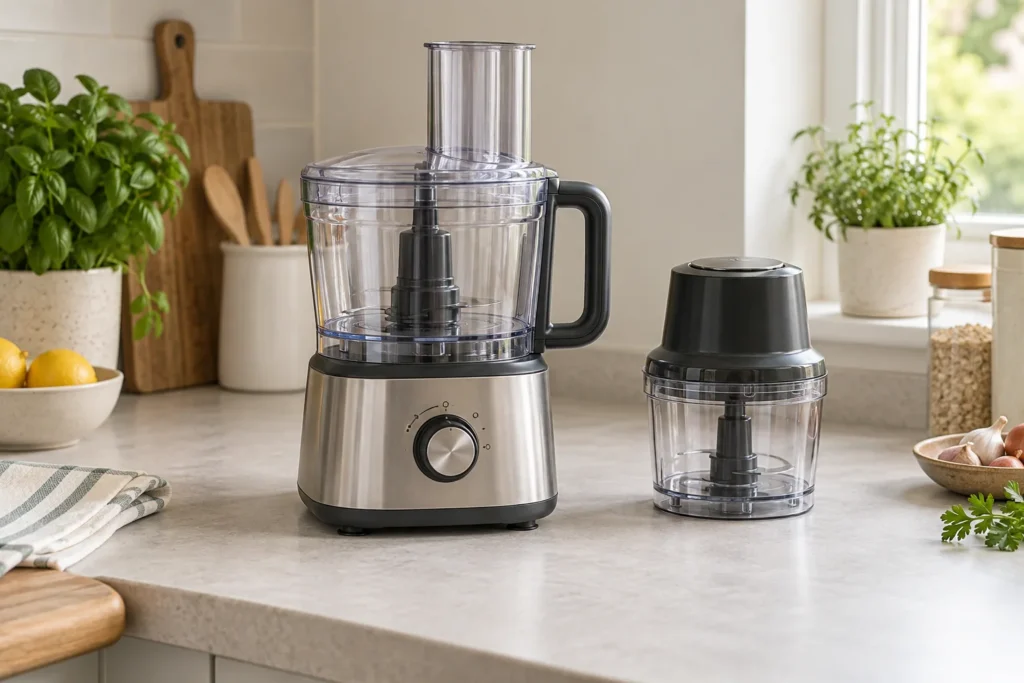
Choose a food processor when the job calls for a supported chopping, slicing or grating tool. Choose a blender when a suitable recipe needs ingredients blended in an approved vessel. The overlap is real, but the target texture and exact attachments matter more than the name on the motor base.
Image: AI-generated editorial illustration of generic equipment; not a photograph of a reviewed product.
Table of Contents
Start with the finished texture
Think about what you want on the plate. Separate vegetable slices, a coarse chopped salsa and a smooth drink are different outcomes. A machine capable of reducing ingredients to small pieces is not necessarily the convenient tool for making every one of them.
A processor’s available discs can provide a defined cutting action, while a chopping blade offers another approach. A blender’s jug and blade system are designed around the mixtures its manufacturer supports. Use those documented functions rather than assuming that a stronger motor turns one into the other.
| Desired result | First equipment to consider | Check before deciding |
|---|---|---|
| Slices or grated vegetables | Processor with the appropriate disc. | The disc is included and supports the ingredient. |
| Coarsely chopped mixture | Processor or suitable chopper. | Batch quantity and controllable stopping. |
| Smooth drink | Blender with an appropriate jug or cup. | Liquid, ingredient and fill restrictions. |
| Smooth soup | A specifically approved blender arrangement. | Hot-liquid permission; cooling may be required. |
| Bread dough | A machine with a documented dough method. | Dough tool, mass limit and operating period. |
Liquid capacity is not the same as bowl volume
A food-processor bowl can look spacious while having a much smaller permitted liquid load. A blender jug also needs working headroom. Keep total volume, working fill and any minimum batch requirement as separate figures on your comparison sheet.
Kenwood’s guide to food processors describes several processing tasks and the use of separate blender attachments. That is a useful reminder that even a versatile system may use different vessels for different textures. One large bowl does not prove that every liquid recipe belongs in it.
Soups require a separate heat check
The word soup on a recipe does not prove permission to blend it hot. Identify the exact jug, lid and blade assembly before adding warm ingredients. A cold-use personal cup should not be treated as a hot-soup vessel because another attachment from the same brand allows heat.
If the recipe or manual requires cooling, include that stage in the meal plan. A hand blender can be another possible arrangement, but its shaft, vessel and temperature permissions also need checking. Choose the supported route first and plan reheating or serving accordingly.
Compare two ordinary meal scenarios
For a week of slaws, sliced vegetables and chopped ingredients, start by assessing the processor’s cutting tools and feed preparation. Count how often you need each disc and whether it is convenient to clean. A smoothie-only blender may leave most of that knife work unchanged.
For someone mainly making drinks, a suitable blender cup or jug may address the central need with fewer unused parts. If the occasional chopping job is modest, a board and knife may remain sufficient. Your appliance choice should respond to frequency as well as capability.
Account for setup and storage
List the components used for one typical job, not just the entire box. A processor can require a bowl, lid, pusher, disc and holder for slicing. A blender uses its own jug or cup assembly. Either can be convenient when it is easy to retrieve, assemble and clean.
If you genuinely need both functions, a combined system is worth comparing with two separate appliances. Check the exact included attachments and remember that a shared base usually serves one task at a time. Storage savings depend on the whole kit, not simply the number of motors.
Make the choice without a universal winner
Pick the appliance that performs your most frequent supported task in the most manageable way. A broad specification cannot guarantee a texture, and this guide does not claim to have tested either type against the other.
The clearest shortlist has a specific sentence beside each candidate: “This handles my weekly vegetable slicing” or “This fits my usual drink batch”. If that sentence depends on an accessory or permission you have not verified, resolve it before purchasing.
When drinks are the recurring job, our smoothie blender guide is a useful next comparison; still check each shortlisted model’s current manual.