
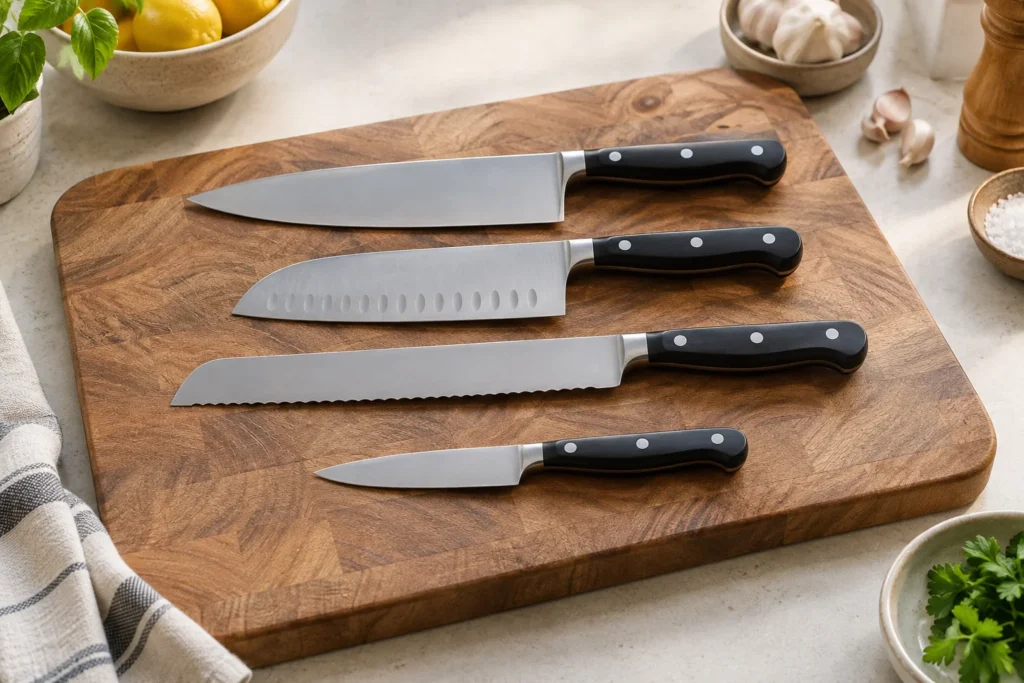
Kitchen knife names are most useful when they connect a shape to a task. A large set can include several blades you rarely use while leaving the everyday knife uncomfortable or awkwardly sized. Start with the jobs you repeat, then identify which knife types are designed to cover them.
Image: AI-generated editorial illustration of generic equipment; not a photograph of a reviewed product.
Table of Contents
Separate general preparation from specialist tasks
List the preparation you do in an ordinary week: vegetables, small trimming jobs, bread, cooked meat or other regular foods. Note which task currently feels poorly served by the knives you own. That gives you a reason to compare a particular type rather than choosing by a retailer’s set size.
WÜSTHOF’s knife-type guide separates chef’s, paring, bread and specialist forms. Its three-knife introduction presents the chef’s knife, paring knife and bread knife as a practical core within its range. Treat that as a starting framework, then adapt the collection to your actual cooking.
Understand the main shape differences
A chef’s knife is a general preparation form with a broad blade. A paring knife is smaller and suited to more compact tasks. A bread knife uses a serrated edge for its intended slicing role. Beyond these, specialist knives may have narrower, longer, more flexible or differently bevelled blades for particular jobs.
Do not infer permission from size alone. A broad vegetable knife is not automatically a cleaver for bones, and a thin slicing blade is not a substitute for a tool designed for a different material. Read the exact manufacturer’s intended uses and exclusions before treating one knife as a universal solution.
Compare the knife with your board
Consider the complete preparation area. A blade may be suitable for a food but inconvenient on a small board or in a crowded working patch. Check actual length and height, not only the type name. The same category can contain noticeably different dimensions.
Handle shape and balance are personal fit questions. Where possible, compare appropriate samples safely in a shop rather than choosing solely from a photograph. A comfortable grip for one person does not establish that a model is the best choice for every household member.
Use a job-to-type shortlist
| Regular need | Type to investigate | What still needs checking |
|---|---|---|
| General board preparation | Chef’s knife or another documented general-purpose form | Size, grip and intended cutting tasks |
| Small precise preparation | Paring or suitable utility knife | Blade dimensions and handling instructions |
| Bread slicing | Bread knife | Length, serration and maintenance route |
| Specialist food task | Maker-specified specialist knife | Technique, exclusions and care |
The table is a shortlist, not a complete instruction on using each blade. A specialist shape may require learning a different technique. Buy it when that learning supports a task you actually perform rather than because the name sounds essential.
Count useful roles within a set
When comparing sets, list every blade and the job it would have. Distinguish knives from extras included in the piece count, such as a block or sharpening accessory. Check whether the storage fits your counter or drawer and whether the included maintenance tool is compatible with the actual blades.
As a practical example, two near-identical utility knives may add less value to your routine than a bread knife of a useful length. Another household may need a specialist slicer frequently enough to justify it. The decision depends on repeated tasks rather than an assumed universal collection.
Try a role audit before adding another knife
Write your current knives down by the jobs they actually perform, rather than by the names printed on the boxes. You might find two medium blades both used for the same chopping task, while neither handles your usual loaf comfortably. That points towards a missing role rather than a need for a larger matching set. Equally, an unfamiliar knife name may describe a shape whose job is already covered. Keep the audit short: current tool, regular task and unresolved difficulty. Use it to decide which shape deserves closer inspection, not as a rule that every household must own the same collection.
Build a collection you can maintain
Our knife-set guide offers wider purchase context. Choose types that cover distinct jobs, then check washing, storage and sharpening instructions for each. A smaller collection with clear roles is easier to assess than a crowded block bought mainly for its headline piece count.