
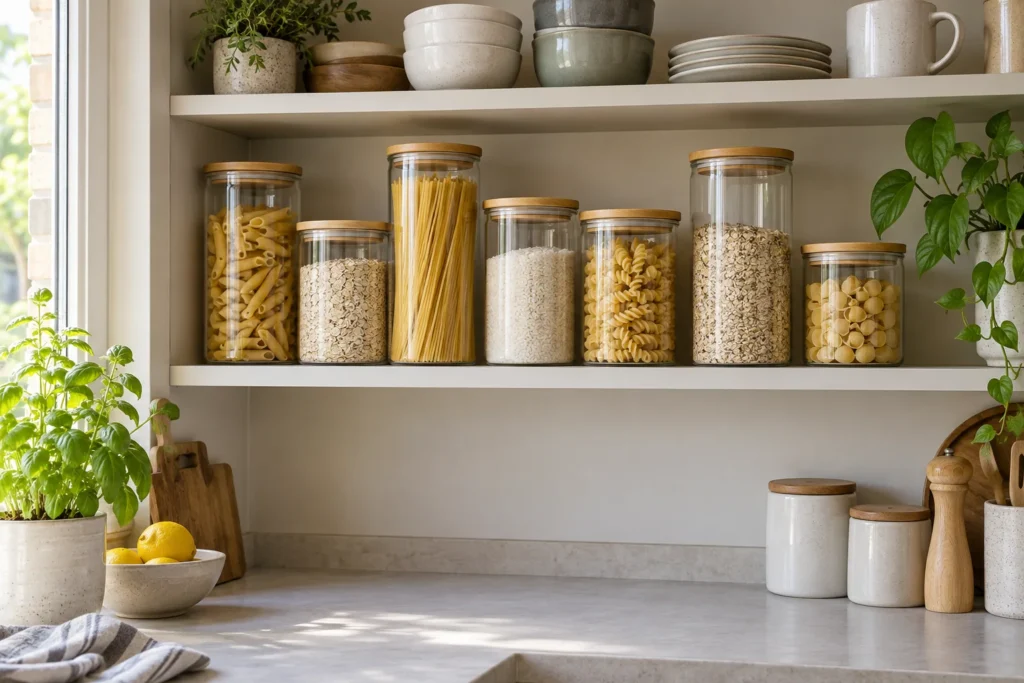
Food storage jars can make a pantry easier to use, but a matching row is not the same thing as a working arrangement. The right jar lets you refill it, remove the amount you need and read its label without rearranging the shelf. Begin with those movements before choosing a style of glass or lid.
Image: AI-generated editorial illustration of generic equipment; not a photograph of a reviewed product.
Table of Contents
Match the opening to the way you serve the food
Think about what passes through the mouth of the jar. Pouring rice, lifting a tea bag and scooping flour require different access. If you use a measuring scoop, measure its widest part, including any lip that must enter the opening. A generous body with a narrow neck may hold plenty of food while making the ordinary serving task frustrating.
Take account of your hand position too. A lid may be easy to remove on an empty worktop but awkward behind another jar. The relevant question is whether you can operate it where the jar will actually live. For a clip-top design, allow room for the clip and hinged lid to move; for a screw lid, consider how you will stabilise the body while turning it.
Use capacity guides as a shortlist
Kilner’s jar-size guide groups its jars by suggested household contents and capacity. Such examples help identify a starting shape, but they cannot tell you how much of your particular pasta, flour or cereal will fit without checking the product and ingredient involved.
Keep mass and volume separate. A bag sold by weight does not translate directly into a jar capacity in litres. Also leave practical space for accessing the food rather than planning to fill the jar to the absolute rim. If you regularly buy a particular pack, choose around that pack and your refill routine rather than a vague “large pantry jar” label.
Measure the lid as part of the footprint
Record external height, body width and any projecting hinge or handle. Then measure the shelf opening, including its front edge and door hardware. A jar that fits at the back may still be difficult to bring past a hinge or shelf lip.
Make a simple paper layout of the shelf and mark the jars as circles or rectangles. Leave room to grasp the ones you use most. Squaring every container tightly against its neighbour can create an impressive photograph while making the back row inaccessible. It may be better to keep fewer jars on that shelf and use another area for unopened packets.
Understand what the closure claim means
Look for the maker’s instructions on closing, carrying and cleaning. OXO’s POP container guidance, for example, says the lid button is not a handle for carrying the whole container. That detail shows why an apparent handhold should not be treated as a carrying feature without checking.
A pantry seal is not permission to use a jar for preserving, freezing or transporting liquids. Those are separate uses that need their own instructions. Choose a jar for the actual pantry task and keep preserving methods outside this purchase decision unless the manufacturer explicitly supports them.
Put information where you can see it
Keep the food’s identity, date information and any instructions available after decanting. Decide whether the original label will be retained with the jar or recorded in another reliable way. Position your own identifier where it is visible in the actual cupboard: a front label suits eye-level storage, while a clearly marked lid may be easier to read in a drawer.
| Pantry task | Useful jar check |
|---|---|
| Daily scooping | Opening accepts the scoop and leaves hand clearance |
| Long dry ingredients | Usable internal height suits their shape |
| Frequent refilling | Lid and seal are straightforward to clean as instructed |
| Back-row storage | Label and grip remain accessible |
Trial the layout with a few jars
Choose a small number for the ingredients you reach for most. Keep them in use long enough to discover whether the problem is opening width, shelf depth or refill capacity. Our kitchen storage guide helps with the wider cupboard plan; a pantry jar should earn its place by making a specific ingredient easier to use.