
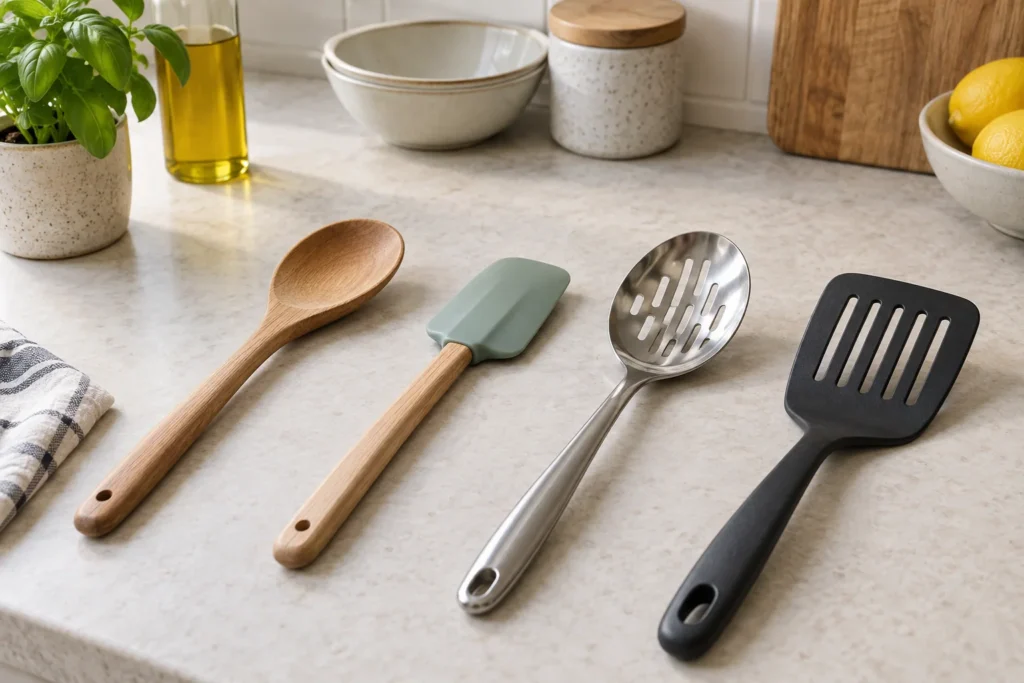
A useful wooden kitchen utensil needs the right shape, a sound surface and care instructions you are willing to follow. The wood species is one part of that decision. A beautifully patterned spoon can still be too large for your saucepan, uncomfortable to hold or inconvenient to wash after every meal.
Image: AI-generated editorial illustration of generic equipment; not a photograph of a reviewed product.
Table of Contents
Choose the working shape first
Start with the movement: stirring around a saucepan, scraping along its bottom, folding a mixture or serving at the table. A round spoon bowl and a broad flat scraper solve different problems. Examine the transition between the bowl and the handle, because that changes how far you can reach into a vessel without your hand meeting its rim.
Use your current favourite tool as a reference. Record its total length, head width and any detail you dislike. If its head is too deep to scrape neatly, a shallower spoon may be worth considering. If it is difficult to lift from a crowded utensil jar, a smaller head or different storage position may solve the problem without changing material.
Ask what the wood and finish actually are
A clear listing identifies the wood and explains the finish. “Natural” alone does not tell you whether an item is unfinished, oiled or coated. It also does not establish that a decorative piece is intended for cooking. Choose a utensil sold for the food preparation task you have in mind, with an identifiable maker and instructions.
Compare these purchase questions rather than treating a species name as a quality ranking:
| Detail | Useful question |
|---|---|
| Surface finish | What finish is supplied, and how should it be maintained? |
| Construction | Is it a single piece, or are there joined components? |
| Intended use | Is the tool for cooking, serving or decoration? |
| Care | Does the maker specify a particular conditioner or cleaning method? |
Different woods can have different appearances, but a photograph cannot tell you the comfort of the handle or the smoothness of the edge. Those are better assessed on the delivered item or an authorised display sample.
Inspect the parts that meet food and hands
Look closely at the spoon bowl, the thin leading edge and the handle end. Check for cracks, splinters, loose joints or a rough area that catches a cloth. Natural colour variation is different from a damaged working surface. If you are uncertain about a mark on a new item, send the maker a photograph before using or altering it.
Pay attention to asymmetry. An angled scraper may be designed around a particular hand or stirring direction. Hold it in your usual cooking grip and imagine reaching the near and far corners of your pan. Avoid buying an uncomfortable shape because the grain is attractive or because several pieces match.
Follow the maker's care routine
OXO UK care questions says its wooden tools are hand-wash only and specifies food-grade mineral oil when conditioning is needed. This is an example of actionable manufacturer advice, not a treatment schedule for every wooden spoon. Follow the instructions for your own utensil and finish; do not assume a bottle intended for furniture or machinery is appropriate.
Think through the routine before buying a large set. Where will washed tools dry? Will another household member put them in the dishwasher by habit? A small collection with a clear home is easier to care for consistently than a drawer containing unidentified woods and finishes.
Decide whether to maintain or replace
Distinguish an ordinary care need from damage. If the maker describes the surface as ready for conditioning, use its method. A split, a loose component or a persistent rough patch needs a different decision; ask the maker whether repair is suitable rather than treating every defect with oil.
Keep one everyday stirring tool and add another shape only when a task calls for it. A useful purchase note might read: “flat-ended wooden spoon, comfortable in my left hand, fits the small saucepan, hand-wash routine understood.” That is a clearer basis for shopping than buying a large mixed-wood set and working out its purpose afterwards.