
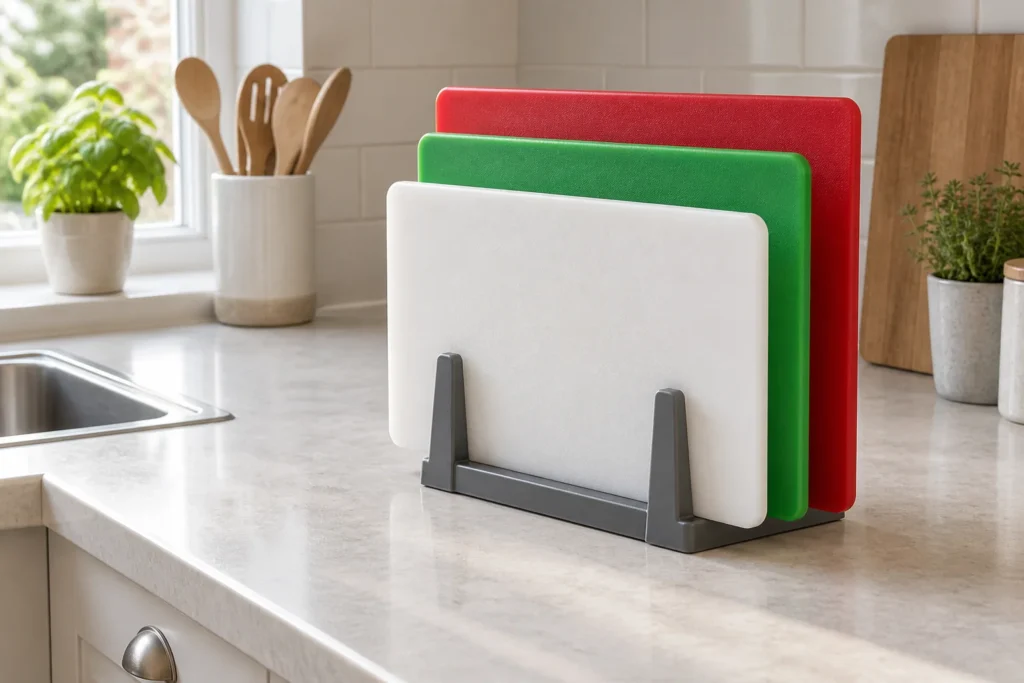
Good chopping board storage begins after washing. A rack that holds several boards neatly is only useful if the boards can reach it clean and dry, fit without force and come out without moving everything else. Plan the route from sink to drying position to permanent storage before choosing a holder.
Image: AI-generated editorial illustration of generic equipment; not a photograph of a reviewed product.
Table of Contents
Inventory the boards you actually use
Measure each board’s height, width and thickness, including handles, feet and raised rims. A slim board may occupy little shelf space but have a handle that catches beneath the shelf above. A thick wooden board can require a wider slot than a rack’s promotional photograph suggests.
Group boards by frequency of use. The everyday board deserves easy access; an occasional serving board can occupy a less convenient position. Keep this exercise separate from deciding which foods use which board. A storage system should preserve your existing food-preparation separation rather than making the boards difficult to identify.
Give drying its own space
Board maker John Boos advises storing its boards on edge with air circulation and out of direct sunlight in its care FAQ. Follow the instructions for your own board, especially where its material or fittings differ. A closed cupboard is not a substitute for completing the drying routine.
Look at where water goes from a freshly washed board. It should not drip into a knife drawer, onto stored food or into a rack base that is difficult to clean. If the drying location and storage location are different, make that transition simple enough to happen routinely.
Match the holder to the whole board
Check slot width and depth, the support height and the size of the base. A short holder may physically accept a tall board while leaving much of its weight high above the support. Ask for the manufacturer’s size and loading guidance rather than judging stability from the slot count.
If using an existing cupboard divider, confirm that it is suitable for the board’s weight and dimensions. Pan-lid racks, file holders and plate organisers are not automatically interchangeable. Choose a purpose and loading arrangement the product actually supports.
Measure the removal path
A board needs space to leave its slot as well as space to stand inside it. Hold a cardboard outline where the board would live and move it through the proposed removal path. Check shelf lips, door hinges and adjacent handles. This is particularly useful inside a narrow base cupboard.
For a drawer, measure the closed internal height and consider any handle standing above the board surface. For a wall position, establish the approved fixings and wall suitability before buying. Do not use an unverified hook merely because the board has a hole.
| Location | Useful check |
|---|---|
| Worktop rack | Base footprint, support height and room to lift boards |
| Cupboard slots | Door opening, shelf clearance and visible board identification |
| Drawer | Internal height and protected separation from loose knives |
| Wall storage | Permitted board hanging method and suitable fixings |
Keep the rack itself accessible
Remove the boards periodically so the holder can be inspected and cleaned according to its instructions. Check corners, feet and the underside rather than treating an attractive rack as permanently clean. Avoid storing loose utensils between boards, where they can obstruct removal or contact the cutting surfaces.
Test the planned arrangement with the board you use most. You should be able to identify it and remove it without disturbing a stack of unrelated items. If you cannot, reducing the number stored in that location may be more useful than buying a larger holder.
Our chopping-board guide helps with the board itself. Storage works best when it supports that choice: enough space for its real dimensions, a suitable drying position and a straightforward route back to the preparation surface.