
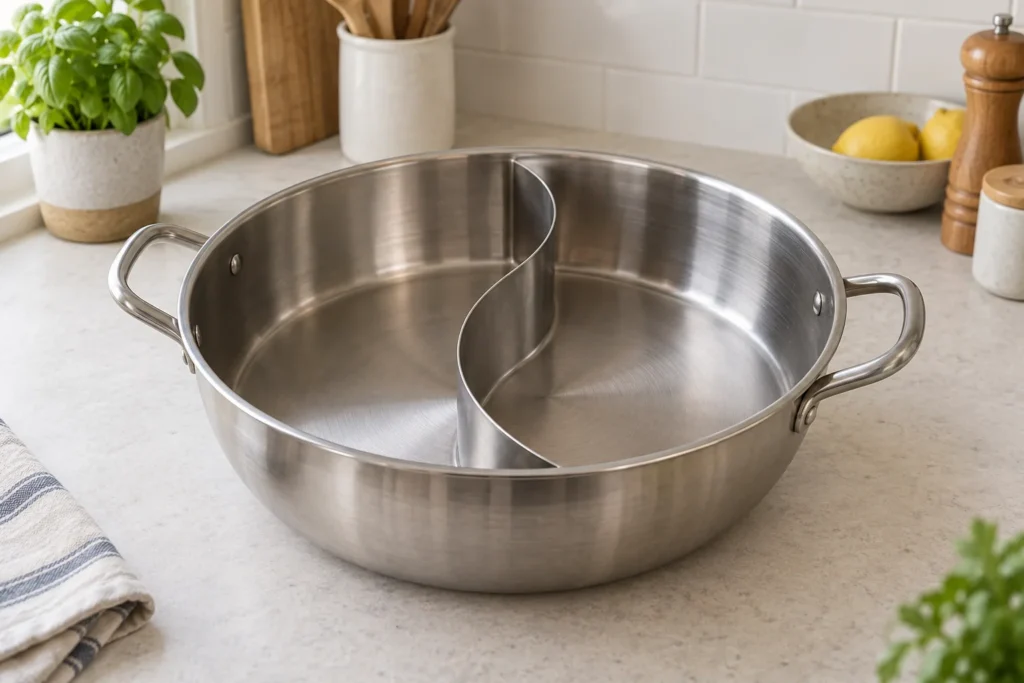
Choose hot pot cookware by the amount you need in each compartment and the heating equipment you will use. A divided pot can hold two broths, but its total capacity does not tell you how much working space each side provides. Check the base, handles and serving arrangement before deciding that the largest pot is the most useful one.
Image: AI-generated editorial illustration of generic equipment; not a photograph of a reviewed product.
Table of Contents
Decide whether a divider serves your meal
A single compartment keeps the vessel simple; a divided form can accommodate different broths in one body. Steelite Creations hot-pot designs shows both designs and describes heating arrangements for its own products. That is an example of the choices available, not permission to place any divided pot on any portable burner.
Think about how the two sides will be used. If one broth is for one person and the other for several, equally sized compartments may not match the meal. A curved partition also changes access for a ladle or strainer. Examine the shape rather than dividing the advertised capacity by two and assuming the result is a usable serving allowance.
Treat capacity as a working-space question
Ask whether the stated volume is a maximum brimful capacity or a recommended working amount. Food, liquid movement and the recipe's loading instructions need room within that vessel. Follow the product's fill guidance rather than filling to an attractive line in a photograph.
| Detail | What to check |
|---|---|
| Total capacity | Basis of the stated measurement |
| Each compartment | Usable dimensions and any separate fill instructions |
| Divider | Fixed or removable, with approved assembly and cleaning |
| Lid | Fit over the complete pot and safe handling arrangement |
| Serving tools | Access into both sides without awkward reaching |
If no compartment dimensions are supplied, ask for them. They are more useful to your decision than a broad claim about how many guests the pot can serve.
Match the heating equipment precisely
Read the pot's permitted heat sources and the burner's pan-size and load guidance. Check actual base diameter, not just the rim. A wide pan can project over controls or require more clearance than the dining table provides. Follow the appliance instructions for positioning and ventilation.
Use only equipment intended for the location and cooking method. This article does not recommend adapting outdoor fuel appliances for indoor use or combining unrelated stands and burners. If the proposed setup is not documented by the relevant makers, choose a supported arrangement.
Plan access around the table
Measure the footprint with handles and any heating base included. Allow space for bowls, raw ingredients, cooked food and utensils without requiring people to reach across a hot vessel. Keep cables and other obstacles out of the serving route according to the appliance instructions.
Decide who manages the cooking steps and how food is transferred. Follow a suitable recipe and current food-safety guidance for the ingredients; this cookware guide does not supply cooking times for meat or seafood. A divided pot is a piece of equipment, not a method for determining whether food is cooked.
Do not use a divider as an allergy guarantee
The Food Standards Agency: allergen cross-contamination guidance explains that shared utensils and handling can transfer allergens. A physical divider intended for different broths should not be assumed to provide allergy-safe separation. Plan food-allergy requirements independently, with appropriate ingredient and preparation controls, rather than relying on the pot's partition.
Even when the distinction is simply flavour preference, give each side suitable serving tools and think about splashes or drips during use. The design can help organise a meal, but it cannot control how everyone handles food at the table.
Include cleaning and storage
Inspect the divider-to-base junction, rim and handle fixings. Check how the maker expects those areas to be cleaned and whether any component is intended to detach. Confirm the pot fits your sink and storage space as well as the cooking position.
Choose a size you can lift and wash comfortably when used as directed. Keep the pot and heating-equipment instructions together. A successful purchase is a documented, manageable setup with useful compartment space and clear serving access, rather than a large vessel chosen only for its capacity or dramatic appearance.