
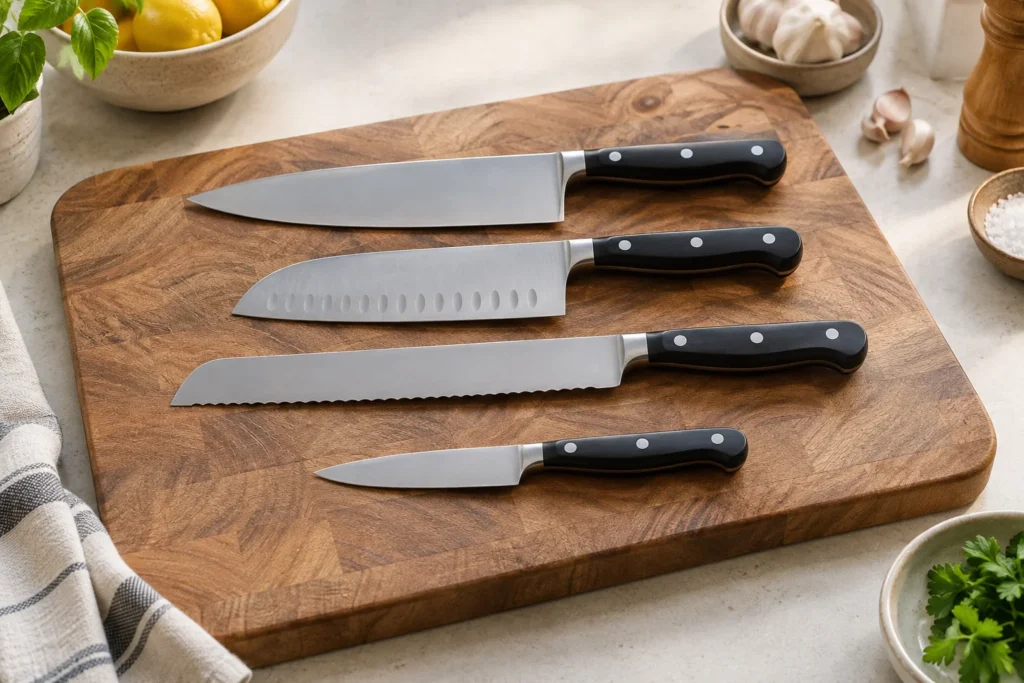
Kitchen knife sharpening is a compatibility decision before it is a technique. The blade material, edge shape and manufacturer’s instructions determine which tools and methods are appropriate. Start with the exact knife rather than buying a sharpener because it appears simple or claims to work on everything.
Image: AI-generated editorial illustration of generic equipment; not a photograph of a reviewed product.
Table of Contents
Identify the blade you want to maintain
Record the brand, model, material and whether the edge is straight or serrated. Check the bevel description and any handedness information. If those details are unclear, ask the maker or an appropriate sharpening specialist before removing material from the edge.
Separate ordinary edge maintenance from a damaged tip, chip or other visible defect. The latter may need an assessment or repair beyond the intended role of a household sharpening accessory. Do not assume more passes through a tool will resolve every blade problem.
Check the knife maker’s permitted methods
KAI’s care guidance says sharpening steels are unsuitable for its hard knives and offers other sharpening systems. That demonstrates why a familiar tool should not be applied to every blade without checking its instructions.
Use the exact knife guidance together with the sharpening tool’s compatibility list. A tool may be designed for particular bevels, edge types or materials. If the two sets of instructions do not clearly agree, obtain clarification before using the combination.
Compare the maintenance routes
A whetstone requires the correct preparation, stable support and a technique suited to the blade. A guided manual sharpener constrains part of the movement but still has specific compatibility and use instructions. An electric system adds its own stages and restrictions. A professional service can be appropriate where the owner does not want to perform the work.
Do not treat convenience as proof of suitability. A short operating sequence is useful only if it is intended for the actual knife. Likewise, a more elaborate stone setup is not automatically better for an owner who cannot reliably follow the required method.
Keep angles and stages model-specific
Do not choose a universal sharpening angle from a general article and apply it across your collection. Obtain the relevant instructions for the knife and tool. Record the units and whether an angle refers to one side or another aspect of the setup, rather than relying on an unexplained number.
Follow the maker’s sequence, pressure guidance and condition checks. Avoid improvised sharpness tests on fingers or fingernails. Use only an appropriate check described by a reliable instruction source and within your ability to perform safely.
Assess a professional service clearly
| Question | Why ask it? |
|---|---|
| Do you handle this blade type? | Specialist materials and bevels may need particular expertise |
| Is repair needed? | Visible damage may be separate from routine sharpening |
| What will be changed? | Understand the proposed work before authorising it |
| How should it be delivered? | Follow the service’s safe packaging and handover instructions |
For an illustrative household decision, someone with one familiar general-purpose knife may prefer a supported home method, while another owner with several specialist edges may prefer a service. Neither choice needs to be justified by invented testing or claims of professional skill.
Compare a service with buying equipment
For a knife you use occasionally, compare the complete sharpening arrangement rather than only the price of a stone or service. A home method may require compatible equipment, a suitable workspace, practice and time for cleaning afterwards. A service requires identifying what it will do, how the knife reaches it and whether it accepts that blade. Write down the steps you are prepared to manage in each route. This will not tell you which method creates a better edge, but it can reveal which ownership routine is realistic. A sharpening tool left unused because its instructions are unclear does not solve a recurring maintenance problem.
Plan storage and care after sharpening
Follow the knife’s cleaning and storage instructions and keep its edge protected in an appropriate system. Our knife-set guide covers broader collection choices. Choose sharpening equipment only after the actual blade, method and ongoing care routine are understood.