
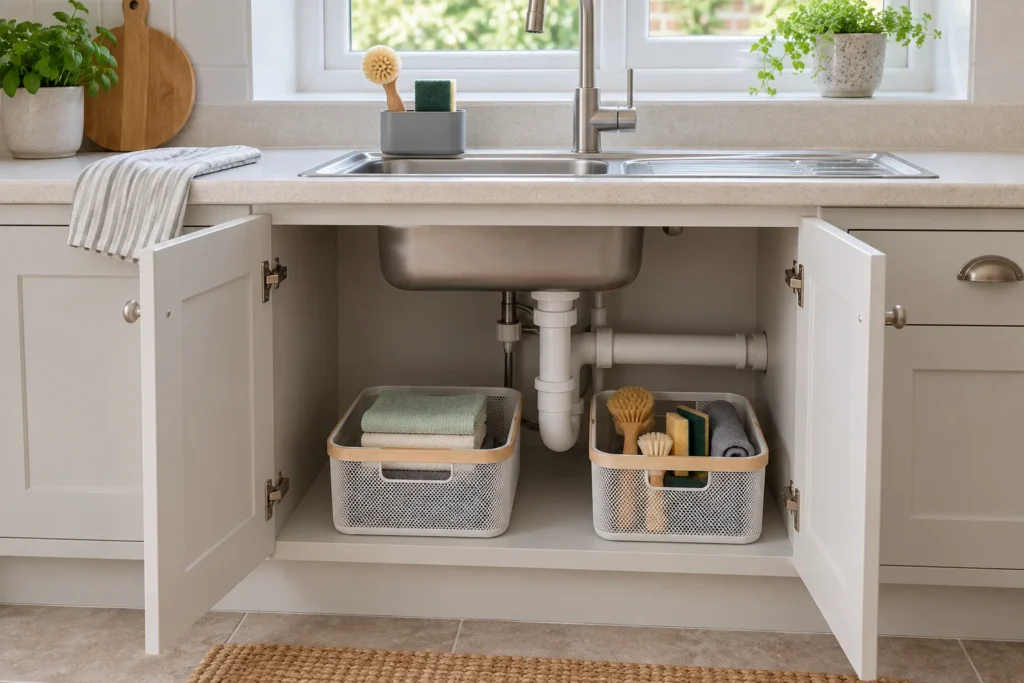
A kitchen sink caddy should give brushes, cloths and washing-up supplies a clear home without taking over the space needed for washing. Its drainage arrangement matters as much as the number of compartments. Start by listing what you actually keep beside the sink, then check how the caddy handles those items after use.
Image: AI-generated editorial illustration of generic equipment; not a photograph of a reviewed product.
Table of Contents
Measure the everyday collection
Use the washing-up bottle, brush and sponge you normally buy as references. Record their footprints and heights rather than estimating from an empty product photograph. A tall brush may fit a narrow compartment but require extra clearance beneath a cupboard or beside a tap.
Decide which items need to remain at the sink and which can be stored elsewhere. A caddy sized for several spare bottles may consume useful washing space simply to keep backup supplies on display. Choose around the working collection first.
Follow the drainage route
Look at where water leaves the brush or sponge and where it ends up. Some designs drain towards the sink; others collect it in a reservoir or tray. Establish how that part is accessed and emptied, rather than assuming holes in the top mean water disappears from the product.
Joseph Joseph’s large Caddy sink tidy uses a concealed reservoir and is described as dismantling for cleaning. The relevant feature to compare is access to the collected water and removable parts.
Check the position against normal sink use
Place a paper outline of the caddy beside the sink. Check tap movement, access to controls and the space needed to turn your usual washing-up items. Include the caddy’s complete footprint, including rails, projecting feet or handles.
If the design mounts inside the sink, check the exact surface and fitting requirements. A suction or adhesive attachment has its own instructions; do not assume it will work on every curved, textured or coated surface. Keep the sink manufacturer’s care guidance in the decision too.
Examine cloth and brush support
A rail may provide a place to hang a cloth, but its useful width depends on the cloth you use and the clearance around it. A brush compartment should allow the brush to be removed without catching neighbouring bottles. Consider the arrangement with the items present, not only the empty caddy.
Check that the base remains stable in the intended position under the maker’s instructions. Do not balance a narrow caddy partly on a sink rim simply because its body almost fits the available space.
Make cleaning access visible
| Feature | What to establish |
|---|---|
| Reservoir or tray | How it is removed, emptied and cleaned |
| Brush compartment | Whether the base and corners can be reached |
| Cloth rail | Usable width and clearance |
| Attachment | Surface compatibility and removal instructions |
Follow the caddy’s own washing instructions and check whether different parts have different permissions. Keep the cleaning routine simple enough that the underside and reservoir are not forgotten merely because they are hidden from view.
Compare the largest bottle you routinely buy with the bottle compartment, then check the brush beside it. If replacing either everyday item with a special smaller version is necessary to make the caddy work, include that inconvenience in the decision. Also consider the moment you remove the brush: does the handle catch a cloth on the rail, or does the bottle have to move first? A paper footprint and the actual clean tools can answer these layout questions without pretending to test the drainage performance of a product you do not own.
Buy the footprint your sink can spare
Our kitchen sink guide covers wider sink choices. For a caddy, prioritise the space left for washing, a clear drainage route and parts you can reach. A smaller organiser that handles the daily brush and bottle well may be more useful than a large unit filled with seldom-used supplies.