
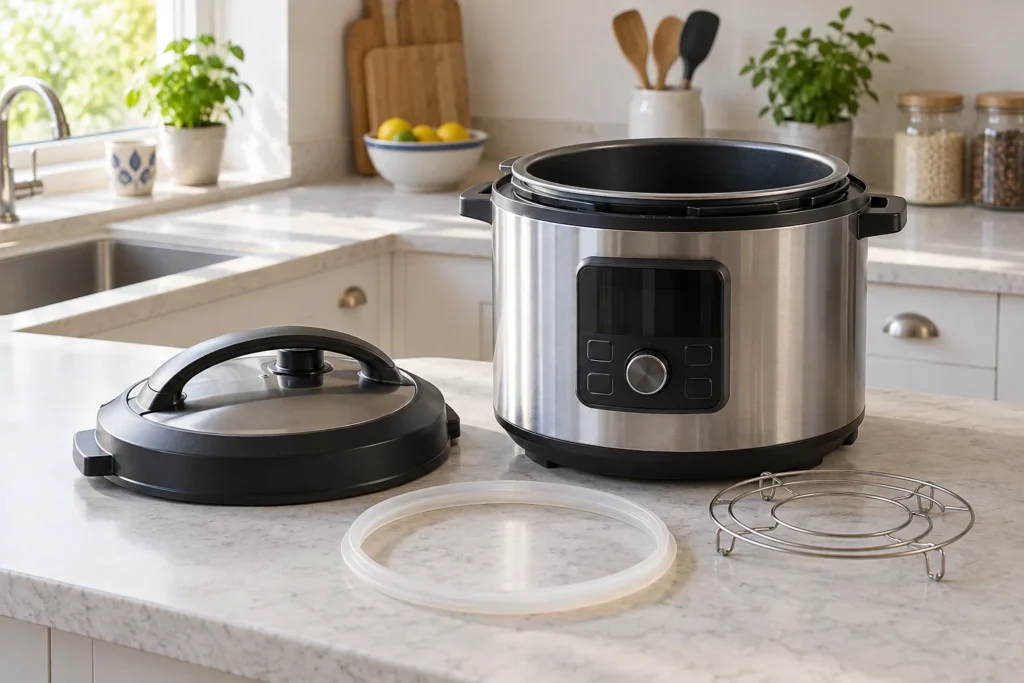
Pressure cooker capacity is not the amount of food you may load to the rim. The maximum for pressure cooking leaves space above the contents, and foods that expand or foam can require a lower limit. Read the actual inner-pot markings and the manual for the dish before measuring a batch.
Image: AI-generated editorial illustration of generic equipment; not a photograph of a reviewed product.
Table of Contents
Identify the correct maximum
The Instant Pot Duo UK manual uses a PC MAX two-thirds line and a lower half-full line for foods that foam, froth or expand. Its examples include rice, beans and pasta. These markings apply to that cooker; your own model’s instructions are the authority.
A pot may show several measurement scales, such as litres and rice-cup levels. Those are not automatically pressure-cooking maximums. Read the words beside the line and check the manual’s diagram while the pot is clean and empty. If a marking is hard to see, do not guess it from a photograph of a different size.
Count food and liquid together
The fill limit applies to the contents, so liquid added after vegetables or meat still takes up space. You cannot fill to a permitted line with ingredients and then add the required stock above it. Measure the assembled recipe with the cooker off and use a smaller batch if necessary.
Consider ingredients before and after preparation. A whole cabbage, chopped leaves and cooked cabbage occupy different volumes. A recipe’s stated ingredient weight may be easier to reproduce than a loosely filled bowl, but neither overrides the final permitted level. Do not press ingredients down hard simply to claim they fit.
Keep the minimum liquid separate
Instant Pot’s Duo guidance also specifies minimum liquid by cooker size. A minimum needed to generate steam is a different rule from the maximum total load. Meeting one does not satisfy the other. Check what type of liquid qualifies in the exact instructions; a dense sauce is not automatically equivalent to water.
When scaling a recipe down, avoid scaling the cooker’s minimum liquid below its required amount. When scaling up, check the permitted level again after the full liquid addition. This is why halving or doubling every recipe ingredient without reference to the cooker can cause problems.
| Figure or marking | What it tells you | What it does not tell you |
|---|---|---|
| Nominal litres | Approximate pot size for comparing models. | A pressure-safe amount to cook. |
| Pressure maximum | Upper contents limit for permitted ordinary loads. | Permission to fill foaming foods to the same level. |
| Lower expansion line | A stricter limit for specified foods. | A finished serving count. |
| Minimum liquid | The steam-generating requirement for that model. | The total water needed by every recipe. |
Translate your normal meal into a batch
Start with a suitable published recipe and the number of portions you genuinely need. If you usually cook two portions plus two lunches, use that as the target rather than an appliance claim about feeding a family. Check both the ingredient quantity and the intended finished serving.
A second meal cooked on another day may be more useful than a very large cooker used at its lower end most evenings. On the other hand, a regular large batch should not depend on exceeding a fill line or compressing ingredients. Compare the permitted recipe size across models, then consider washing, storage and lifting.
Allow for accessories inside the pot
A rack, basket or approved inner dish changes the space available. Use a recipe written for that arrangement and follow the maker’s clearance rules. Do not assume the same volume fits because the food is now above the water rather than sitting in it.
Inspect the space under the lid and around the pressure components using the manual’s assembly diagram. An accessory that prevents the lid closing normally or obstructs the steam path is unsuitable. Never force the lid down onto a stack of containers.
Make the markings part of preparation
Before each pressure recipe, identify its food category, minimum liquid and applicable fill line. Measure and load with the inner pot correctly prepared, then check the level again. Keep the manual nearby until the routine is familiar. The goal is a repeatable safe batch, not the largest possible amount that can be squeezed into the pot.