
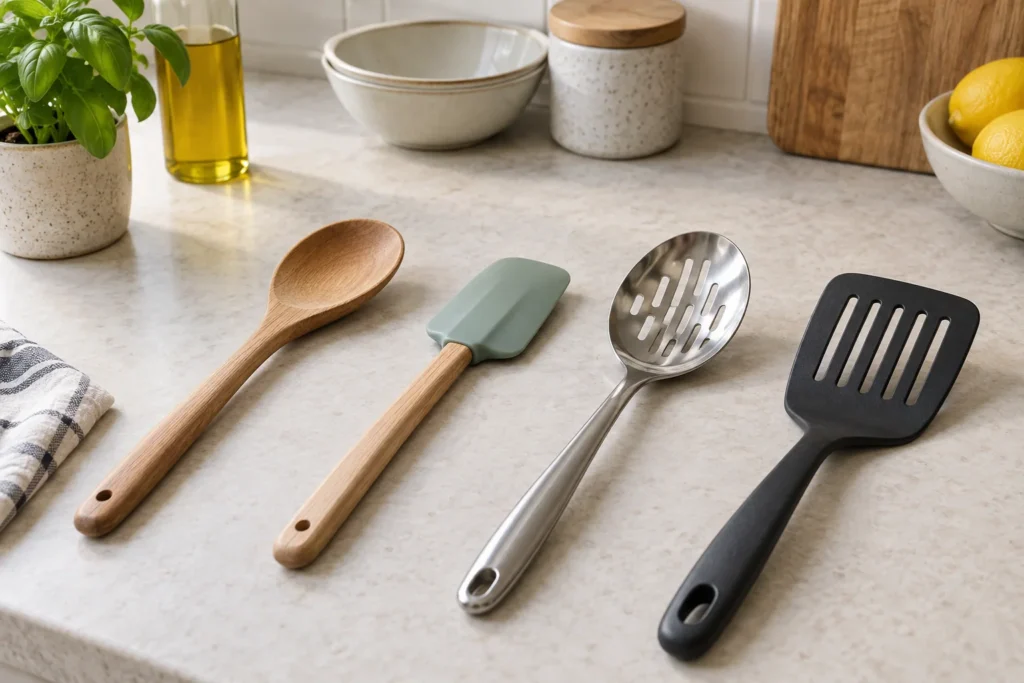
A left-handed kitchen utensil is useful when its shape or controls solve a problem that appears in your normal left-handed movement. Many spoons and whisks are broadly symmetrical; some angled scrapers, pouring tools and mechanisms are not. Inspect the working geometry before assuming every item needs a separate left-handed version.
Image: AI-generated editorial illustration of generic equipment; not a photograph of a reviewed product.
Table of Contents
Separate symmetry from the label
Hold the tool in your usual hand and look at its working face. Does it have an angled edge that lies correctly against the vessel? Does the bowl or spout favour pouring in one direction? Are any controls easy to reach without changing grip? These questions are more useful than a general “suitable for everyone” statement.
A symmetrical head can still have an uncomfortable handle, and a comfortable handle can still point an asymmetric edge the wrong way. Assess both parts together. Product photographs from the front may not show the detail that determines handedness, so look for a top view and a view of the underside.
Know when a dedicated shape is real
Earlywood handed wok spatula offers left- and right-handed versions of an asymmetric wok spatula. That is a concrete example of the working head changing with handedness. It does not mean every wooden spatula needs two versions, or that one manufacturer's geometry will fit every wok and cooking style.
| Feature | Left-handed check |
|---|---|
| Angled scraping edge | Does the edge meet the pan during your natural movement? |
| Curved scoop | Can you lift and transfer without turning the tool awkwardly? |
| Pouring lip | Is there a useful outlet on the side you use? |
| Lock or release | Can you operate it while maintaining a comfortable grip? |
| Shaped handle | Does the contour fit your left hand as intended? |
Use this as an inspection list, not a shopping list. You may find that most of your existing tools already work well and only one specialised shape needs changing.
Try the movement in a cool vessel
With an authorised display item or a suitable tool at home, use an empty, cool bowl or pan to assess fit. Move from the near side to the far side and imagine the intended stirring or scraping action. Notice whether you repeatedly rotate your wrist or reposition the handle to bring the edge into contact.
Compare with your current tool in the same vessel. That controls one important variable: an awkward pan shape can make either version feel wrong. Do not introduce heat or a heavy load merely to test whether a new handle is comfortable.
Check pouring and serving separately
Some tasks depend on which side of the tool faces the receiving dish. When comparing a ladle or small pouring utensil, imagine the complete path from pan to bowl. Check whether the useful edge or lip is on the side you naturally use and whether the handle clears the vessel.
A tool with more than one pouring option may work for different household cooks, but verify the actual design. Do not infer a second spout from a photograph that shows only one side. Ask for an additional view if the feature matters to your purchase.
Read mechanisms before buying a set
A locking ring, release button or shaped grip may be easy for one person and awkward for another. Check how the mechanism is intended to operate and whether you can do so without an uncomfortable change of hand position. Avoid modifying or reversing parts unless the maker explicitly describes that adjustment.
This article concerns cooking and serving utensils. Cutting blades and manual openers need their own design and safety assessment; do not assume that turning an asymmetric cutting tool over makes it a suitable left-handed substitute.
Replace the specific obstacle
Write down the problem you want to solve: “angled wooden scraper misses the near corner when held in my left hand” is a useful specification. “Need a left-handed kitchen set” is much less precise. Look for a tool whose design addresses the former, then check materials, cookware compatibility and care in the ordinary way.
Keep well-functioning symmetrical tools. A small number of carefully chosen handed designs can sit alongside them without requiring a whole new collection. The useful outcome is a natural, controllable movement in your own kitchen, not a particular label on every handle.