
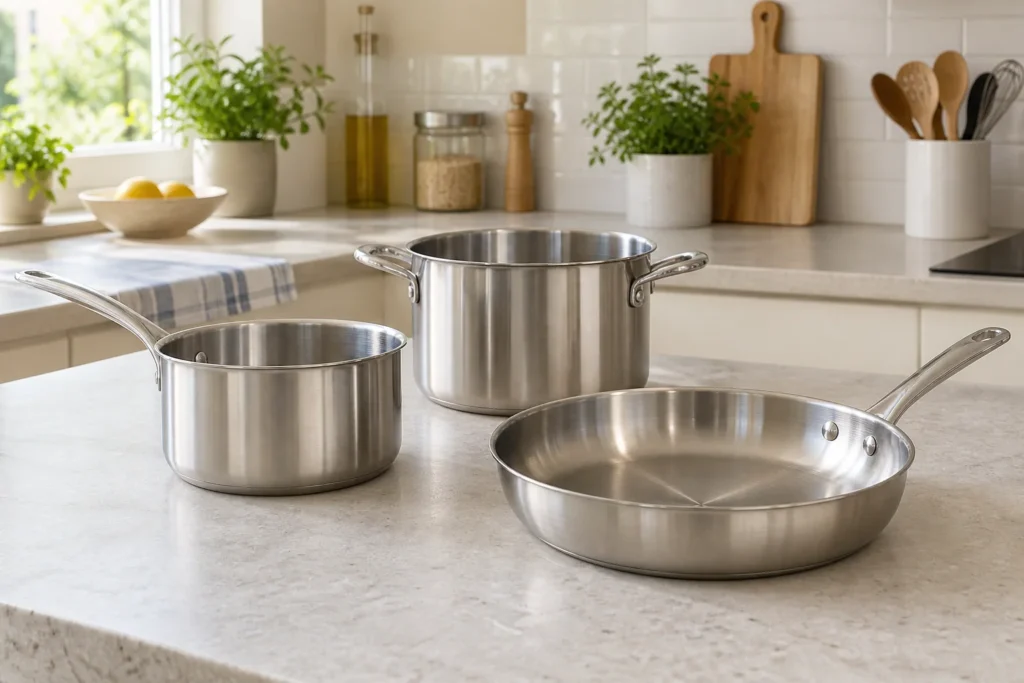
Choose a replacement pan handle by the exact pan model and the manufacturer's approved part, not by appearance alone. A grip cover, a detachable handle and a structural handle fixed to the pan are different components. Establish which one has failed before ordering anything or attempting to fit a substitute.
Image: AI-generated editorial illustration of generic equipment; not a photograph of a reviewed product.
Table of Contents
Stop using an uncertain handle
If a handle is loose, cracked or no longer attaches as intended, set the pan aside while you identify the problem. Do not test it with a full hot load. A new grip covering cannot correct a damaged metal attachment, and a screw that happens to fit a hole does not prove that the complete assembly is sound.
Let the pan cool and inspect it without dismantling parts that are not intended for user removal. Photograph the whole pan, the handle, the underside and any markings. Those images make a manufacturer's compatibility assessment more useful than a description such as “medium black saucepan handle”.
Identify the component correctly
Netherton Foundry replacement components lists handle covers and lid knobs separately among its replacement components. That illustrates why the name of the required part matters. A cover changes the gripping surface; a structural connection supports the cookware. They should not be treated as interchangeable repairs.
| Component | Information to collect |
|---|---|
| Grip cover | Pan model and the approved covering or fixing kit |
| Detachable handle | Exact compatible range and attachment instructions |
| Fixed structural handle | Maker's repair or service route |
| Lid knob | Lid model, fixing and complete heat limit |
| Riveted or bonded connection | Whether manufacturer service is required |
Keep washers, spacers or other supplied parts identified if the maker directs a user replacement. Do not discard apparently minor pieces before understanding their role in the approved assembly.
Find the model rather than guessing dimensions
Check the base stamp, old receipt, packaging or original product page. Record range, size and product code. A manufacturer may change a fixing during a range's life, so a familiar model name without a version or photograph may not settle compatibility.
Use measurements only as supporting information requested by the supplier. Hole spacing, thread size and handle length can help identify a part, but matching one measurement is not proof that the replacement has the correct strength, clearance or heat resistance.
Ask a precise compatibility question
A useful enquiry states: “I have this model and size; this component is damaged; is this exact replacement part approved, and can it be fitted by the user?” Attach the photographs and ask for fitting instructions and any required hardware.
If no approved part is available, ask whether a repair service exists. Do not improvise with glue, a furniture handle or an unrelated clamp. The cost comparison should be between an appropriate repair and suitable replacement cookware, not between a safe assembly and the cheapest object that appears to fit.
Check the heat limits again
A replacement component can have restrictions that matter to the complete pan. Confirm hob, oven and grill permissions after the approved repair, including any instruction to remove a detachable handle before oven use. Do not retain an old temperature assumption without checking the new part's documentation.
A lid knob deserves the same attention. Replacing a damaged knob with a similar-looking one does not automatically preserve the lid's original oven rating. Ask for the complete assembly's permitted use rather than a material rating for the knob alone.
Follow the supplied fitting and inspection process
Use the manufacturer's instructions for the exact part. This guide does not provide universal tightening forces, substitute fasteners or a method for removing rivets. If the procedure is unclear or the attachment area is damaged, stop and use the maker's service route.
After an approved replacement, carry out only the checks described by the maker and keep the part details with the pan record. Do not use a heavy load as an improvised strength test. Resolve any movement or misalignment before returning the pan to cooking use.
A successful handle replacement restores a documented assembly with clear instructions. Identifying the part carefully can preserve useful cookware, but a visual match alone is not enough. Keep the repair specific to the pan, component and permitted use.