
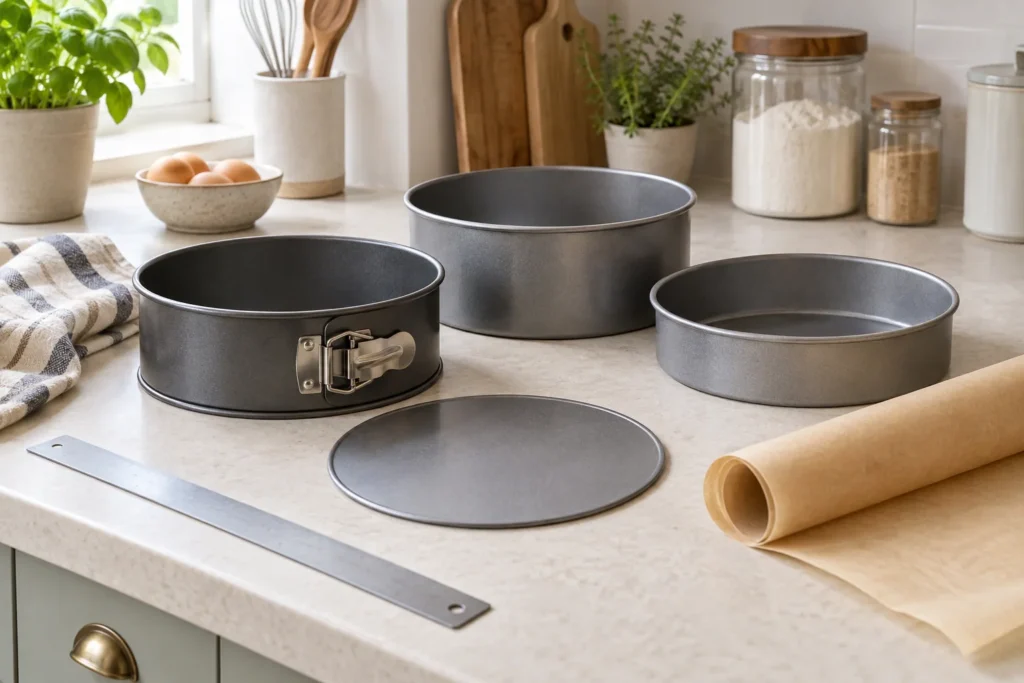
For a layer cake, choose sandwich tins as a matched working set. Check internal diameter, depth, construction and release design together. Two products labelled 20cm may still differ in height, wall shape or overall footprint, so the size on the front of the packaging is not the whole comparison.
Image: AI-generated editorial illustration of generic equipment; not a photograph of a reviewed product.
Table of Contents
Begin with the number of layers
Read how many tins the recipe specifies and whether those tins are used together. A two-layer recipe written for two tins should not be treated as a one-tin recipe simply because a deeper tin appears able to hold the mixture. The mixing, baking and cooling sequence belongs to the recipe's tested arrangement.
Write down the final assembly as well. If you intend to make two separate two-layer cakes, count four baked layers before deciding how many tins you need. Whether that means repeated batches or multiple tins in the oven depends on the recipe and appliance guidance, not just the number of tins available to buy.
Compare the tins side by side
Measure the usable interior and check whether the sides slope. Inspect the base arrangement, rim and any handle projection. A Tala Performance 20cm sandwich pan is an example of a sandwich tin with a loose base, but that feature is not a requirement for every recipe. Choose the release method specified by, or suitable for, the cake you intend to make.
| Detail to match | Why it belongs on the comparison |
|---|---|
| Internal diameter | It defines the width of each layer |
| Internal depth | It must suit the written recipe and quantity |
| Body and surface | It avoids unknowingly mixing different constructions |
| Base mechanism | It keeps the release routine consistent |
| External footprint | It determines the space needed on the shelf |
Buying two of the same model makes this comparison simpler, but still check the delivered items. Product ranges can change, and a tin purchased years ago may not match a new one sharing a similar name. Keep any old product reference rather than guessing from colour and diameter.
Plan equal allocation deliberately
Follow the recipe's instructions for dividing the mixture. If it calls for equal portions, a kitchen scale can help you compare quantities while allowing for the different empty weights of the tins. Weighing the filled tins without accounting for their tare weights would compare metal as well as mixture.
For an illustrative calculation, 900g of mixture divided equally among three matching tins gives 300g per tin. That example explains allocation only; it does not state that those tins should hold that quantity or that a particular recipe yields 900g. The recipe's prescribed tin and batch size must establish suitability first.
Check oven and cooling space for the set
Lay the empty tins on a cool shelf or measure their footprints against the usable shelf area. Include the space and positioning the oven instructions require. Do not assume that tins fitting physically edge-to-edge are an approved baking arrangement. If they do not fit as intended, choose a recipe with an appropriate batch sequence.
Set aside cooling space for every layer. Two cakes emerging from their tins need more room than two tins nested in a cupboard. Plan where the empty bases and rings will go during release so they do not occupy the same space you need for the cakes.
Store the matching pieces together
Follow the tin maker's cleaning instructions, then return each loose base to its own ring. If the tins are easily confused with other sizes, keep a small inventory note in the cupboard rather than marking food-contact surfaces with an unsuitable pen or label.
Record the recipe that uses the set and any observations from your own bake. If one layer differs, note which tin and oven position it occupied before blaming the whole recipe. A matched pair removes one avoidable uncertainty; it does not guarantee identical results or replace the publisher's method. Choose the set that makes the intended number of layers straightforward to prepare, handle and repeat.