
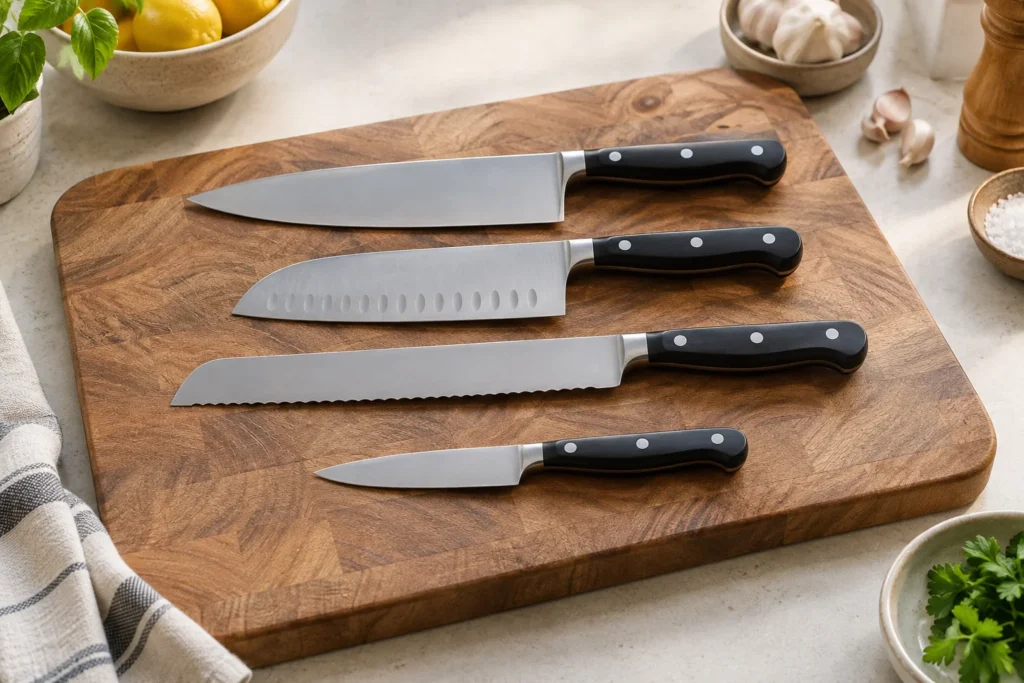
A serrated kitchen knife should be chosen around the food it is designed to slice. Tooth patterns, blade lengths and handle positions vary, so the word serrated does not identify one interchangeable tool. Begin with the task, then compare the usable blade and the space needed to work with it.
Image: AI-generated editorial illustration of generic equipment; not a photograph of a reviewed product.
Table of Contents
Define the main slicing job
Bread is an obvious starting point, but the size and shape of the loaves you buy still matter. A small roll, a wide round loaf and a long sandwich loaf present different dimensions. Measure a typical example so you can compare blade lengths with something concrete.
WÜSTHOF describes the serrated edge of its 20 cm Classic bread knife for its bread-slicing task. The model name and specification establish an intended use and length; they do not prove how every serrated blade will perform or make it suitable for unrelated hard materials.
Compare blade length with the food and board
Look for blade length separately from the total knife length. The handle takes up storage and working space but does not increase the portion of the edge available for slicing. Check whether the blade shape leaves enough clearance for your preferred grip above the board.
Use a paper outline to compare the overall knife length with your board and drawer. This is a space-planning exercise, not a cutting test. Include the area around the food rather than assuming that a knife fits the task because the blade and loaf have similar measurements.
Read the tooth description without ranking by appearance
Product photographs may show fine teeth, larger scallops or a double-serrated pattern. Read how the maker describes the design and intended task. Counting teeth in a photograph does not establish sharpness, durability or cutting quality, and an attractive close-up is not a comparative test.
If a retailer uses a vague description, check the manufacturer’s page for the precise model. Avoid transferring claims from another length or series just because the handles look alike. Where possible, compare the actual shape in a suitable retail setting without attempting an improvised demonstration.
Check maintenance before purchasing
Serrated edges need a supported maintenance method. Do not assume that the pull-through sharpener or whetstone used for a straight-edge knife is compatible. Look for explicit instructions covering the model’s serration and a suitable professional service if you do not intend to maintain it yourself.
Consider replacement support and storage as part of the ownership cost, without relying on an advertised lifetime claim as evidence that no maintenance will be needed. A guard or slot should fit the blade’s actual width and length and protect it from contact with other utensils.
| Detail | Useful comparison |
|---|---|
| Intended task | Whether the maker specifies the food you prepare |
| Blade length | Fit with typical food dimensions and board space |
| Handle position | Clearance and handling preference |
| Tooth pattern | Documented design, without unsupported performance rankings |
| Maintenance route | Compatible sharpening or service options |
Measure the food that causes difficulty
Take a common slicing problem, such as a loaf that is awkward with your current knife, and note the food’s widest section, the board’s usable area and the room for the intended movement. Compare those measurements with the candidate blade rather than selecting a longer knife automatically. A blade can be longer than the food while still being inconvenient on a crowded board. Also consider where the sliced pieces will collect. The decision is about the complete slicing setup, with the tooth pattern remaining a separate specification to check.
Choose a useful addition to the collection
Take stock of any serrated knives already in the kitchen. If one covers the same task, identify the precise reason for replacing or supplementing it: insufficient length, unsuitable handling or a maintenance problem. Several near-identical blades can add storage and cleaning without solving another need.
Our knife-set guide covers the broader collection. For a serrated knife, the strongest shortlist is built from intended task, actual dimensions and a workable care route. Keep any performance claims tied to evidence for the specific knife rather than the presence of teeth alone.