
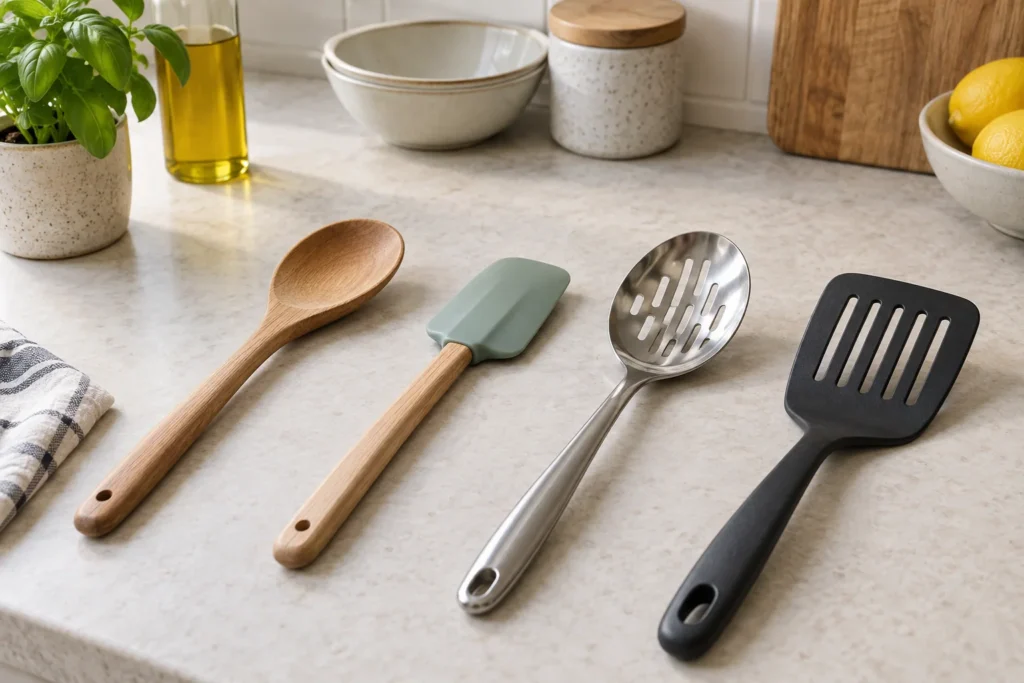
Build a baking utensil kit around a few recipes you want to repeat. Cakes, bread and pastry share some tools, but they do not need identical collections. Start with the measuring, mixing and scraping actions in your chosen recipes, then add shaping or finishing tools only when those methods require them.
Image: AI-generated editorial illustration of generic equipment; not a photograph of a reviewed product.
Table of Contents
Choose your first three projects
Write down three realistic bakes and read each recipe from start to finish. Include the equipment list and the instructions for transferring, shaping and finishing. A recipe may need a scraper after mixing or a brush near the end even when neither appears prominently in the opening description.
Separate utensils from larger equipment. Bowls, tins, scales and an oven need their own checks; this article focuses on the hand tools that work with them. Keep existing suitable tools on the list so a new hobby does not become an excuse to duplicate every spoon and whisk in the kitchen.
Cover mixing and scraping first
A cooking spoon, manual whisk and flexible bowl scraper cover different movements. Follow the recipe's requirements rather than assuming they are interchangeable. Check the head against the bowl: it needs to reach the mixture without an awkward grip or a handle that strikes the rim.
| Recipe action | Tool to assess | Fit question |
|---|---|---|
| Stir or combine | Suitable spoon or recipe-specified whisk | Can it move comfortably through the working area? |
| Clear a mixing bowl | Flexible scraper | Does its edge follow the lower curve? |
| Divide or move dough | Appropriate dough or bench scraper | Is it intended for the work surface and task? |
| Spread a topping | Spreading or offset spatula | Is the blade manageable across the bake? |
| Apply a wash or coating | Pastry brush | Does the head suit the area being covered? |
This is a task map, not a promise that every recipe can be made with five tools. Some methods specify an appliance or a specialised implement; check before substituting.
Add tools according to the baking branch
For cakes, bowl access and transferring mixture are often early priorities. If decorating becomes part of your routine, compare a spreading spatula with the size of the cake you usually make. There is little reason to buy a large professional-looking blade for a small occasional project unless it solves a clear handling problem.
For bread, a flexible bowl scraper and a tool intended to divide or handle dough may serve different roles. For pastry, a rolling pin and suitable work surface can become central, while brushes and cutters depend on the recipe. Buy those additions when you have a method in mind and know the required size.
Distinguish tool design from claimed results
King Arthur Baking: its baking-tool designs describes its own offset spatulas, brushes and dough or batter whisks. The useful lesson for shopping is that these are separate working shapes. The manufacturer's development story does not mean you need the complete range or that a particular purchase will guarantee a successful bake.
A tool can make a movement more convenient, but ingredients, method and equipment all matter. Keep recipe notes so you can distinguish an awkward transfer from a mixing or baking issue. That prevents replacing utensils in response to a problem they were never intended to solve.
Check cleaning before assembling a set
Look at handle materials, detachable heads and sealed joints. Read the care instructions for each item, especially when a matching collection combines wood, silicone and metal. A shared colour does not imply a shared washing method.
Think about drying and storage too. Whisk wires can snag on neighbouring tools, a wide scraper may not fit a narrow divider, and a long rolling pin needs an appropriate space. Store frequently used pieces where they can be removed without unpacking the entire drawer.
Review the kit after several bakes
Record specific inconveniences: a scraper could not reach the jug, the spreading blade felt too long, or the dough-handling tool was difficult to grip. Those observations create a useful specification for the next purchase. Avoid replacing a complete kit when one shape is the only problem.
A sensible starter collection grows with the recipes you enjoy. Keep a few dependable tools, add a purposeful specialist when needed and retain the care information. This gives you a baking kit organised around actual practice, with fewer unused accessories and clearer reasons for every item you own.