
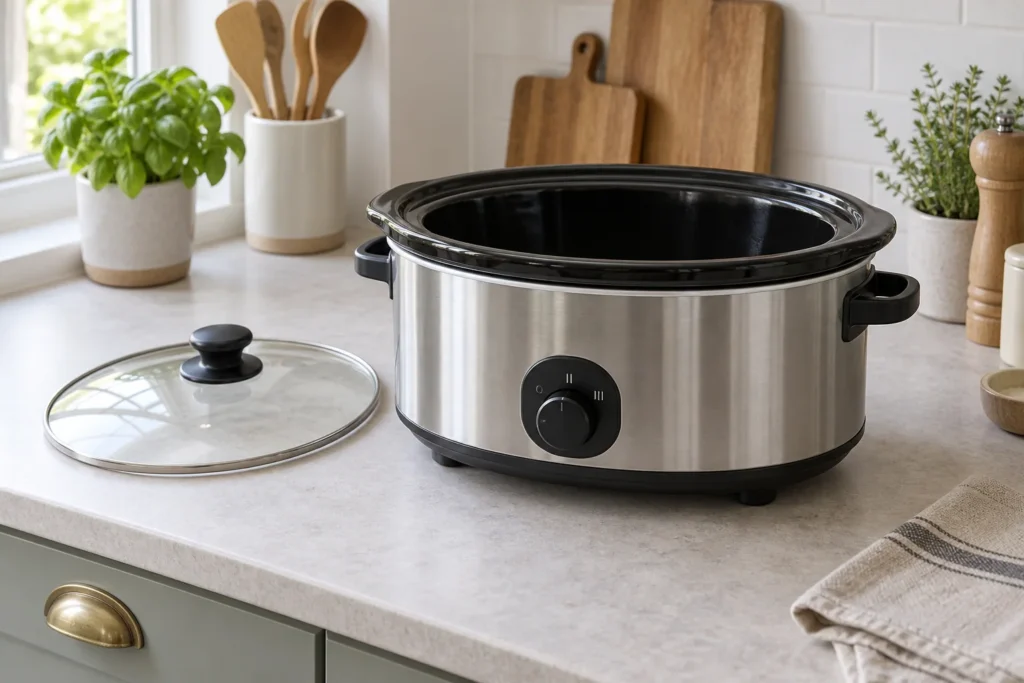
A slow cooker and a casserole dish can both support one-pot meals, but they organise the cooking day differently. A slow cooker is a dedicated electrical appliance. A casserole relies on a compatible hob or oven. Compare the complete routine, including preparation and finishing, before deciding which deserves space in your kitchen.
Image: AI-generated editorial illustration of generic equipment; not a photograph of a reviewed product.
Table of Contents
Start with how you want to manage the meal
Think about when you can prepare ingredients, whether you will be present during cooking and which finishing steps you enjoy. Some meals suit a long planned cooking period; others benefit from adjustments made while you are already in the kitchen. The equipment should support that pattern rather than force every recipe into the same schedule.
Use a method written for the equipment you choose. A familiar casserole recipe is a useful starting point for understanding the flavours and quantities you like, but its time, liquid and oven setting cannot simply be copied onto a slow-cooker dial.
| Part of the routine | Slow cooker question | Casserole question |
|---|---|---|
| Heat source | Does the appliance provide every required programme? | Is the vessel approved for your hob or oven? |
| Browning | Separate pan, hob-safe insert or integrated sauté? | Can browning happen in this exact dish on your hob? |
| Finishing | How does the recipe specify sauce or topping adjustments? | Which hob, oven or grill permissions apply? |
| Serving | Will food be served from the insert or transferred? | Can you handle the loaded dish comfortably? |
| Storage | Where will the base, insert and lid live? | Where will the pot and lid fit? |
Dumpling timing is a concrete example of why the cooking method matters. Our guide to dumplings in a slow cooker keeps the timing tied to documented recipes instead of transferring an oven instruction directly to a slow cooker.
Check the whole vessel’s permissions
For a casserole, the body, handles and lid can affect how it is used. Read the maker’s instructions rather than assuming every component shares the same heat permission. Le Creuset’s UK care-and-use guidance separates advice by material and product type, illustrating why the word casserole is not a sufficient specification.
The equivalent check for a slow cooker is the removable insert. Being removable does not make it hob-safe or oven-safe. If the recipe needs a heat source the insert does not support, plan a suitable second vessel before beginning.
Count the actual components you will wash
One-pot cooking does not always mean one item to wash. Preparation boards, browning pans, serving dishes and lids can be involved with either approach. List what your normal recipe really uses. The comparison may look different for a recipe that starts with seared ingredients and one that is assembled directly.
Also consider sink and dishwasher space. A casserole can be heavy and awkward, while a slow cooker has an electrical base that must be cleaned separately from its insert. Assess those parts in the context of your own worktop and washing-up arrangement.
Compare costs without inventing a saving
Purchase cost is only one part of the decision, but operating cost cannot be inferred from a wattage label alone. Cooking duration, heating behaviour and your energy tariff all matter. A claim that one method is always cheaper needs a defined recipe and a valid measurement or calculation for that arrangement.
For a useful personal comparison, record the actual equipment and complete method you would use for the same meal. If you measure energy, keep the conditions comparable and label the result as your observation. Do not generalise one reading into a promise for every cooker, oven or recipe.
Choose the method that fits the recurring job
If you already own a suitable casserole and enjoy cooking while nearby, another appliance may not remove much work. If a dedicated slow-cooking routine fits your week and the recipes you repeat, a slow cooker can be a coherent addition. Neither choice needs a claim that it is universally healthier or produces superior flavour.
Try planning three ordinary meals with each arrangement on paper. Note preparation, cooking, finishing, serving and cleaning. The gaps reveal what extra equipment or attention is needed. Choose according to those recurring steps, and keep recipes specific to the method rather than forcing a direct conversion.