
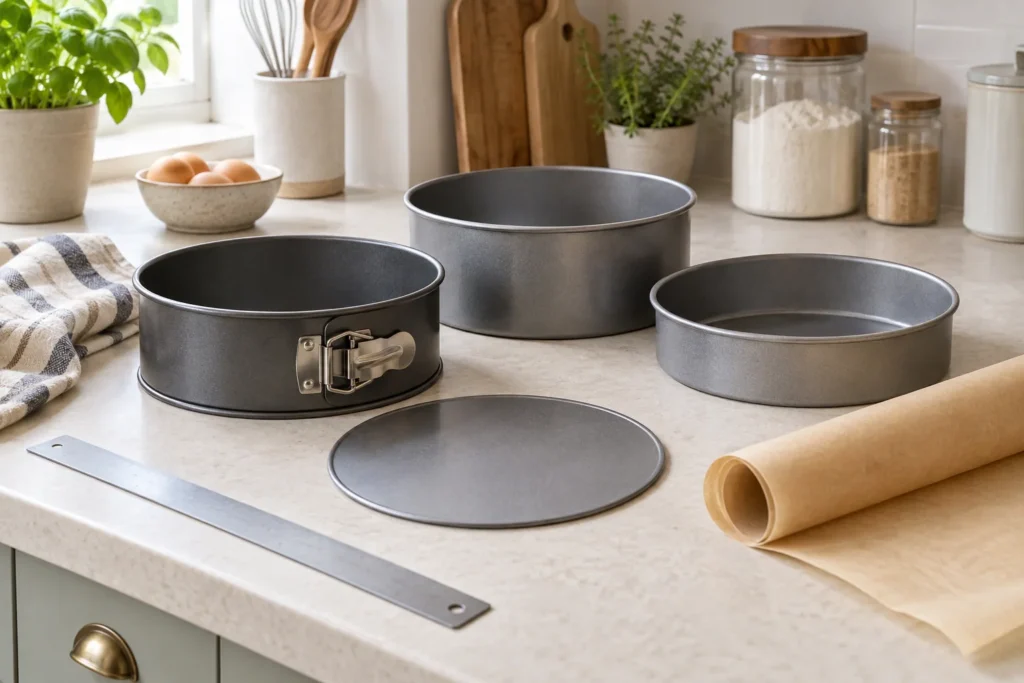
Choose between a springform and a loose-bottom cake tin by considering how you need to remove the sides. A springform ring opens outwards when its clip is released. A conventional loose-bottom tin has a separate base but its surrounding wall stays the same size. That difference matters more than whether either product is described as easy release.
Image: AI-generated editorial illustration of generic equipment; not a photograph of a reviewed product.
Table of Contents
Understand the two mechanisms
A springform tin normally has a side band, a base and a closing clip. The clip holds the band around the base during use. Lakeland 20cm Springform Cake Tin is one current example of this construction. Releasing the band creates room around the cake before the ring is removed; the cake may still need to be separated from the base afterwards.
A loose-bottom tin has a base that fits into the wall. Removing the wall requires a supported movement relative to that base. Check the supplied method rather than improvising a precarious stack of objects. Both styles leave a final handling question: how will the cake move from its metal base to the serving surface, if it needs to move at all?
Work backwards from the finished cake
Imagine the cake at the moment of release. Does it have a fragile top, a soft filling or decoration that makes turning it upside down unsuitable? Does the recipe tell you to cool it in the tin? Follow that sequence when assessing the mechanism. Do not choose a tin because it looks easy to open while overlooking the rest of the recipe's handling instructions.
| Your handling priority | Inspect on a springform tin | Inspect on a loose-bottom tin |
|---|---|---|
| Clear the side wall | How far the clip allows the band to open | How the wall moves past the cake |
| Keep the base supported | The base's edge and any raised lip | The support needed beneath the removable disc |
| Transfer to a platter | Whether the base shape obstructs the intended transfer | Whether the disc can be removed by the recipe's method |
| Wash and store parts | Clip, overlap and base channel | Wall, supporting rim and separate base |
These are inspection points, not a ranking. A person who finds one clip comfortable may dislike another clip on a different range. Where possible, practise the empty mechanism before choosing several tins for the same kitchen.
Treat the seam as a separate question
Neither the word springform nor the phrase loose bottom proves that a tin is leakproof. Read any sealing claim for the exact model, including limitations. A seam suitable for one mixture may not be the setup a recipe specifies for another. If a water bath is involved, the recipe and tin manufacturer need to support the complete arrangement.
Parchment is useful where the recipe calls for it, but it is not a substitute for matching the tin to the mixture. Avoid treating layers of improvised wrapping as evidence that an unsuitable tin has become watertight. For a new purchase, choosing the specified construction is a simpler decision than relying on a complicated workaround.
Measure and check the assembled tin
Close the empty tin correctly before measuring the inside. Record diameter and depth, then measure the widest external point with the clip included. A protruding clip matters when two tins share an oven shelf. Also check whether the base has a right way up and whether that orientation changes the internal depth or leaves a lip around the finished cake.
Look along the join without forcing the parts. A base that is bent, a clip that does not engage or a ring that has become misshapen needs assessment against the manufacturer's guidance. Do not try to tighten a damaged mechanism around a full tin. Establish that the assembly works while it is empty, accessible and cool.
Choose the easier complete routine
Consider the whole routine from lining to storage. Count how many loose parts must be washed and where they will dry. Think about whether the clip can be reached comfortably with the tin on your worktop, and whether your intended serving board leaves space to remove the wall.
For a recipe that specifies one style, start there. If it allows either, choose the mechanism you can operate confidently and the dimensions that match the recipe. The most useful distinction is the direction in which the sides release; coating, sealing, size and cleaning permissions still need their own checks.