
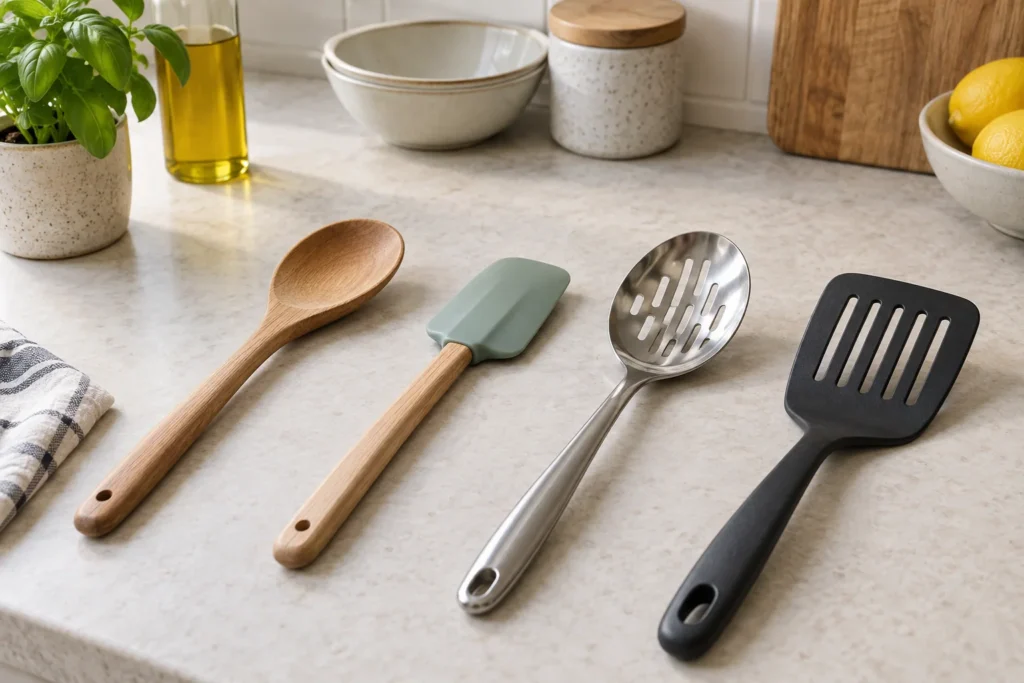
A turner supports food from underneath; a bowl scraper follows the vessel's surface; a spreading spatula smooths a mixture across another surface. Shops and recipes sometimes use “spatula” for all three. Choose by the intended movement and the shape of the working edge, rather than relying on the name printed on the label.
Image: AI-generated editorial illustration of generic equipment; not a photograph of a reviewed product.
Table of Contents
Read the verb before choosing the tool
Look at what the recipe asks you to do. Turning a piece of food requires a head that can get underneath and support it. Folding a mixture involves moving around and beneath it in a bowl. Spreading icing calls for a controllable flat surface. The same broad word in two recipes does not necessarily mean the same implement.
If the instruction is unclear, examine the vessel and the next step. “Scrape into the tin” suggests clearing a mixing bowl. “Slide underneath and turn” suggests lifting support. You can often identify the necessary shape without buying a product specifically named by the recipe writer.
Compare three working edges
| Tool | Main geometry | Useful fit check |
|---|---|---|
| Turner | Broad, fairly flat supporting head | Can it get beneath the food inside the pan? |
| Flexible scraper | Edge that follows a bowl or jug | Does it reach the lower curve without excessive force? |
| Spreading spatula | Flat blade or face | Is it manageable across the area you want to cover? |
A spoon spatula combines a shallow scoop with a scraping edge. OXO silicone spatula shapes distinguishes this from a smaller flat spatula within one range. Such hybrids can reduce the need to switch tools, but the added scoop may be unnecessary if your main problem is reaching a narrow corner.
Choose a turner around support and clearance
Measure the usable pan area and compare it with the head width. A large turner may support a broad piece of food but be difficult to angle into a small pan. A narrower one can improve access while supporting less area. Decide which trade-off matters for the meals you cook most often.
Examine the leading edge and the head's flexibility. A thin edge alone does not establish suitability for a pan coating; read the cookware instructions and check the complete tool. Think about the handle angle too, because it affects whether your hand can stay comfortably clear of the rim while the head lies where you need it.
Choose a scraper around the bowl
A flexible corner is useful only if it matches the vessel's curve. In a deep narrow jug, reach and head width may matter more than the overall size of the tool. In a broad mixing bowl, a tiny scraper can make a simple transfer unnecessarily fiddly.
Check the joint between head and handle. Some designs intentionally detach for cleaning, while others are continuous or permanently bonded. Follow the maker's instructions rather than pulling at a head to discover how it is made. For a hand-held bowl scraper, check that you can hold it securely without your fingers crowding the working edge.
Choose a spreading tool around control
A spreading spatula or palette knife may have a straight blade or an offset between blade and handle. The offset changes hand clearance over the surface you are covering. Choose a manageable blade length for your usual cake or tray, and check whether the edge and material suit the receiving surface.
Do not assume a spreading blade is suitable for cutting or levering food from a tin. Follow the tool and bakeware guidance. A useful tool performs the intended movement comfortably; it does not need to double as every other implement in the drawer.
Keep a collection of distinct functions
Lay your existing tools side by side and identify the job each does best. If three flexible scrapers all fit the same bowl, another size may add little. If you have a good scraper but no tool that supports food in the frying pan, a turner fills a different need.
Check heat ratings, washing instructions and physical condition before use. Then give each shape an accessible place. Understanding the distinction between lifting, scraping and spreading makes both recipe reading and shopping simpler, and it helps you choose a useful replacement when one familiar utensil wears out.