
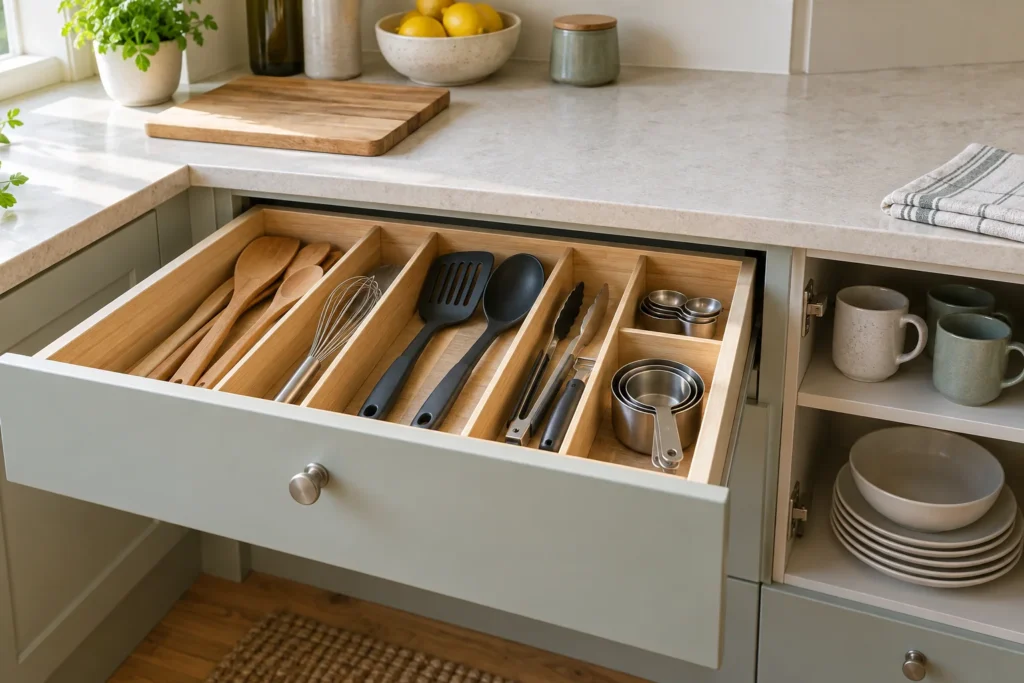
Kitchen utensil drawer dividers should stop useful tools becoming a tangled pile without creating compartments too narrow for their heads. Measuring the drawer is only half the job. Measure the utensils you want to keep there, then plan how each will be lifted out and returned.
Image: AI-generated editorial illustration of generic equipment; not a photograph of a reviewed product.
Table of Contents
Sort by shape and frequency of use
Bring the clean tools together and separate everyday utensils from occasional gadgets. Group long, narrow items separately from broad spatulas, deep ladles and bulky whisks. These shapes use drawer space differently even when their handles are similar lengths.
Keep sharp tools in storage intended for them rather than mixing them into an open utensil compartment. This layout exercise is for ordinary preparation and serving tools; a divider does not provide the edge protection of a suitable knife guard or insert.
Measure usable drawer space
Record the width inside the sides, the depth you can actually access and the clear height when the drawer closes. Account for runners, rear fittings and any narrowing of the internal shape. The decorative front panel is not a reliable guide to usable capacity.
Check the proposed insert’s minimum required drawer height as well as its own physical height. Joseph Joseph’s expanding DrawerStore organiser, for example, specifies a minimum drawer height of 7.5 cm although the organiser itself is listed as 6.5 cm high. Tool clearance matters.
Draw compartments around the tools
Place the largest everyday utensil on a paper outline of the drawer. Allow space to grasp it without lifting three neighbours. Add the next most used tools and look for shapes that sit comfortably together.
Do not assume a straight handle needs a narrow straight channel for its whole length. A broad spatula head can overlap the available area differently from a whisk. Compare whether one open section for bulky heads is more useful than several identical narrow compartments.
Choose the divider mechanism
An adjustable tray provides a defined set of compartments with some expansion. Separate dividers let you create different section widths within their supported range. Small loose trays can group minor accessories but may leave gaps or move unless their design addresses that.
Check the manufacturer’s fitting and surface instructions, particularly where a divider uses spring pressure or adhesive. Do not force a part against a drawer wall or extend it beyond its stated range. A divider that damages the drawer or catches when closing has not improved the storage.
Test retrieval before making the layout permanent
| Tool shape | Layout question |
|---|---|
| Long handle | Is the full length supported without diagonal jamming? |
| Broad head | Can it be lifted without catching a neighbouring tool? |
| Deep ladle | Does the head clear the closed drawer? |
| Small accessory | Is it visible rather than lost beneath larger pieces? |
Use the proposed arrangement for a few ordinary preparation tasks. Notice which tool repeatedly ends up outside its section. That often indicates an inconvenient compartment, not a failure of tidiness. Adjust the geometry before adding more dividers.
As a paper-planning example, place a long spatula and a short but wide peeler in the same proposed section. Their handles may appear compatible while the peeler head blocks access to the spatula beneath it. Moving the peeler into a small visible compartment can be more useful than widening the whole tray. Repeat that exercise with the two or three tools that usually jam the drawer. The troublesome combinations reveal where a divider should go; the number of compartments in a product photograph does not.
Leave a sensible return space
Make it easy to put a tool away after washing. A layout that only works when every handle is aligned perfectly is difficult to maintain in a shared kitchen. Our kitchen storage guide offers broader drawer options. Choose dividers that support the real shapes and daily movements of your utensil collection.