
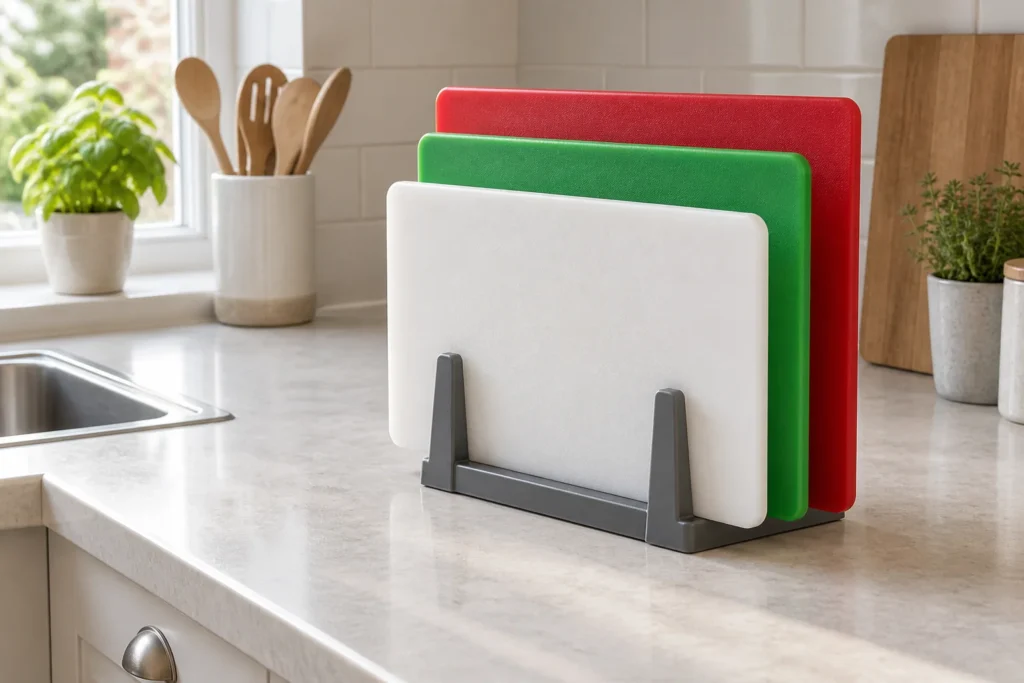
Separate chopping boards are useful only when everyone knows what they are for. A collection of different colours does not explain where a knife should go after use, which board is ready for salad, or what happens when the preferred board is still waiting to be washed. Build a small household system around those everyday decisions.
Image: AI-generated editorial illustration of generic equipment; not a photograph of a reviewed product.
Table of Contents
Begin with food tasks, then assign equipment
The Food Standards Agency recommends different boards and utensils for raw meat, fish and poultry, fruit and vegetables, and ready-to-eat foods where possible. Its household cross-contamination guidance also explains cleaning between tasks when equipment must be reused. Food Standards Scotland stresses that a surface touched by raw meat, fish or poultry must be thoroughly washed before ready-to-eat food is placed on it in its kitchen cleaning advice.
Use those principles to name the tasks your household actually performs. “Ready-to-eat salad and bread” is clearer than “the nice board”. Avoid a system that depends on remembering who used an unlabelled board most recently. The intention is to make the next correct choice easy to identify at a glance.
Make the labels understandable to everyone
Colour can be a useful additional cue, but write down its household meaning. Choose wording or simple symbols people can recognise without relying on colour alone. Put the explanation in the storage area rather than on a surface that contacts food. If you use labels on equipment, check that they are appropriate for that product and do not interfere with cleaning.
Do not assume visitors know a professional kitchen’s colour convention. A domestic kitchen needs a clear, consistently understood arrangement. Read the labels together when you first put the system in place and explain them to anyone who regularly helps with preparation.
Give utensils a place in the plan
The board is only one part of the working area. Decide where the knife, tongs and preparation bowl for each task will sit. A board assigned to raw ingredients should not become a convenient resting place for the clean knife needed for bread. Keep the clean equipment you will use later outside the immediate working patch.
Consider a meal with a salad, bread and a dish containing raw chicken. Before starting, identify the equipment for each stage, the serving dishes and the washing route. This is a planning exercise rather than a cooking timetable: preparation methods and food instructions still determine how the meal is made. The useful question is whether you can complete one task without borrowing an unwashed tool from another.
Create a visible used-equipment route
Have a clear destination for equipment awaiting washing. Choose a location that does not block the sink or obscure taps and cleaning supplies. The purpose is to prevent an apparently spare board from returning to service because nobody could tell whether it had been used.
Wash the board using a method permitted by its manufacturer, applying the relevant official cleaning guidance. Check the care instructions for handles, feet or removable pieces as well as the main surface. After cleaning, give each item its usual storage place so its household role remains easy to recognise.
Check the system against a busy evening
| Likely situation | Decision to make in advance |
|---|---|
| The usual board is being washed | Which appropriate clean board is the alternative? |
| Two people are preparing food | Which area and tools belong to each task? |
| A visitor helps with salad | Where can they read the equipment labels? |
| Preparation is interrupted | How will used equipment remain clearly identifiable? |
If the arrangement needs a long explanation every time, simplify the labels or move the equipment. Buying more boards may not solve a confusing storage layout. First establish whether the problem is availability, identification or the distance between preparation and washing.
Choose boards that fit the routine
Use our chopping-board guide when selecting suitable materials and formats. For this household plan, prioritise clear identification, manageable washing and a storage location that everyone can reach. Review the arrangement after an ordinary week: the best improvement may be a clearer label or an extra clean utensil, rather than a larger set.