
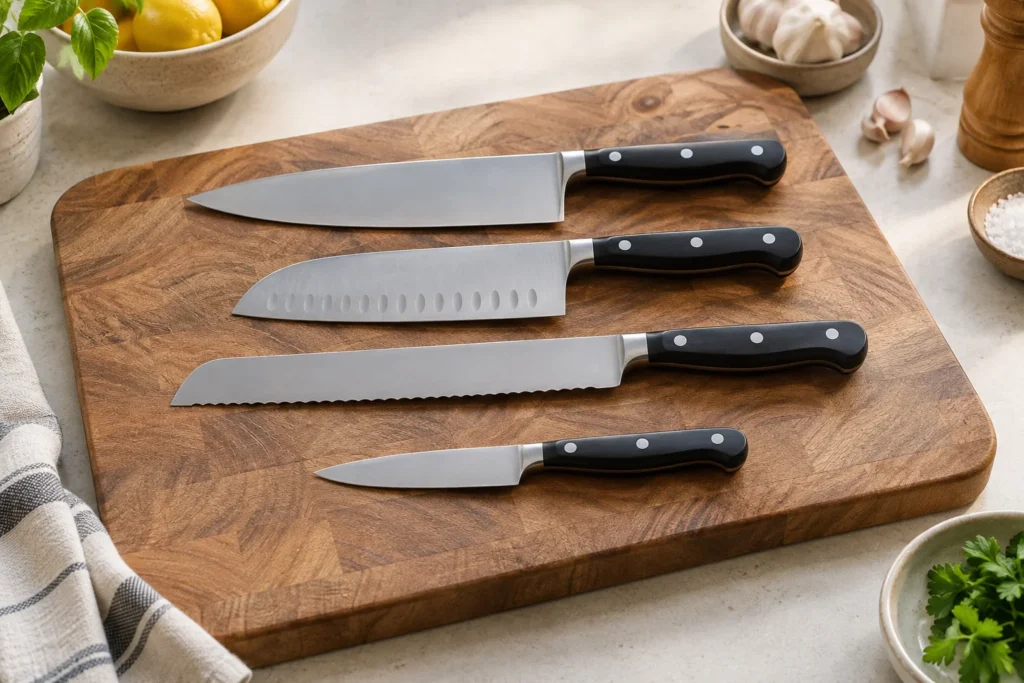
Japanese kitchen knives cover many shapes and constructions. A knife described as Japanese-style may be a general-purpose tool, a specialist slicer or a vegetable knife, and the description alone does not establish where it was made or how its edge should be maintained. Start with the task you want to improve, then read the exact specification.
Image: AI-generated editorial illustration of generic equipment; not a photograph of a reviewed product.
Table of Contents
Choose the task before the blade name
Write down the foods you regularly prepare and the result you need. Everyday vegetable preparation, slicing a loaf and specialist fish work are different jobs. A dramatic-looking blade is not automatically the right tool simply because it appears in a skilled cook’s video.
KAI’s blade-type guide distinguishes the general-purpose santoku, vegetable-focused usuba and long slicing yanagiba. It also notes that the usuba’s broad appearance does not make it a bone-chopping tool. Use the actual intended use rather than judging capability from silhouette alone.
Read the bevel description
Check whether the exact knife has a single or double bevel and whether any handedness restriction is specified. This affects the purchasing and maintenance decision. Do not assume every Japanese knife has the same edge geometry or that one sharpening guide applies across all of them.
If the specification is unclear, ask the maker or an authorised specialist before buying. Record the precise model and its sharpening instructions. A product page saying only “razor sharp” does not tell you the information needed to choose a compatible maintenance method.
Compare actual length, height and handle fit
Blade length is only one dimension. Consider the height near the heel, the handle shape and the space available on your usual chopping board. A long knife may suit a particular slicing task while feeling inconvenient in a small preparation area.
Where possible, handle an appropriate sample in a controlled retail setting. Compare the grip and balance without treating one person’s preference as a universal ranking. Check whether a shaped handle suits the intended user’s hand and whether the maker identifies any directional design.
Treat material and origin as separate specifications
Look for the named blade steel, any cladding and the handle construction. If country of manufacture matters to you, find that stated separately from the style name. A Japanese blade shape and a manufacturing origin are not interchangeable claims.
Avoid choosing by the largest hardness figure or layer count alone. Those numbers do not describe the whole knife or prove how it will perform in your household. Keep them within a fuller comparison that includes geometry, intended use and the maintenance you can actually provide.
Plan care before buying
| Specification | Decision it supports |
|---|---|
| Intended food tasks | Whether the knife solves a regular need |
| Bevel and handedness | Whether use and sharpening suit the owner |
| Blade and handle materials | Which care instructions apply |
| Dimensions | Fit with the board, storage and handling preference |
| Sharpening support | How the edge will be maintained later |
Consider the full ownership routine: an appropriate cutting surface, permitted washing method, dry storage and a supported sharpening route. If you do not want to maintain a specialist edge yourself, investigate the maker’s recommended service options before purchase rather than improvising after the edge wears.
Compare two real specification sheets
Imagine two knives described as Japanese-style, both with a nominal 20 cm blade. One listing identifies the bevel and steel but gives no handle dimensions; the other gives a handle photograph but no sharpening guidance. Neither description answers the complete ownership question. Ask for the missing details before using the shared style label to rank them. Then compare each knife with a task your current collection does poorly. If the only clear difference is decoration, you have not yet identified a functional reason for the purchase. Keep the unanswered questions alongside the product names so that an attractive photograph does not replace the comparison.
Begin with one useful addition
Our knife-set guide covers broader household collections. For a Japanese knife, identify the specific missing task and buy around it. A well-understood general-purpose shape may be more useful than several specialist blades whose intended handling and care you have not yet established.