
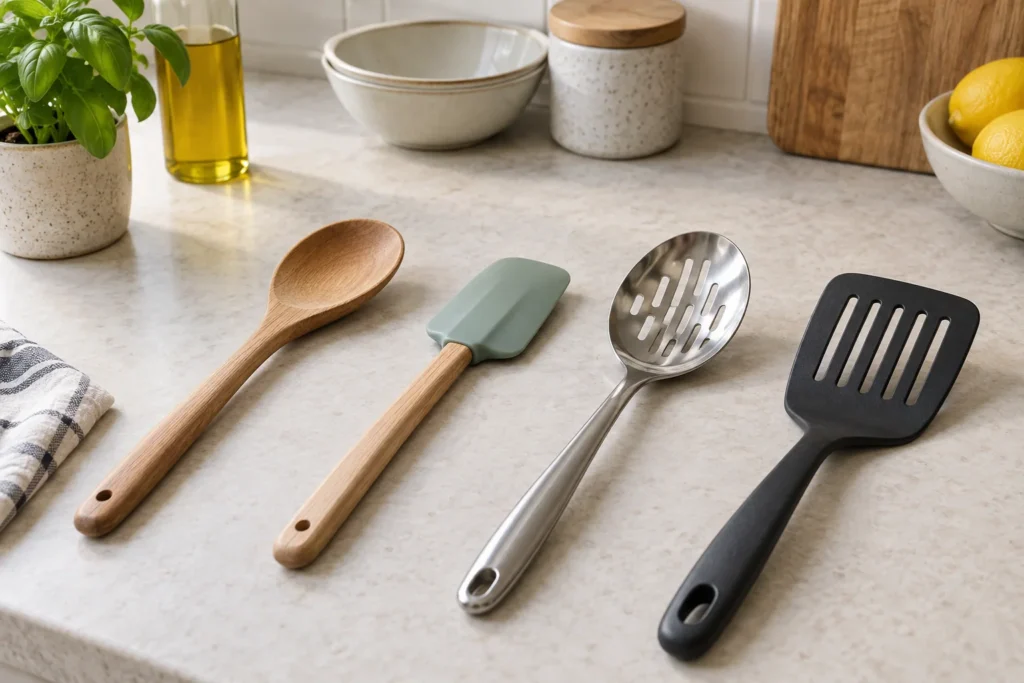
Choose silicone kitchen utensils by the job their heads need to do, then check the heat rating and construction of the complete tool. A flexible bowl scraper, a firm cooking spoon and a reinforced turner can all be sold as silicone utensils while behaving very differently in your hand.
Image: AI-generated editorial illustration of generic equipment; not a photograph of a reviewed product.
Table of Contents
Read the temperature claim carefully
A heat-resistance figure needs a subject: does it describe the head, the neck, the handle or the whole utensil? For example, OXO small silicone spatula specifications identifies the silicone head and neck when describing its temperature limit. That is useful specification wording, but it does not establish a rule for other tools or every way of using that one.
Look for accompanying restrictions on direct heat, resting against a pan and dishwasher placement. Keep the care information with the purchase record. A prominent number on the packaging is less useful than a clear explanation of permitted use. If the listing supplies no instructions, ask for them before choosing the tool for regular hob work.
Match stiffness to the task
Consider the movement you want to make. Scraping a rounded mixing bowl calls for an edge that follows the curve. Supporting a piece of food calls for a head that remains sufficiently level. Stirring a thick mixture puts a different demand on the connection between head and handle.
| Main task | Useful detail to examine | Question to ask |
|---|---|---|
| Scraping a bowl | Flexible edge and curved corner | Can the edge reach the bowl's lower curve? |
| Stirring a saucepan | Firm head and comfortable handle | Does it feel controlled through a full stirring movement? |
| Turning food | Width, thin leading edge and reinforcement | Does the head fit the food and the pan? |
| Emptying a narrow jar | Small head and usable reach | Will the widest part pass through the opening? |
A huge spatula may clear a large bowl quickly but be awkward inside a small measuring jug. A small one can complement an everyday tool without replacing it. Choose the size for the container you actually use, rather than assuming a matching set needs every size.
Inspect the joins and hidden structure
Some tools have silicone over a rigid core; others have a removable head fitted to a separate handle. Product photographs may conceal these differences. Look for an underside view and a description of the materials. If the head detaches for cleaning, confirm that this is intentional and read how it should be reassembled.
For a display item, inspect the edge for an even finish and look around any joint. Flex only as the tool is intended to flex. You are assessing shape and access, not conducting a durability test in the shop. A loose head or unexplained gap deserves an answer from the seller, even if the colour and advertised rating are attractive.
Check the pan as well as the utensil
Read your cookware's utensil guidance separately. A statement that a tool suits non-stick cookware should sit alongside the requirements of your particular pan. Take account of exposed parts, too: a silicone head does not make every metal edge or adjoining component irrelevant.
Plan a resting place outside the cooking vessel. That is an ordinary layout choice, not an extra feature you must buy: use a suitable clean spoon rest or plate positioned clear of the heat. Being able to put the tool down conveniently matters when comparing handle length and balance.
Buy for your washing and storage routine
Check whether the washing instructions cover every component. Measure the usable drawer length, including space for a broad head to pass a divider. For upright storage, consider whether a very flexible tool becomes buried between heavier spoons.
Before ordering, write a one-line specification: “medium scraper for my mixing bowl, continuous cleanable surface, care instructions I can follow.” Add a separate cooking spoon only if you need that firmer shape. After delivery, compare the actual tool and leaflet with the listing before first use. This gives you a more useful purchase decision than choosing the set with the highest temperature number or the most pieces.