
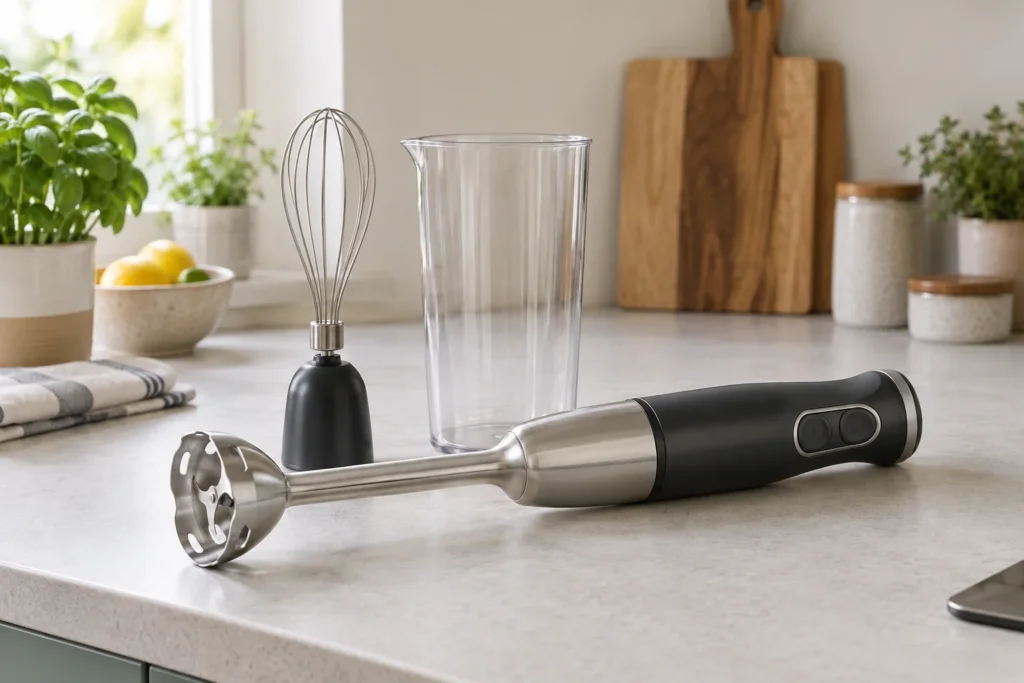
Choose a hand blender by picturing where it will work: a tall beaker, an approved saucepan or a separate chopper bowl. The motor rating does not answer whether the grip is comfortable, the shaft fits your vessel or the included accessories suit your usual meals. Start with those practical requirements.
Image: AI-generated editorial illustration of generic equipment; not a photograph of a reviewed product.
Table of Contents
Choose the main task before the bundle
If most of your use will be soup, focus first on the blending shaft, approved temperatures and suitable vessels. If you want to chop vegetables as well, inspect the separate chopper’s capacity and ingredient guide. A whisk is another distinct tool with its own permitted mixtures.
List these tasks in order of frequency. An attachment used every week deserves attention; an impressive accessory you cannot name a recipe for is less important. Remember that a small chopper attachment does not automatically add slicing discs, dicing or dough processing.
Compare two documented UK arrangements
The Russell Hobbs 27141 lists two speed settings, a whisk and chopper, with 500ml working capacity for its chopping bowl and a 600ml beaker. The KitchenAid Go 5KHBRV71BM uses a removable battery and includes a blending arm and 700ml jar. These are different equipment arrangements, not a performance ranking.
Use the complete product code when comparing bundles. A nearly identical-looking hand blender may be sold with or without a battery or with a different selection of attachments. Compare what will actually arrive, not the fullest accessory photograph shown for the range.
| What you do most | What to inspect closely | What to avoid assuming |
|---|---|---|
| Blend in a saucepan | Shaft, guard, temperature and cookware permissions. | That every metal shaft is approved for boiling food. |
| Prepare small chopped ingredients | The chopper bowl’s working limit and blade. | That the beaker capacity also describes the chopper. |
| Whisk occasionally | The whisk, connector and supported mixtures. | That a whisk attachment can knead bread dough. |
| Move between work areas | Cord reach or battery arrangement and grip. | That cordless means unlimited continuous running. |
Check the controls with your normal grip
If possible, hold a display model without operating it. Can you reach the required controls while maintaining a secure grip? Does changing speed require a movement that feels awkward? Consider the action required to keep it running, including any safety control. These details are difficult to judge from a front-facing photograph.
The vessel matters too. Compare the shaft and guard with the depth and opening of the containers you expect to use. A narrow jar may not accept the guard; a broad shallow pan may not provide the working depth required by the instructions. Choose the vessel and appliance as a practical pair.
Read operating limits before buying extra power
A hand blender may have limits on continuous operation and different requirements for each attachment. Find those instructions before planning large repetitive batches. A high wattage does not remove a rest period or make an unsupported ingredient suitable.
For a demanding task, look for explicit manufacturer guidance rather than extrapolating from a smoothie photograph. If the machine is not documented for the mixture you want, another appliance may be the better fit even if the hand blender has a more impressive motor number.
Plan cleaning and replacement parts
Identify what detaches, which parts may enter water and which must only be wiped. Gearboxes and motor housings can need different treatment from a metal whisk or blending shaft. Keep the component diagram available until the routine is familiar.
Before deciding, check the exact replacement shaft and attachment route. A clear model-specific parts system is useful if a beaker breaks or a connector wears. Choose the simplest set that covers your recurring tasks safely and comfortably, with room to store the parts you genuinely expect to use.
If most of your blending happens in a drink jug rather than a saucepan, consider the alternative arrangements in our smoothie blender guide.