
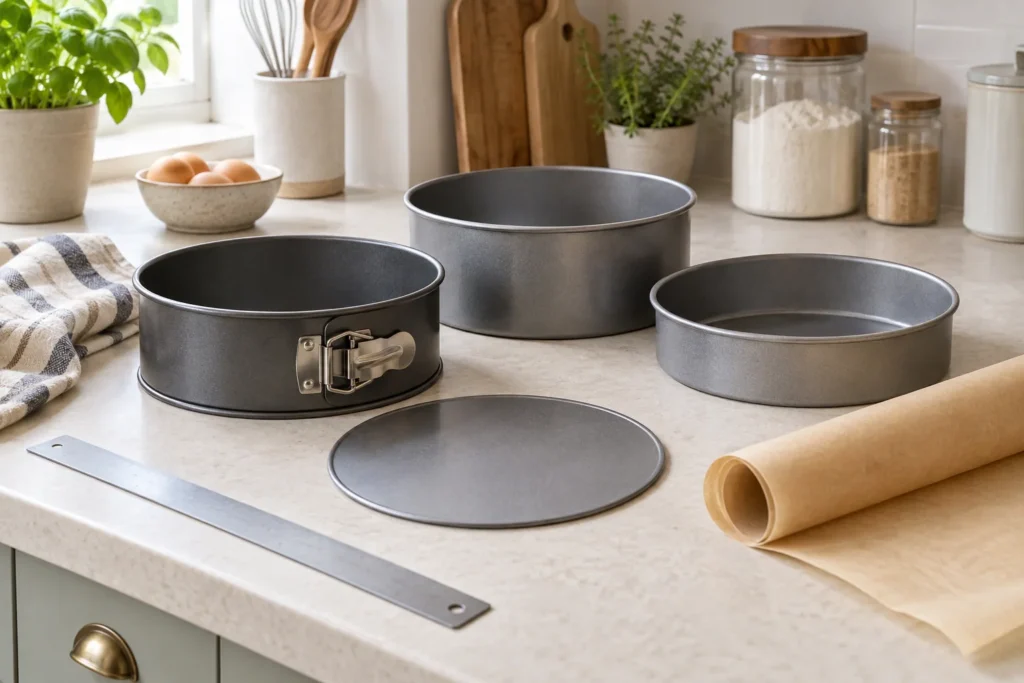
Cake-tin conversion starts with internal measurements and the original recipe. Base-area arithmetic can estimate how much mixture would occupy the same depth in another straight-sided tin. It cannot establish a new baking time or make every shape interchangeable. Keep that distinction clear before changing a recipe for an important occasion.
Image: AI-generated editorial illustration of generic equipment; not a photograph of a reviewed product.
Table of Contents
Measure the part that contains the mixture
Record the internal length and width of a rectangular tin, or the internal diameter of a round one. Measure the depth separately. Handles, rolled rims and projecting clips belong in your oven-fit measurements, not the cake-area calculation. If the walls slope, record that too: the area at the top will differ from the area near the base.
Check how many tins the recipe uses. Two round tins are two portions of the total mixture. Comparing a replacement with just one of them while pouring in the entire batch would defeat the purpose of measuring. Also note specialist features such as a central tube, individual cavities or a shaped interior before deciding whether a simple area model is appropriate.
Calculate base area for simple shapes
For a rectangle, multiply internal length by internal width. For a circle, multiply the radius by itself and then by pi, approximately 3.142. Radius is half the diameter. Keep the units consistent: centimetres multiplied by centimetres produce square centimetres. King Arthur Baking: alternative baking pan sizes explains the role of pan area when considering substitutions.
| Illustrative tin | Area calculation | Approximate base area |
|---|---|---|
| 20cm round | 3.142 × 10 × 10 | 314cm² |
| 23cm round | 3.142 × 11.5 × 11.5 | 416cm² |
| 20cm square | 20 × 20 | 400cm² |
| 18cm by 24cm rectangle | 18 × 24 | 432cm² |
These are mathematical examples, not tested recipe conversions. They assume the stated internal measurements. A manufacturer's nominal size may be rounded, so use actual measurements when accuracy matters rather than treating a label as a precise engineering drawing.
Work out an illustrative quantity factor
Divide the new base area by the old base area. Moving from a 20cm round tin to a 23cm round tin gives a factor of about 1.3225. In a simple same-depth model, an ingredient originally weighing 200g would become 264.5g before practical recipe rounding. The diameter has increased by 15%, but the area has increased by about 32%.
Write the factor beside every ingredient rather than making mental adjustments while mixing. If the arithmetic produces an awkward fraction of an egg or a very small leavening quantity, look for a publisher-approved version of the recipe in the new size. A calculator can produce a number without resolving how that change should be handled in the kitchen.
Know when the model stops being useful
Area comparison assumes the intended mixture depth stays comparable. A much deeper tin does not give permission to add proportionally more batter. Nor does a larger empty volume establish the correct fill level for a cake that rises. The original recipe's tin, quantity and preparation method remain the reference points.
A Bundt tin, a chiffon tin with a central tube and a group of miniature moulds introduce different geometry. A tapered loaf tin also resists a simple top-area comparison. For those changes, seek a recipe designed for the destination vessel or explicit substitution advice from its publisher. Keep mathematical neatness separate from evidence about the bake.
Plan the first attempt as an adaptation
Do not multiply the baking time by the quantity factor. Follow any validated adaptation notes from the recipe publisher and its stated doneness checks. If there are no such notes, choose the original tin for a time-critical bake. A first experiment is a poor place to promise a precise serving time to guests.
Keep a short record of the original recipe, measured tin dimensions, arithmetic and any publisher guidance you followed. Label your own observations as observations from that particular attempt. If you later repeat the bake, this record is far more useful than remembering that you used a bigger tin. The calculation helps you ask a better question; it does not replace the recipe's tested method.