
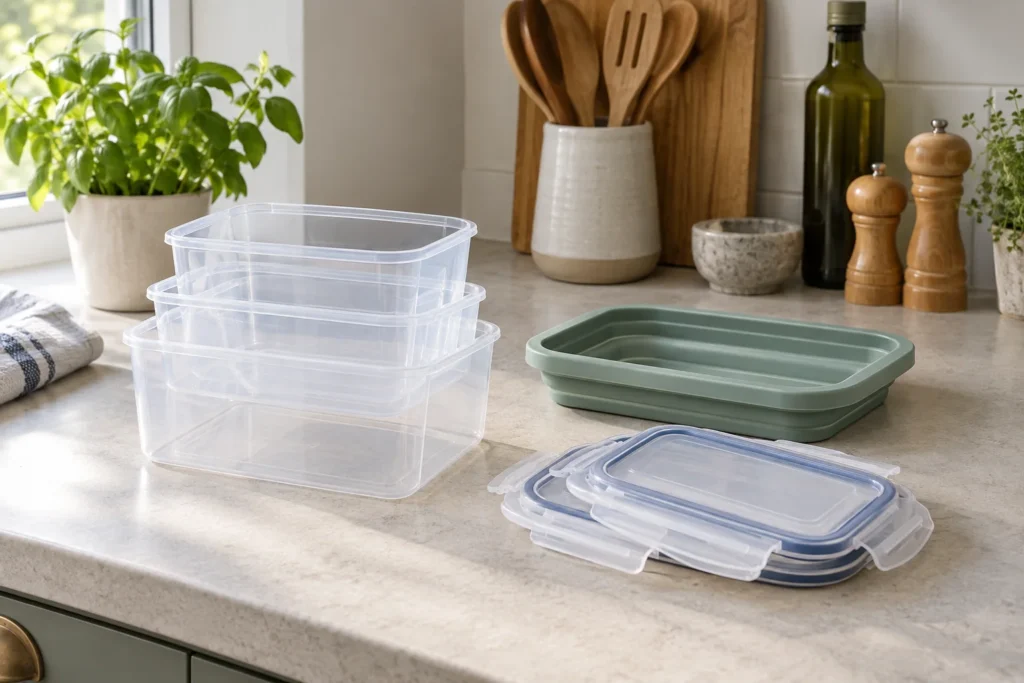
Plastic food storage containers often accumulate gradually: a lunch box, a leftover tub and several nearly matching lids. The difficulty is remembering which combination permits which use. Start by identifying complete pairs, then record the instructions for each rather than applying one rule to everything in the drawer.
Image: AI-generated editorial illustration of generic equipment; not a photograph of a reviewed product.
Table of Contents
Identify the container before interpreting a symbol
Look for a brand, product reference or range name on the body and lid. Photograph those markings while they are legible and keep the images with any instructions. A familiar-looking shape is not enough to establish compatibility with a lid from another range.
If a symbol is unclear, find the manufacturer’s explanation for that product. A triangle, a temperature figure and an appliance illustration can communicate different kinds of information. Do not infer heating permission from a material name alone. The exact use instructions are the relevant evidence for the action you want to take.
Make a component-by-component record
Use a simple table for the body, lid, seal and any insert. Note whether each is intended for the freezer, microwave or dishwasher and whether particular preparation steps are required. The result is a household reference, not a substitute for the full manufacturer instructions.
For example, the 750 ml round IKEA 365+ container lists microwave, freezer and dishwasher suitability and also warns against sharp metal cutlery and use when visible cracks, chips or surface damage are present. Those are instructions for that item; they should not be transferred to an unidentified takeaway tub.
Treat the lid as a working part
A matching lid should be identifiable by the range information, not merely by whether it can be forced over the rim. Check the maker’s instructions for clips, vents and seals. If a lid needs to be loosened or removed for a permitted use, record that detail in the same place as the permission so it is not overlooked later.
Try the opening and closing movement with an empty, clean container before buying a large set where possible. Consider everyone who will use it. Small clips, strong seals or broad lids may suit different hands differently; a label describing a closure as convenient cannot decide that for your household.
Inspect what you can actually see
Take a container out of regular use while you investigate unexplained damage or an unreliable closure. Check the rim as well as the centre of the body, and look at the lid hinges, clips and seal channel. Follow the maker’s replacement criteria rather than relying on a fixed age for every type of plastic.
Do not conceal a crack with a label or improvise a replacement component simply because the box still holds its shape. Where parts are sold separately, confirm the precise model compatibility. Where the original instructions cannot be recovered, reserve judgment on uses you cannot verify rather than inventing a reassuring temperature limit.
Organise by useful compatibility
| Drawer problem | Practical change |
|---|---|
| Several similar lids | Group by confirmed range and size |
| Instructions are forgotten | Keep a photographed model-and-care record |
| Most boxes are too small | Count complete pairs by actual meal use |
| A clip no longer works | Check the maker’s replacement options |
Store clean components in a way that lets you find a complete pair promptly. Nesting may save space, but it is less helpful if the matching lids disappear beneath unrelated containers. You can use one small section for each compatible family rather than sorting every lid only by apparent diameter.
A useful household record can be as simple as a photograph of the body and lid together, followed by the saved instruction page. Keep one record per confirmed combination. This avoids the common problem of remembering that a range had a microwave permission while forgetting which lid or accessory was excluded.
Purchase the missing function
If your current collection already covers fridge storage but lacks a verified reheating option, shop for that specific gap. There is no need to replace an entire drawer just to make it visually uniform. Our kitchen storage guide can help with the wider layout; the priority here is a container-and-lid combination with clear instructions and an everyday job.