
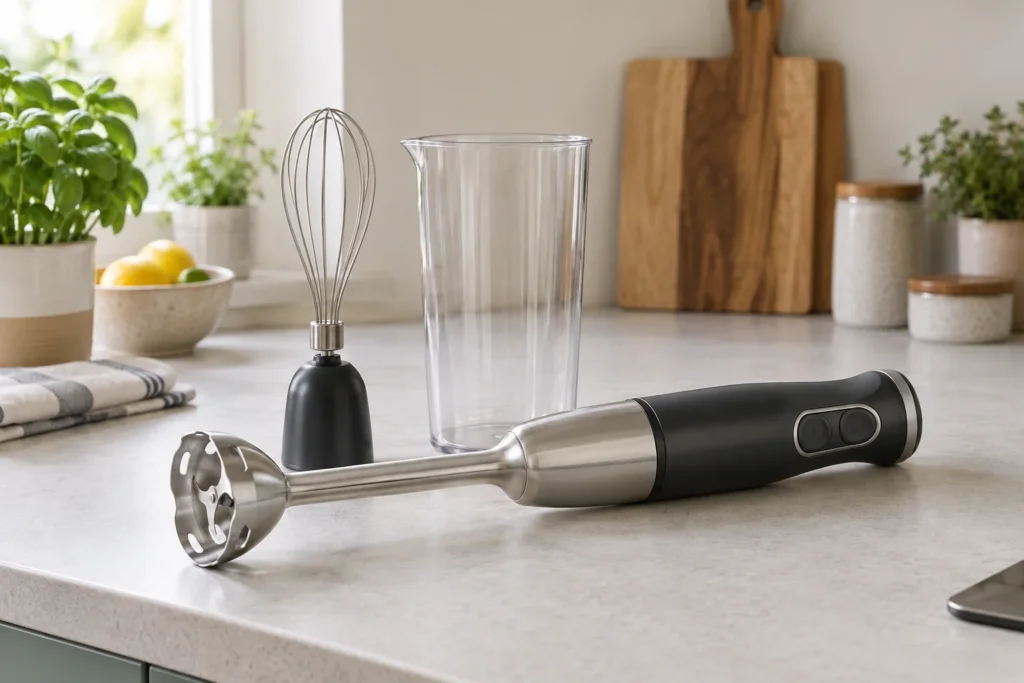
A cordless hand blender is useful when removing the cable solves a real problem in your preparation area. It also adds a charging routine. Compare how the battery is supplied and charged, which attachments are supported and what the manual permits during operation, rather than choosing solely on an advertised runtime.
Image: AI-generated editorial illustration of generic equipment; not a photograph of a reviewed product.
Table of Contents
Identify the inconvenience you want to remove
Perhaps the practical blending position is awkwardly placed relative to a socket, or you move between two clear preparation areas. Describe that issue before choosing a battery appliance. Cordless operation should not become a reason to work in an unsuitable vessel or an unstable location.
If a mains model already reaches a comfortable work area, the battery may add little to your normal routine. Conversely, a removable-battery system may be convenient when you already own compatible equipment. The benefit depends on the actual kitchen arrangement, not a generic promise of freedom.
Check whether a battery is included
The KitchenAid Go 5KHBRV71BM listing specifies a removable 12V battery included with that model. Its advertised runtime is qualified by battery age and life. A version sold without a battery is a different purchase, even when its blender body looks the same.
Make a small purchase checklist: blender body, battery, charging cable, required adapter and desired attachments. Confirm the complete product code for the UK bundle. Do not assume a cable in the box necessarily means every charging component you need is supplied.
| Battery question | Why it changes ownership | What to record |
|---|---|---|
| Built-in or removable? | Affects charging and compatibility with a wider system. | Exact battery and appliance codes. |
| Can it operate while charging? | Determines whether charging interrupts the job. | The manual’s explicit answer. |
| What does the runtime claim mean? | Ingredients and battery condition can affect use. | The maker’s qualifications, not just the headline minutes. |
| How long may one operation last? | Continuous running can have a separate limit. | Attachment-specific duty cycle and rest instructions. |
Runtime and continuous operation are different limits
A battery-runtime figure describes an energy allowance under specified conditions. It does not necessarily permit one uninterrupted run of that length. The attachment’s operating instructions can impose a shorter continuous period or rest requirement. Read both before planning a large batch.
For an ownership example, the Cuisinart RHB100U manual says the blender cannot run while plugged in and charging. Its UK product page is marked discontinued, so this is a manual example rather than a current buying recommendation. Other cordless models need their own charging check.
Build charging into the preparation routine
Choose a dry suitable location for charging and use the equipment specified by the manufacturer. Keep the charging setup distinct from the wet washing area. Read what the indicator lights mean so that you can tell charging, ready and low-battery states apart.
Before starting a recipe with several stages, check the available charge and prepare a suitable alternative if the appliance cannot complete the supported task. Do not improvise a different charger or bypass a safety control to finish a mixture.
Compare attachments as separate purchases
A cordless shaft does not guarantee a compatible chopper or whisk is included. Check the exact connector system and whether each desired accessory is approved for the model. If you mainly want soup blending, a large collection of unused bowls may offset the storage benefit of removing a cable.
Consider how the hand unit feels with its battery installed. The grip and controls still need to suit you. If possible, assess an unpowered display model in the position you normally use, without assuming that a cordless label means lighter handling.
Choose on the complete routine
A sensible choice links a real worktop problem to a documented battery system and a manageable charging habit. Keep the comparison focused on the meals you prepare and the parts you need.
If you would regularly discover an empty battery halfway through cooking, a mains model may fit your habits better. If the charging routine is easy and the cable is the recurring inconvenience, a cordless model can be a useful option within its stated operating limits.