
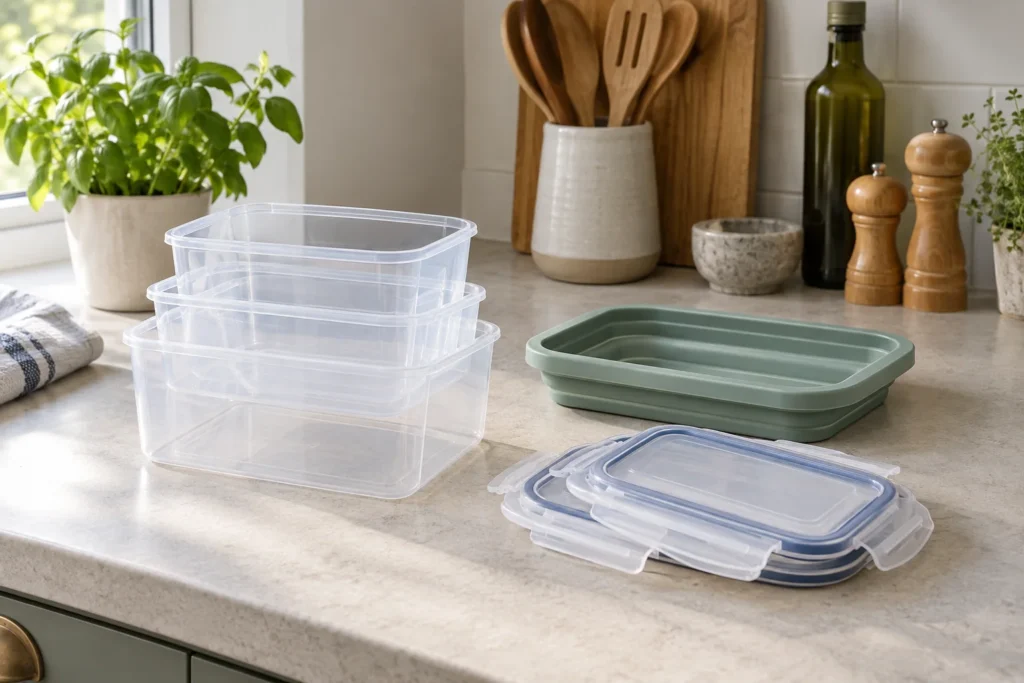
A collapsible food container saves space at a particular point in its journey, usually after the contents have been removed. That can be valuable in a bag on the way home, but it does not automatically reduce the space needed for a packed lunch in the morning. Identify when you need the smaller shape before choosing a design.
Image: AI-generated editorial illustration of generic equipment; not a photograph of a reviewed product.
Table of Contents
Compare expanded and packed dimensions
Record both sets of dimensions, including the lid. Check whether the quoted packed height describes the body alone or the complete item. A photograph of a compressed bowl beside a ruler is useful only if it shows the same configuration you intend to carry.
Sea to Summit’s Frontier collapsible bowl illustrates the distinction: its manufacturer describes a bowl that collapses to 17 mm. It is an open camping bowl, so that compact dimension is not evidence of a sealed food-storage box. Product categories that look similar can serve different jobs.
Decide whether you need a bowl or a carrier
Write down whether you want to eat from the item, transport food in it, or do both. For transport, verify that the exact product has the closure and carrying instructions your intended food requires. An open bowl with flexible sides cannot become a lunch container simply by pressing a vaguely matching lid over it.
Consider the shape of the filled bag as well as the empty return journey. Will the expanded container sit alongside a bottle and other possessions? Where will the lid go when the body is collapsed? If the lid remains almost as bulky as the original box, the overall benefit may be smaller than the product photograph suggests.
Check the folding movement
Look at how the body changes shape and where your hands are meant to go. Follow the maker’s instructions for when it may be collapsed. Sea to Summit’s Frontier bowl warnings, for instance, specify collapsing it only when empty and prohibit microwave use. Those instructions belong to that bowl, not to every silicone container.
Do not assume all flexible foodware has identical heat or appliance permissions. A product may combine silicone walls with a rigid base, rim or lid made from another material. Record the instructions for the whole assembly before using it outside ordinary serving or storage.
Inspect cleaning access around the folds
Examine the inner contour when fully expanded. Can you see and reach the places where the wall changes direction? Check whether components detach and whether the manufacturer explains how they are refitted. A flexible body does not necessarily mean it should be turned inside out or stretched beyond its intended shape.
Allow a practical place for the item to dry in the configuration its care instructions require. If your drying area is already crowded, a broad expanded container may need more room than a conventional narrow tub. The storage saving is useful only if the cleaning routine is also workable.
Use a simple journey comparison
| Stage | What to compare |
|---|---|
| Filling at home | Expanded stability and opening access |
| Carrying food | Verified closure, footprint and instructions |
| Eating | Depth, rim and access to the contents |
| Returning empty | Complete packed size, including the lid |
| Washing and drying | Access around folds and removable parts |
For a home-only container, compare the collapsed footprint with the nested storage of ordinary containers you already own. For a lunch carrier, compare the space released in your actual bag. These are different benefits, and one may matter much more to you than the other.
For example, compare the return journey of an empty lunch bag with the same bag carrying your usual other belongings. A collapsed container that releases a useful pocket of space has a specific benefit. If the bag is otherwise empty, the folding feature may matter less than the opening and cleaning routine.
Choose the saving you will use
A collapsible design earns its place when it makes a regular part of your routine easier. Keep the decision focused on that point rather than buying solely because the folding action is appealing. Our kitchen storage guide offers wider ways to manage cupboard space if the main problem lies at home rather than in your lunch bag.