
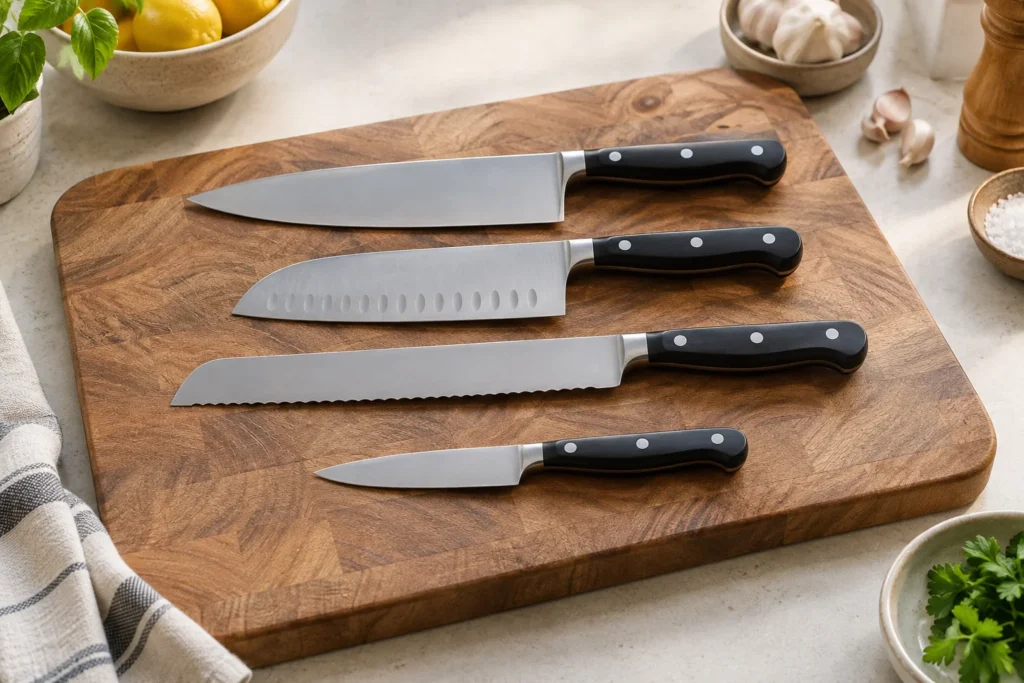
Disposing of kitchen knives starts with confirming the route that accepts them in your area. Do not assume a knife belongs loose in household rubbish or mixed recycling because its blade is metal. The receiving service needs to tell you what it accepts and how the item should be prepared and presented.
Image: AI-generated editorial illustration of generic equipment; not a photograph of a reviewed product.
Table of Contents
Identify the item and the local service
Use the GOV.UK council finder to reach your council’s waste information. Search its guidance for kitchen knives, cutlery or sharp household items. If the information is unclear, ask the waste service directly before placing the knife in a collection container.
Describe the item accurately, including whether it is an ordinary kitchen knife or something the service may treat differently. Do not rely on a general scrap-metal category to answer a question about a sharp blade. Acceptance and presentation instructions are separate facts to establish.
Check whether a collection or drop-off route applies
Find out whether the council directs residents to a household collection, a recycling centre or another service. Confirm any booking, residency or opening requirements from the current local page. Avoid copying a route from another council, where the same material may be handled differently.
If a charity, repair service or other organisation might accept the item for a legitimate reuse purpose, obtain its acceptance requirements first. An unwanted knife should not be left unexpectedly in a donation bag or delivered without the recipient’s agreement.
Use current surrender information where relevant
The Home Office’s 2026 surrender guidance for England describes designated bins and says those bins remain after the August scheme. It instructs users to wrap items, place them in a sealed bag or box and not carry them openly. Confirm the current location and instructions before relying on that route.
That guidance applies to its stated scheme and jurisdiction. It is not a promise that every police station or public bin accepts knives, or that an old mobile-collection date remains valid. Use the current instructions for the actual service you intend to visit.
Obtain preparation instructions before packing
Ask the receiving service how the edge and point should be protected, what outer container is required and whether any label is needed. Follow those instructions so the item is not an unexpected hazard to another person handling the package.
Do not test a disposal package by pressing against the blade or attempting to bend or break the knife. If the item is damaged or difficult to handle, explain that when seeking advice. The task is to use an accepted disposal route, not to modify the blade at home.
Keep the handover plan clear
| Before disposal | What to confirm |
|---|---|
| Accepted item | The service accepts this specific type of knife |
| Preparation | Edge protection, outer packaging and any label |
| Destination | Current site, collection or designated surrender point |
| Timing | Opening, booking or collection requirements |
Keep the unwanted item in appropriate secure storage until the route is arranged, separate from the knives still in use. Make the plan understandable to anyone helping with the disposal so nobody places it into another waste stream by mistake.
Save the service details before travelling
Make a short handover note with the official service name, the date you checked it, any booking requirement and the preparation instruction supplied by that service. Include the exact item description you used when asking, so a kitchen knife is not confused with general scrap metal or an unrelated restricted item. If the website gives no clear preparation instruction, obtain clarification before packing or travelling. A neighbour’s previous experience can identify a question to ask, but it should not override a changed local rule. Having the details available also helps you explain the item accurately if a staff member asks on arrival.
Replace only after identifying the original problem
If you are replacing the knife, consider whether its size, condition or maintenance requirements caused the difficulty. Our knife-set guide provides wider purchasing context. Complete the disposal through the confirmed local route, then choose any replacement around a clear household task and a workable care routine.