
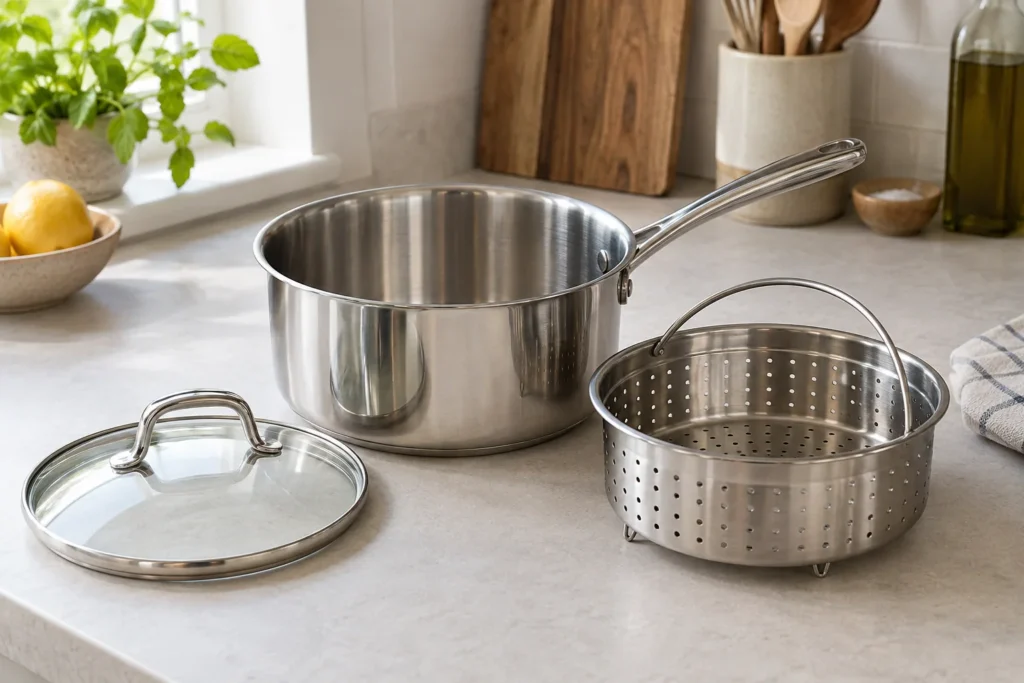
A steamer basket should fit the pan’s width, depth and lid arrangement, while leaving the space required by its water and handling instructions. Diameter alone is not enough. Before buying a folding insert, check the complete assembled height and how you will remove it after cooking.
Image: AI-generated editorial illustration of generic equipment; not a photograph of a reviewed product.
Table of Contents
Measure the pan you will actually use
Record the internal diameter and usable depth, including any change caused by sloping sides. Note whether the lid sits inside the rim or over it, and whether an internal handle or hook would interfere with closure.
Joseph Joseph’s Bloom steel basket provides a useful example of detailed fit guidance: it specifies a minimum 18cm pan, at least 10.5cm depth when used with a lid, and vertical sides rather than a frying pan or wok. Those figures belong to that basket; another folding design may require different dimensions. Joseph Joseph Bloom steel steamer basket
When a listing says fits most pans, look for the measurements behind the claim. If none are supplied, ask the maker before ordering.
Compare support and side movement
A folding basket may expand to fill a wider pan, but check how its feet and centre support behave in the intended position. The ability to fold is a storage feature as well as a fit feature; it does not mean every partly folded arrangement is permitted for cooking.
Inspect the cold basket for damaged feet, loose parts or a lifting mechanism that does not operate as instructed. Do not improvise replacement supports or balance it on household objects to raise the food.
| Detail | Practical question |
|---|---|
| Minimum pan diameter | Can the sides sit in their intended position? |
| Required pan depth | Can the lid close with food inside? |
| Feet or lower support | Is the intended water space available? |
| Lifting hook or handle | Can it be accessed as instructed? |
| Side material | Is it permitted against your pan’s finish? |
| Folded dimensions | Does it fit the storage space? |
Match the basket to the food shape
Think about the items you normally steam. A few pieces of broccoli, a long fish portion and filled dumplings require different layouts. Compare the continuous usable area rather than assuming a taller basket creates more room for every food.
Follow a suitable recipe and the basket instructions for arrangement. Do not overfill simply because the sides hold the pile. The lid should close in the instructed way and the planned steam path should remain available.
If the food is served in a separate dish inside the basket, confirm that arrangement with the equipment guidance. The dish adds height, width and a second hot item to retrieve.
Plan water access and removal
Read the maker’s water-level instructions rather than applying one universal depth. Basket feet, pan shape and the model’s design determine the intended relationship between water and food. Establish how water can be checked and replenished as instructed without an improvised hot lift.
Before cooking, clear an appropriate landing space for the basket or serving dish. Identify the specified lifting tool and protection. A cold handle that feels comfortable does not establish how it should be held around steam.
If removal would require reaching between a hot pan wall and the food, choose a design with a more suitable documented lifting arrangement. Retrieval is part of fit, not an afterthought once the timer sounds.
Check care and storage
Read the cleaning instructions for the exact basket. Stainless steel parts do not automatically mean the entire item is dishwasher approved; feet, fins and fixings may affect the answer. Make sure a permitted brush or sponge can reach between folding sections.
Dry and store it as instructed, checking the folded item does not trap other utensils or become compressed under heavy cookware. Keep the model information so replacement parts can be identified if needed.
The right basket lets you reuse a suitable pan while preserving a clear, supported cooking arrangement. Select it using the pan measurements, usual food layout and removal method together. That is more reliable than choosing the widest advertised size and hoping the lid will fit.