
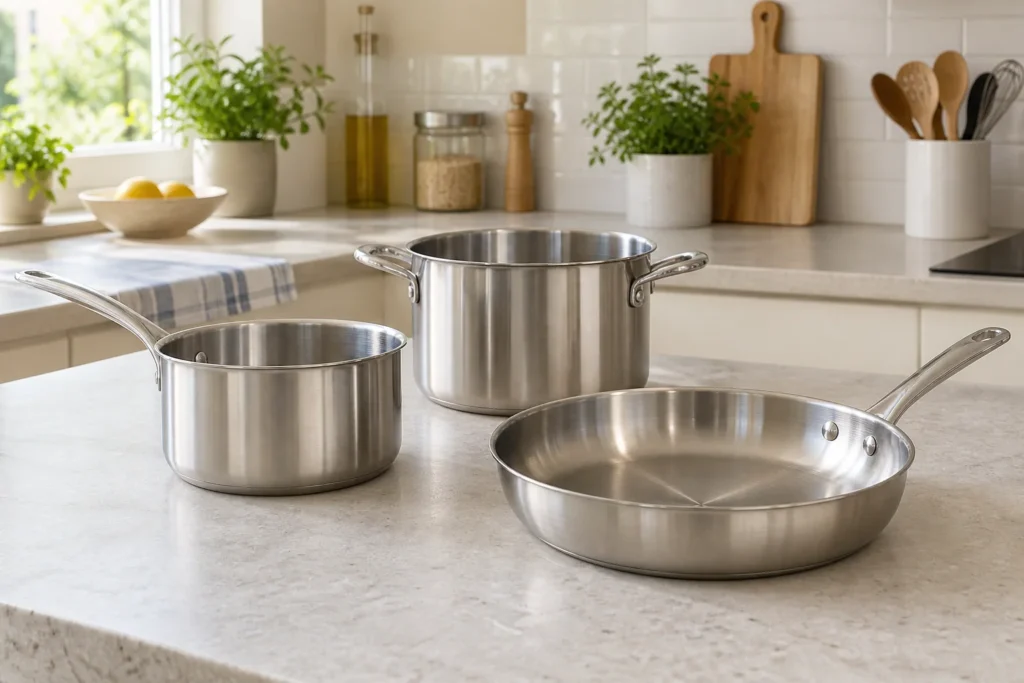
You can steam without buying an electric steamer if you have a pan and an insert expressly suitable for the job. The useful question is whether the complete setup is supported, heat compatible and covered as intended. A random colander or plate balanced over water does not become suitable merely because steam can reach it.
Image: AI-generated editorial illustration of generic equipment; not a photograph of a reviewed product.
Table of Contents
Start with equipment you can identify
Check the instructions for your saucepan and any accessory you already own. Some colanders have a documented second use as steamer inserts. Others are designed only for draining or rinsing and have no such permission.
IKEA describes its 5-litre KLOCKREN colander as usable semi-open as a steamer insert in most 3–5-litre pots. It distinguishes that arrangement from its fully open pasta-insert use. This is a specific design example; it does not make every silicone or metal colander interchangeable. IKEA KLOCKREN 5-litre colander
Find the exact model and instructions rather than matching an accessory by colour or appearance. If its heat use is unknown, choose another supported method for the meal.
Check support before considering the recipe
Assemble the cold, empty components as their makers describe. Establish where the insert rests, whether it can tip or slide, and how the lid fits. Do not add foil balls, cutlery or an upturned household bowl to create an unsupported platform.
A secure cold arrangement is an initial fit check, not proof of heat suitability. Materials, fittings and handles still need permission for the intended conditions. A dishwasher-safe label does not answer whether an item can be used over a hot pan.
| Component | Evidence needed |
|---|---|
| Pan | Suitable hob use and relevant water guidance |
| Insert or dual-purpose colander | Express steaming use and compatible pan dimensions |
| Lid | Correct fit in the assembled arrangement |
| Dish inside the insert, if needed | Permission for that cooking use and adequate clearance |
| Lifting tool or handle | Manufacturer-supported removal method |
Decide whether this is the right method tonight
If you have a documented compatible insert, follow its instructions and a recipe written for that arrangement. If you do not, consider another cooking method already supported by the food’s packet or a suitable recipe.
Vegetables, dumplings, fish and puddings do not share one universal workaround. A covered-pan vegetable method that uses some cooking water is not automatically a substitute for suspending a dumpling above the water. Choose the technique around the particular dish.
Avoid presenting any pan with a lid as an all-purpose steamer. The lid, food position and water relationship are part of the method, so changing them can change the task you are performing.
Plan water monitoring and steam escape
Read the equipment’s water-level and replenishment directions before applying heat. Find out whether topping up requires a particular access point or handling sequence. Do not wait until the pan is nearly dry to decide how to move the hot insert.
Keep the required steam paths clear and follow the lid instructions. Never modify an ordinary covered pan to seal it under pressure. Pressure cooking needs equipment specifically designed and operated for that purpose.
Prepare the permitted lifting tool, protection and heat-resistant landing area before cooking. The setup must work at the removal stage as well as when the cold parts are first assembled.
Compare a small insert with a new appliance
If steaming is occasional, a compatible insert may use less dedicated storage space than an electric appliance. Check the actual folded or nested dimensions and cleaning instructions before assuming that it is the compact option.
If you steam several foods regularly, a complete appliance or matched hob set may offer an arrangement that better fits your routine. That decision should follow the task, capacity and handling requirements rather than a belief that improvised equipment is always simpler.
The practical route is to identify a supported combination, follow its instructions and use a suitable recipe. If a component’s role is uncertain, change the cooking plan or obtain the correct insert. This lets you work with existing cookware without making stability or heat compatibility a guess.