
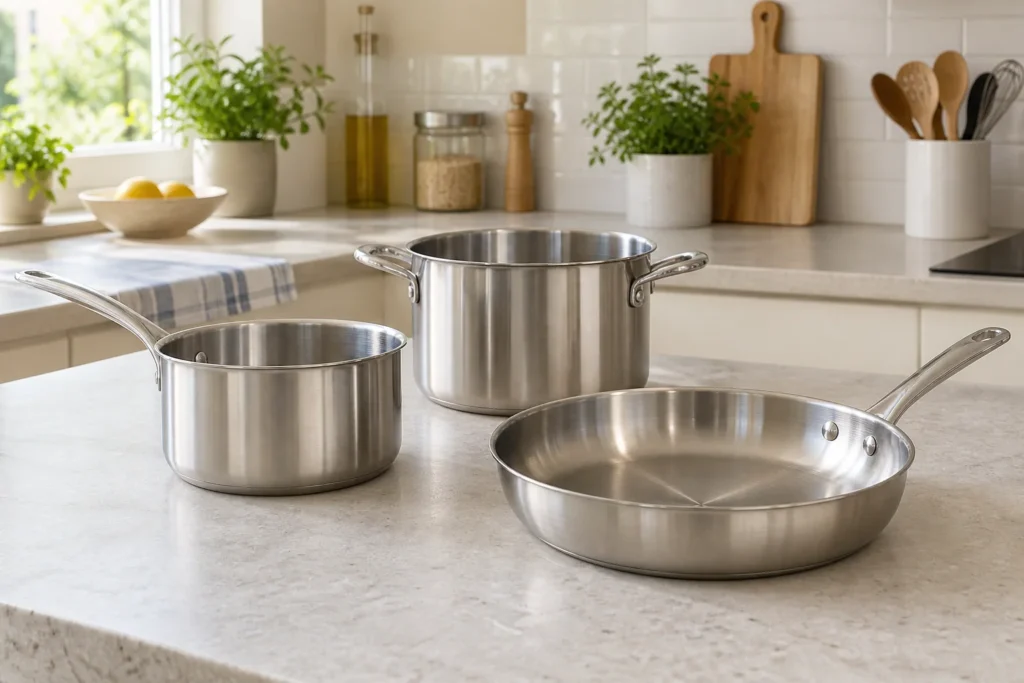
A basic cookware set should cover the meals you cook most often without filling the cupboard with near-duplicates. Start with a saucepan for liquid-based tasks and a frying pan or another shape suited to your usual meals. Add a larger pot, sauté pan or casserole when its particular capacity and method have a clear role.
Image: AI-generated editorial illustration of generic equipment; not a photograph of a reviewed product.
Table of Contents
Plan one ordinary meal at a time
Write down a few meals you expect to repeat and identify which pans they require simultaneously. Cooking pasta and a separate sauce can need two vessels at once. A one-pan meal may require a different shape but fewer pieces. The useful set is determined by that pattern, not the number of people pictured on the packaging.
Keep pans you already own if they are sound and suitable. A first kitchen does not have to begin with an entirely new matching range. Replacing one missing size may be more useful than buying another version of a frying pan you already like.
Give each pan a distinct job
| Cooking need | Pan shape to consider | Main question |
|---|---|---|
| Small liquid-based task | Saucepan | Is the capacity and pouring arrangement suitable? |
| Food spread across a surface | Frying pan | Does the flat cooking area fit the usual amount? |
| A deeper one-pan dish | Sauté pan or suitable casserole | Does it provide the required depth and lid? |
| Larger batch of soup or pasta | Larger pot | Can you fill, move and drain it comfortably? |
This is a selection framework, not a set of universal portion capacities. Follow your recipes and compare the actual usable dimensions. A nominal litre capacity may describe filling to the rim rather than the working quantity for a particular method.
Count the contents properly
A cookware set may count lids as pieces. IKEA 365+ cookware set contents is a clear example: six pieces comprise three cooking vessels and their lids. Read the individual sizes and decide which ones will be useful. A large headline count should not outweigh a missing pan shape you know you need.
List each vessel separately with its lid, capacity, base diameter and intended job. If two entries do the same work, ask whether they are needed together or simply duplicate each other. Keep serving accessories and storage extras outside the pan count.
Check that the set fits the hob together
Individual compatibility is only the first check. Compare the bases with your hob's cooking-zone guidance, then consider whether the pans you use simultaneously fit without crowding handles or controls. A large pan may occupy space intended for another vessel.
Use cool empty pans or measured paper footprints on a worktop when planning the layout; do not place paper on a live hob. Include handles and the space needed to lift lids. If you use induction, confirm each piece's compatibility and base-size requirements rather than assuming the whole box is suitable because one pan is.
Choose surfaces around the method and care
Read whether each cooking surface is coated or uncoated and follow its own instructions. A set can combine different materials or coatings. That can be useful, but it also means different utensil and washing requirements may apply.
Check oven use for complete pans, including lids and handles. Do not buy an oven-oriented casserole only to discover that its useful size is difficult to grip through the oven opening. Think about the route from cupboard to hob or oven, then to a suitable landing surface and the sink.
Leave room to learn what is missing
Begin with the smallest collection that covers your known routine. Over the first month, note repeated inconveniences: not enough room for a batch, an awkward pouring lip or a pan occupying two useful cooking positions. Those observations tell you which addition is worthwhile.
Choose the next pan for that specific task. A basic set can remain small while becoming more capable, because each piece has a purpose. Clear compatibility, manageable handling and useful sizes matter more than a uniform finish or an impressive number of pieces on moving day.