
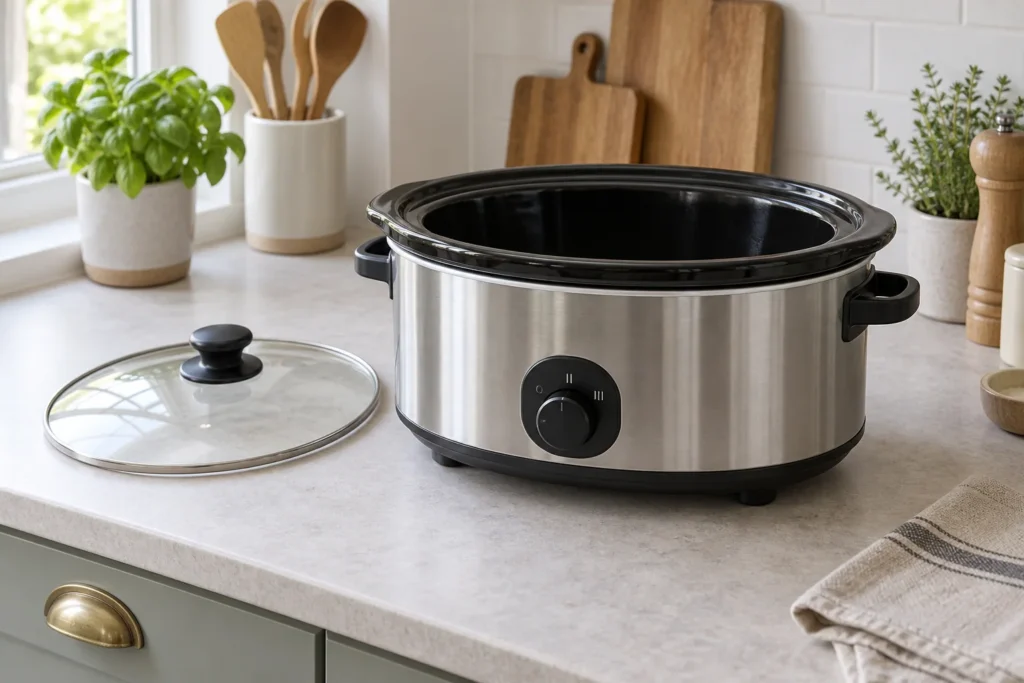
A clip on a slow-cooker lid does not necessarily belong in the locked position during cooking. Some latches secure the lid for transport. Others appear on appliances with different operating systems. Identify the exact model and the intended purpose of its lid mechanism before pressing the clips shut.
Image: AI-generated editorial illustration of generic equipment; not a photograph of a reviewed product.
Table of Contents
Find the instruction that names the locking feature
Look for the lid, transport and cooking sections of the manual. A photograph of a closed appliance cannot tell you whether the latches are engaged during heating. Marketing terms such as secure lid or travel-friendly also need the manufacturer’s operating instructions beside them.
Crockpot’s Cook & Carry guidance says that the locking lid must not be locked while cooking on the models covered by that feature. This is an explicit product-family example. A pressure cooker’s locking system works under different instructions and should not be used as an analogy for a conventional slow cooker.
Distinguish the parts you can see
A loose lid, hinged lid, carrying latch and gasket can all affect handling, but they do not mean the same thing. A hinge may simply keep a lid attached while serving. A gasket may be part of a transport arrangement. Neither establishes a pressure-cooking function or an airtight storage container.
Inspect the parts only as the manual permits. If a clip feels difficult to close, do not force it or alter the gasket to make it fit. First check that the correct insert and lid are seated properly and that the appliance is in the appropriate state for the operation.
| Feature or situation | What to establish | What not to infer |
|---|---|---|
| Lid clips | When the exact model says to engage them. | That a tighter lid is always better during heating. |
| Hinged lid | How it opens and whether it detaches for cleaning. | That the hinge is a transport lock. |
| Gasket around the lid | Its fitting, care and replacement instructions. | That it turns the cooker into a pressure vessel. |
| Carrying a meal | Whether, when and how the manufacturer permits transport. | That the lid alone makes a hot loaded appliance easy to carry. |
Plan the journey before the meal
If transport is a genuine requirement, consider the whole route: lifting, doorways, vehicle space and the destination. Read the appliance’s carrying instructions, including its required state and what handles should be used. A latch is one component of that plan, not a promise against every spill.
Food temperature and transport time also require an appropriate food-safety plan. Do not treat a closed cooker as refrigeration or assume a disconnected appliance can hold food safely for an arbitrary journey. If those conditions cannot be controlled, choose a different preparation and transport arrangement.
Set up the destination before serving
Make sure there will be a stable approved surface, suitable serving utensils and a clear cable route if the appliance will be used there. Check whether the recipe is being cooked, held or reheated; those are separate activities with different requirements.
Do not ask a guest to guess which clips to release or which setting to use. Keep the relevant instructions available and explain the intended operation. Allowing someone to help is easier when the appliance’s state is clear and the lid can be handled in the prescribed way.
Look after the lid mechanism
Clean removable lid parts only as directed and check for damage before the next use. A distorted gasket, cracked glass or broken clip is a parts-and-support issue, not something to solve with tape or a stronger clamp. Use the model number when asking for a replacement.
If you never transport the cooker, a locking arrangement may add little to your routine. If you do, choose a model with clear documented carrying instructions rather than relying on a feature name. The essential habit remains the same: use the lid mechanism in the way the exact appliance specifies for the task underway.