
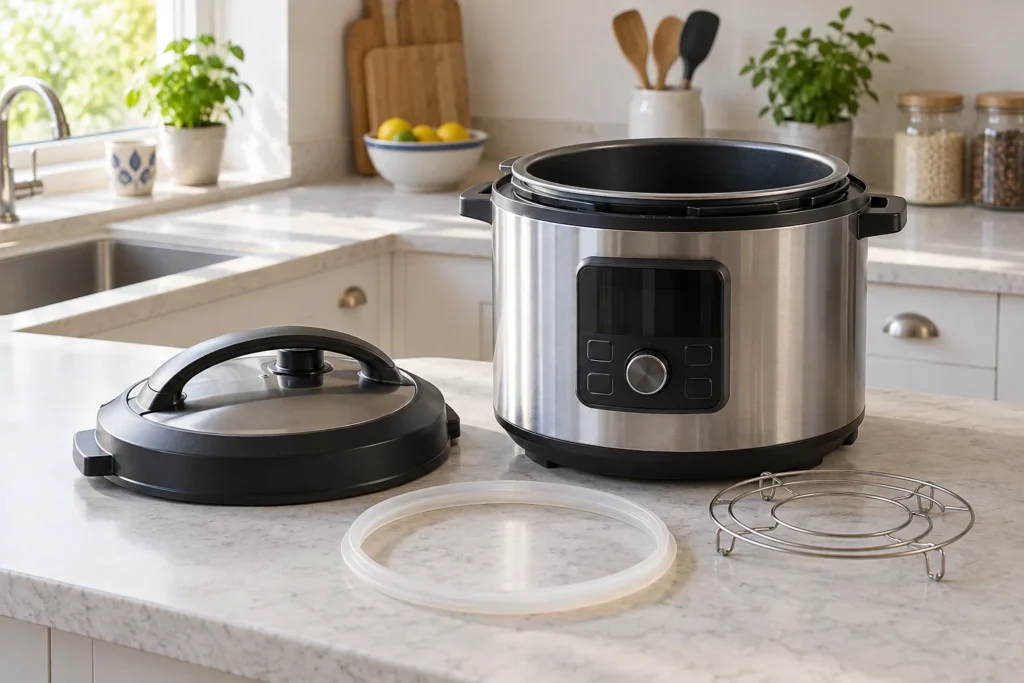
Pot-in-pot pressure cooking uses an additional suitable dish inside the cooker’s normal inner pot. It can keep one preparation separate from the liquid or another dish below. The extra container, rack and recipe must all be appropriate for your pressure cooker; fitting inside is only one requirement.
Image: AI-generated editorial illustration of generic equipment; not a photograph of a reviewed product.
Table of Contents
Understand which pot is which
Instant Pot’s official pot-in-pot explanation describes using a steam rack and another suitable pot within the normal inner pot. This concept does not replace the cooker’s liner or permit cooking directly in an electrical base. Keep the manufacturer’s inner pot installed as instructed.
The arrangement is easiest to understand as three items: the cooker’s approved inner pot, the rack and the additional cooking dish. Name them clearly when reading a recipe. A direction to add water to the inner pot should not be mistaken for putting all that water inside the small dish.
Choose an explicitly suitable dish
Check both the cooker’s instructions and the dish maker’s stated suitability for this use. Oven-safe alone does not prove pressure-cooker suitability. Do not use a cracked dish, a sealed storage container or an accessory whose intended use is unclear. A metal, glass or ceramic label cannot settle the question by itself.
Read whether the recipe requires a particular material, size or cover. Changing those may alter the way the food heats and the space available. Avoid creating an airtight improvised lid or placing an unrelated container on top of the food simply because it appears to act as a cover.
Check the complete stack while cold
Place only the approved empty parts in the cold cooker and compare the arrangement with the instructions. Include rack height, dish handles and any permitted cover. The pressure lid must close normally, with the required clearance from valves and other components. Remove anything that interferes rather than pushing the lid down.
Think about removal as well as insertion. A dish can fit inside yet leave no safe way to lift it when hot. Choose an approved rack or lifting accessory and make sure you can use it with oven gloves. Do not rely on an improvised handle that could slip under the loaded dish.
| Check | Why it matters |
|---|---|
| Dish approval | Heat resistance alone does not establish this pressure-cooking use. |
| Rack and total height | The lid and steam path need their specified clearance. |
| Water in the main inner pot | Liquid inside a separate dish does not automatically satisfy the cooker’s steam requirement. |
| Recipe and release method | Both dishes must suit the same complete pressure cycle. |
| Safe lifting route | A hot dish must be removable without reaching awkwardly around it. |
Keep liquid and fill rules intact
Follow the cooker’s required liquid in the main inner pot and the recipe’s separate liquid inside the dish. Do not count a dense sauce or a covered bowl of water as automatically fulfilling the main pot’s requirement. The applicable fill limits still matter when accessories occupy space.
A recipe that cooks food below the rack needs to be written for that combination. Replacing the lower dish with an unrelated stew changes thickness, quantity and heating conditions. Start with an appliance-compatible pot-in-pot recipe rather than constructing a two-course meal from separate pressure recipes with different timings.
Match the cooking cycle, not just the timer
Two foods sharing a cooker also share pressurising and pressure release. A lower dish needing natural release and an upper dish written for immediate quick release may be a poor pairing even if their stated pressure minutes match. Follow a recipe that has considered the whole sequence.
Do not compensate for an uncertain setup by adding an arbitrary number of minutes. A taller dish, deeper filling or different cover changes more than a label. Where the arrangement is not documented, use separate cooking methods until you have an appropriate recipe and equipment guidance.
Open and serve by the cooker’s instructions
Wait for complete depressurisation and the correct opening indication before accessing the dishes. Open away from steam, use proper hand protection and place the hot dish on a heatproof surface. Check that the food is cooked appropriately; the end of a programme is not a universal doneness test.
After cooling, clean the rack, dish and cooker parts by their individual instructions. Store the approved accessories together with a note of the recipe and arrangement they suit. That makes pot-in-pot cooking a repeatable method rather than a new improvised stack each time.