
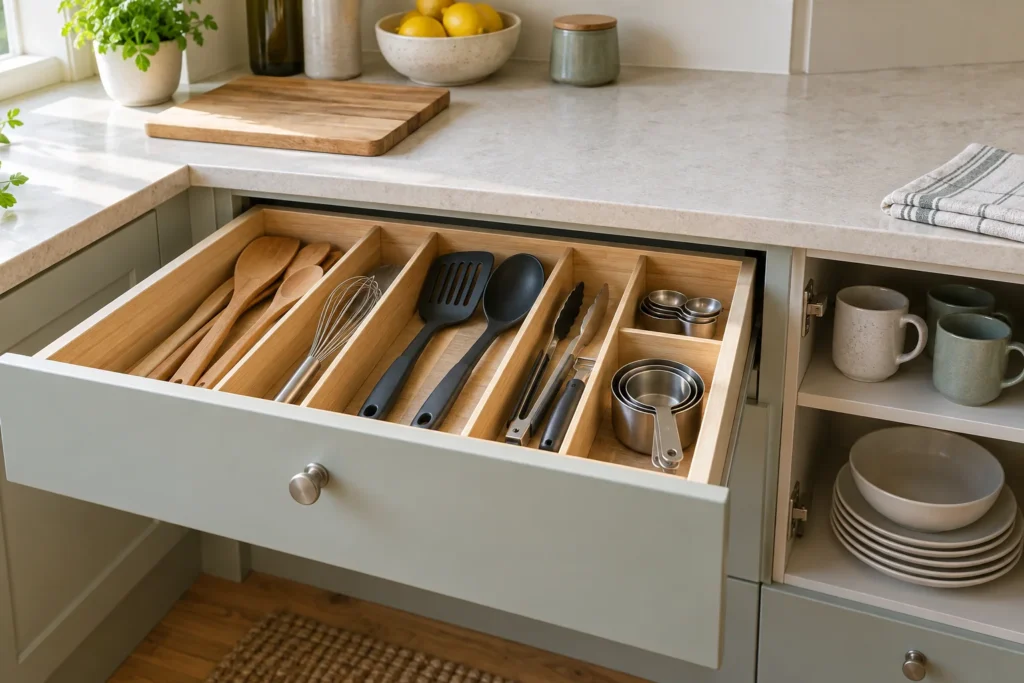
Reusable bottles often occupy cupboard space inefficiently because the tall bodies are easy to see while lids and straws disappear into a separate pile. Start by matching the complete collection. Then choose a storage arrangement that makes the next bottle easy to assemble without confusing clean storage with the drying stage.
Image: AI-generated editorial illustration of generic equipment; not a photograph of a reviewed product.
Table of Contents
Match bodies and components first
Bring the clean bottle bodies, lids, straws and removable accessories together. Use product references or the manufacturer’s parts information to confirm uncertain combinations. A lid that starts to screw onto a similar neck is not necessarily the correct match.
Keep unidentified pieces separate until their compatibility is established. Photograph model names or markings that may become difficult to read. This is particularly useful where several family members own similar bottles in different sizes.
Separate drying from cupboard storage
Follow each bottle’s washing, drying and storage instructions before putting components away. A drying rack has a different role from a cupboard organiser. OXO’s water-bottle drying rack, for example, includes positions for bottles, lids and straws; that component separation is useful to consider when planning the washing-up stage.
Do not force parts together while trying to clear the drainer quickly. Establish a visible place for the complete group while it dries as instructed, then move it to the cupboard. Keep small removable parts within the appropriate household safety arrangements, particularly where young children are present.
Measure the tallest complete bottle
Record height with the lid fitted, body width and any projecting handle or loop. Check the shelf opening and the movement needed to retrieve it. A bottle can fit upright on the shelf while being awkward to lift past a cupboard edge.
If considering horizontal storage, verify that the organiser supports the bottle’s shape and prevents unwanted movement as intended. Do not assume all round bottles fit one rack equally well. A tapered body or large handle can change the supported contact points.
Group by actual use
Put everyday bottles in the easiest position and occasional flasks or travel cups elsewhere. If ownership labels help, keep them clear and readable in the storage position. The purpose is to make complete sets obvious rather than to sort solely by colour.
A small basket or divided section may work for lids if compatibility groups remain clear. Avoid one deep container where every straw and cap becomes mixed. You should be able to find the matching parts without emptying the entire collection onto the worktop.
Check the return journey
| Stage | Question |
|---|---|
| After use | Where do complete sets arrive for washing? |
| After washing | Where do removable parts dry as instructed? |
| In the cupboard | Can each body and matching lid be identified? |
| Before leaving home | Can the next complete bottle be retrieved promptly? |
For a family with several similar bottles, a labelled group per person may be easier than a row of bodies and a separate communal lid pile. For one person with different activity bottles, grouping by use may make more sense. Choose the distinction that reduces searching in your household.
Make missing parts easy to spot
Give each frequently used bottle a recognisable group of compatible parts, especially when several household members own similar bottles. A small labelled compartment can hold a dry spare lid or removable component without mixing it with unrelated seals. Before adding a bottle to the cupboard, check that the next user can find its required parts without opening every storage pot. If a lid is missing, put the incomplete bottle in a separate location while you identify the correct replacement. This keeps the ready-to-use shelf honest and prevents a last-minute search from undoing the entire arrangement.
Keep only the working collection in prime space
Review unmatched or damaged parts using the manufacturer’s guidance and local disposal options where needed. Our kitchen storage guide offers wider cupboard layouts. Bottle storage succeeds when clean, dry components return to an obvious home and the next complete set can be found without rummaging.