
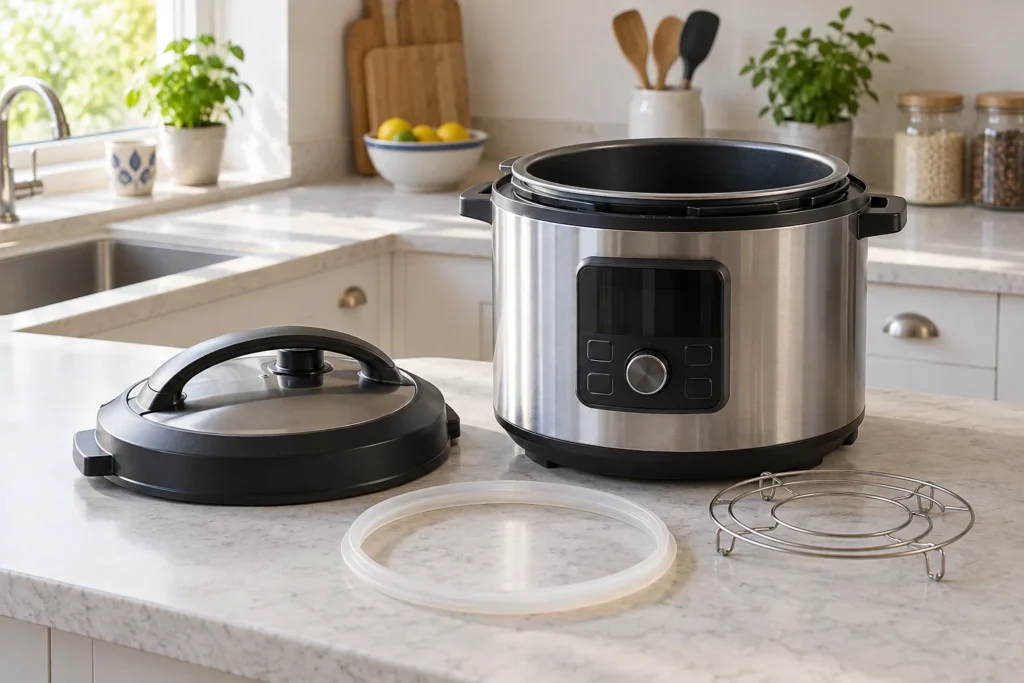
If a pressure cooker lid will not open, do not force it. Treat the cooker as potentially pressurised until its own instructions establish that it is safe. A finished programme, silence or a cool-looking exterior does not by itself prove that the contents are ready to uncover.
Image: AI-generated editorial illustration of generic equipment; not a photograph of a reviewed product.
Table of Contents
Stop trying to turn the handle
Instant Pot’s official troubleshooting guidance explicitly says never to force a lid after pressure cooking. Tefal’s Secure 5 guidance likewise ties opening to cooling and the pressure indicator dropping fully. Use the criteria for your exact appliance, not the behaviour of another cooker.
Do not pry under the rim, hit the handle or press a locking pin down to defeat it. Keep other people away from the steam path while you find the manual. A stuck meal is inconvenient, but it is not a reason to turn the pressure mechanism into a DIY repair.
Identify the current state from a safe position
Note whether the appliance is still heating, warming, releasing steam or displaying an error. Cancel or turn off as the manual instructs. On an electric model, follow its guidance about power and pressure release; on a hob model, turn off the heat as directed.
Observe the specified pressure indicator without putting your face above the lid or touching a hot valve. If you cannot confidently interpret its position, stop there and seek the manufacturer’s advice. Do not use a sound test, a shaking motion or the feel of the handle as an alternative pressure gauge.
Use only the permitted release procedure
Follow the recipe-compatible release method and the cooker’s safety instructions. Some foods require a gradual natural release; a blocked lid is not a reason to vent them aggressively. Keep hands and exposed skin clear, and never cover a steam outlet with a cloth.
Do not put an electrical cooker under a cold tap or pour water over it to hurry cooling. Even for a hob model, any water-cooling method needs explicit approval for that exact design. If the manual does not describe the situation you see, contact support instead of borrowing a technique from a forum.
| Situation | Safe next step |
|---|---|
| Indicator still shows pressure | Continue the documented depressurisation procedure; do not force the lid. |
| You cannot read or interpret the indicator | Keep clear and obtain model-specific advice. |
| Steam or liquid escapes abnormally | Follow the manual’s stop procedure and seek support. |
| Cooker appears fully depressurised but remains locked | Use the manufacturer’s stuck-lid guidance or support, without improvised levering. |
| A component is damaged | Keep the cooker out of use until assessed and correctly repaired. |
Do not improvise a valve intervention
A manual may include a carefully conditioned troubleshooting action for a particular model. That does not make poking a valve a general remedy. If you cannot establish every prerequisite, such as complete pressure release, do not attempt it. Support can guide you using the actual model and symptoms.
Never loosen a screw, remove a regulator or dismantle a lid while the cooker is hot or potentially pressurised. Do not ask another person to hold the body while you apply more turning force. The lock is there to prevent access while conditions may be unsafe.
Prepare a useful support description
Have the model and serial number available from a safe accessible location, or use your purchase record if the label cannot be reached safely. Describe the recipe, approximate load, programme and release method used, along with the indicator and display.
A concise description helps: “Cooking has ended, I followed the specified release, the indicator position is unclear and the handle will not turn normally.” Do not restart the cooker or reproduce the fault just to film it. Follow the manufacturer’s instructions about leaving the appliance while waiting for help.
Check the cause before the next meal
Once the lid has been opened safely and the cooker has cooled, complete the permitted inspection and cleaning. Residue, a damaged seal or a locking fault need different responses, so do not assume cleaning alone proves the appliance is ready. Replace only authorised parts and carry out any manufacturer-directed check before using pressure again. Keep a record of the advice received with the manual.